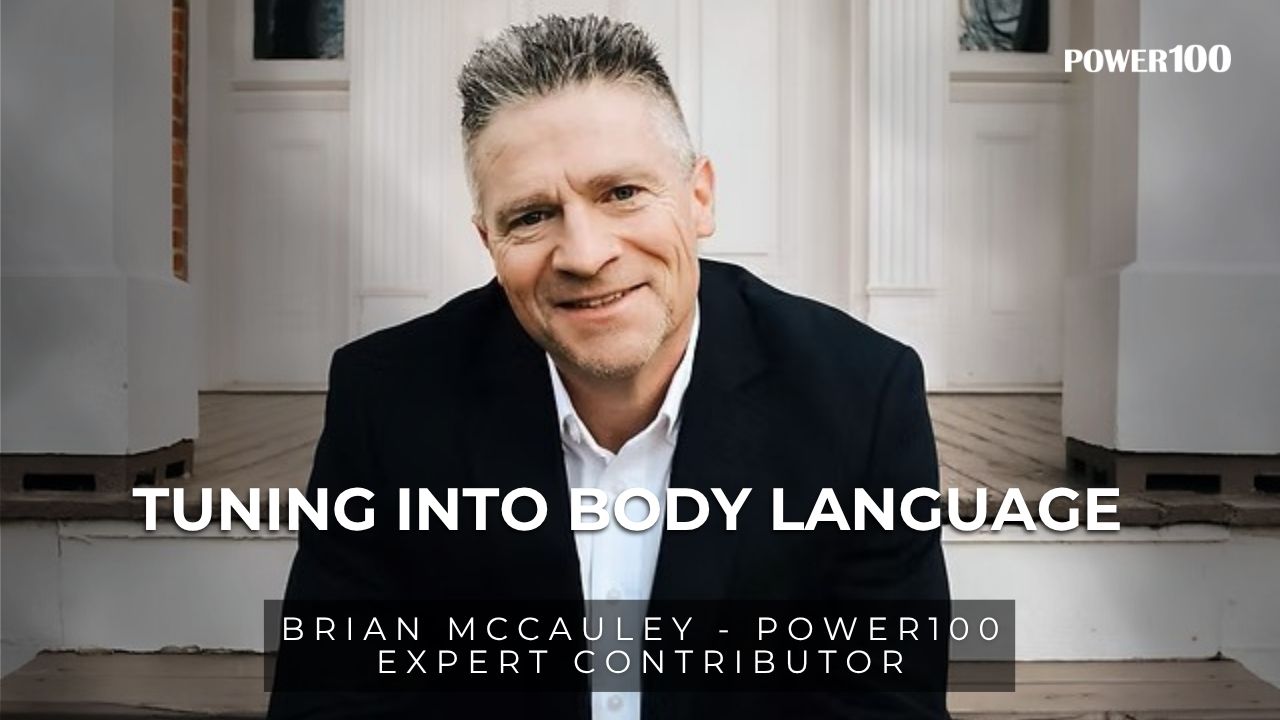
By Brian McCauley, Founder of The Sales Guy and Director of Sales Training at Cornerstone Building Brands | Power100 Expert Contributor
Homeowners decide whether to trust you long before you show them a price. The way you walk in, smile, listen, sit, and speak tells them who you are. Here is how home improvement sales teams across the United States can use body language and tone to communicate confidence, close more sales, and earn more referrals.
In sales, the words you use are only part of the message. Your tone of voice, facial expressions, and body language also play an important role in how potential customers see you.
That is especially true in home improvement, home services, and outdoor living sales. Whether you are selling replacement windows, entry doors, roofing, siding, a new deck, a patio cover, or an outdoor kitchen, you are a guest in someone’s home. The homeowner is about to invest thousands of dollars, sometimes tens of thousands, in the place where their family lives. They are watching you closely, even if they don’t realize it.
They notice how you stand at the front door. They notice whether you look at them or at your tablet. They notice if your voice tightens when they mention a lower quote from a competitor. They notice whether your hands are relaxed or restless.
After more than 30 years in the building materials industry, in both distribution and manufacturing, I can tell you this: the best salespeople I have worked with were not always the smoothest talkers. They were the ones whose words, tone, and body language all told the customer the same story.
“Your customer is listening with their eyes before they ever listen with their ears.” – Brian McCauley

Brian McCauley, Founder of The Sales Guy and Director of Sales Training at Cornerstone Building Brands
Psychologist Albert Mehrabian, a professor at UCLA, conducted influential studies in the 1960s examining how people communicate feelings and attitudes. He later shared that work in his 1971 book Silent Messages. His research is often summarized by the 7-38-55 rule: words account for 7% of the message, tone of voice for 38%, and facial expressions for 55%.
Here is the part most sales trainers leave out. Those percentages from Albert Mehrabian apply to specific situations involving feelings and attitudes, especially when a person’s words and nonverbal signals don’t match. They do not mean your words only matter 7% of the time. If you explain a warranty poorly, a great smile won’t save you.
The real takeaway for sales professionals is simple: your words, tone, and body language should work together to communicate the same message. When these elements line up, customers are more likely to see you as genuine, confident, and trustworthy. When they don’t, customers tend to believe what they see and hear over what you say.
Picture a rep who tells a homeowner, “I’m confident this is the right window for your home,” while looking down at the floor and speaking in a flat voice. The words say confident. Everything else says unsure. The homeowner will go with everything else.
“If your words say ‘trust me’ and your body says ‘I’m not so sure,’ the customer will believe your body every time.” – Brian McCauley
I spend a lot of my time on airplanes and in training rooms. One of the things I love most about this work is that every group teaches me something too.
In Rock Hill, SC, I worked with a group of sales professionals connected to Daimler Truck AG. It was a lively group, and they shared some really personal and eye-opening takeaways. That session reminded me that confidence in sales is not an industry thing. It is a people thing. Whether you are selling commercial trucks or a full-home window replacement, the person across from you is asking the same quiet question: “Can I trust this person?”
When we talked about body language, people opened up about their own habits. Some realized they cross their arms when they’re thinking. Others noticed they talk faster when a customer pushes back. A few admitted they check their phone between questions without even thinking about it. None of those habits came from a lack of skill. They came from a lack of awareness.
That’s the point. You can’t fix what you don’t notice.
“Most salespeople don’t have a confidence problem. They have an awareness problem. Once you see your habits, you can change them.” – Brian McCauley
As in-home salespeople, our goal is to help prospective customers feel comfortable and confident in their interactions with us. Here are five ways to use body language and vocal tone to create a positive impression and build stronger customer relationships.

Brian McCauley in Rock Hill, SC with a group of sales professionals
You’ve probably heard the saying, “Smile and the world smiles with you.” A genuine smile can make you appear more approachable, relaxed, and friendly. Those are all valuable qualities in sales.
A smile can also help set a positive tone at the beginning of a sales call. When you greet a customer at the door with a warm, natural smile, you give them a chance to respond in kind. That simple exchange can help build rapport and make the conversation feel comfortable from the very start.
The key is authenticity. Customers can often spot a forced smile, so let your expression reflect a real interest in meeting them and understanding their needs.
In San Diego, CA, I spent the day with a fairly new sales team from Dixieline Lumber & Home Centers, a Builders FirstSource company. Everyone in that room was looking for ways to stand out from the competition. That’s a fair question in any market. When competitors can match your product and get close on price, what’s left?
You are what’s left. How you show up becomes part of the value. A team at Dixieline Lumber & Home Centers or any Builders FirstSource location can carry the same products as the store down the road. But a sales professional who greets a contractor or homeowner with real warmth, listens fully, and speaks with calm confidence creates an experience the competition has a hard time copying.
“Your competitor can match your product. They can even match your price. They can’t match the way you make the customer feel.” – Brian McCauley
How you say something can be just as important as what you say. A calm, steady, conversational voice communicates confidence and professionalism. A strained, rushed, or overly loud delivery can create tension.
When emotions run high, stress can affect your breathing and tighten the muscles you use to speak, which changes the sound of your voice. You have probably felt this when a homeowner says, “That’s way more than we expected,” or “We got a quote for half that.” In those moments, take a deep breath, slow down, and respond with intention instead of reacting emotionally.
During most sales conversations, aim for a positive, energetic tone that shows enthusiasm without sounding exaggerated or rehearsed. When you’re discussing a concern or handling an objection, adjust your delivery to be calm, measured, and reassuring.
Here’s a simple example. A homeowner says, “I’m worried about the installation mess.” If you answer quickly and loudly, “Oh, don’t worry about that!”, it can sound like you’re brushing them off. If you slow down, lower your voice slightly, and say, “That’s a fair concern. Let me walk you through exactly how our crew protects your home,” you sound like someone who has handled this many times before.
Remember, your tone should support your message. Enthusiasm can build excitement. A composed, thoughtful delivery helps customers feel heard and understood.
“When the customer gets tense, that’s your cue to get calm. Your voice can lower the temperature in the room.” – Brian McCauley
Appropriate eye contact communicates attention, confidence, and interest. When customers are speaking, looking at them naturally shows that you are listening and that their questions, needs, and concerns matter to you.
Eye contact also helps you build a connection and keep the conversation engaging. But the goal is not to stare or dominate the interaction. Too much eye contact can make some people uncomfortable, while too little may suggest you’re distracted or uninterested.
This matters even more today because so many in-home presentations happen on a tablet or laptop. Technology is a great tool, but it can quietly steal your eye contact. If you spend the whole appointment looking at a screen, the homeowner ends up talking to the top of your head. Turn the screen toward the customer, point to what matters, and then look back at them when they respond.
Pay attention to your customer’s comfort level and adjust. Some people naturally make less eye contact, and that does not necessarily mean they are uncomfortable or uninterested. Let the conversation develop naturally, and focus on making the customer feel at ease.
Hand gestures are a natural part of communication. When used thoughtfully, they can help you emphasize important points, explain ideas, and make your presentation more engaging.
The brain regions involved in speech and language work alongside other systems that support gestures and communication. Research suggests that meaningful gestures can help listeners follow explanations and understand information more easily.
I saw this firsthand in Vacaville, CA, where I led a Level 2 sales training session at our Simonton Windows & Doors plant with an awesome group of Sales Associates from The Home Depot. Training inside a plant is special because the product is right there. You can show how a sash tilts in for cleaning, run your hand along a weatherstrip, or trace the frame to show how a window is built. When associates use their hands to show a feature rather than just describe it, customers understand it faster and remember it longer.
After that session, I caught a red-eye home so I could make the Louisville vs. Florida State football game the next day. Long day, short night, and worth every minute. Watching those The Home Depot associates get more confident with every demonstration is exactly why I love this work.
As you present your products or explain the benefits of a solution, use natural hand movements to highlight key points. You might use a gesture to show size, demonstrate how something works, or emphasize an important benefit. On an outdoor living appointment, that could mean sweeping your hand across the backyard to help the homeowner picture where the new patio, pergola, or deck will sit.
The key is to be intentional. Excessive, abrupt, or repetitive movements can distract customers from what you are saying. Keep your gestures relaxed and purposeful so they complement your words rather than compete with them.
“Don’t just tell the homeowner how the product works. Show them with your hands, and let them touch it. People buy what they understand.” – Brian McCauley
Your posture can influence how others see you and how comfortable you feel during an interaction. Standing or sitting upright, keeping your shoulders relaxed, and maintaining an open posture can help communicate confidence and approachability.
Avoid habits such as slouching, looking down for long periods, hunching your shoulders, or making yourself look unnecessarily small. These behaviors can unintentionally signal uncertainty or disengagement.
At the same time, confidence does not mean taking over the room or claiming as much space as possible. In a customer’s home, your posture should communicate self-assurance while respecting their personal space. Wait to be invited to sit. Sit at the kitchen table, not at the head of it, unless the homeowner puts you there. Keep your bag and samples neat and out of their walkway.
Social psychologist Amy Cuddy and her colleagues helped popularize the concept of “power posing,” exploring whether expansive postures might influence how people feel and behave. Some of the original claims about hormonal changes and performance have been challenged by later research, and Amy Cuddy has written about the current state of the science. The practical takeaway still holds for salespeople: an upright, open, comfortable posture helps you present yourself with greater composure, and it can help you feel more confident too.
Over the years, I’ve noticed three habits that hurt more sales conversations than almost anything else. Each one is easy to fix once you see it.
“The homeowner remembers how you left just as much as how you arrived.” – Brian McCauley
In my recent Power100 article, The Words That Win Trust, I shared three phrases sales teams should avoid: “no problem,” “to be honest,” and “just.” Body language makes those phrases even riskier.
Saying “no problem” with a shrug makes a customer’s request feel like a minor inconvenience. Saying “to be honest with you” while breaking eye contact makes people wonder what you were being before. Saying “I’m just here to measure” while slouching in the doorway shrinks your expertise before you even start.
Now flip it. Picture a rep who looks the homeowner in the eye, smiles, and says, “You’re welcome. I know this project is important to you, and I’m happy to help.” Or one who sits up, leans in, and says, “Based on what you told me about your goals, this is the option I recommend.” The right words, delivered with the right tone and posture, build trust fast.
That’s how sales teams use language to their advantage. Choose words that show value, then make sure your face, voice, and posture back them up.
“The right words are powerful. The right words delivered with confidence are what close the deal.” – Brian McCauley
Referrals don’t start when you ask for them. They start the moment you knock on the door.
Homeowners refer people who made them feel comfortable, respected, and informed. Think about how a homeowner describes you to a neighbor six months after their new roof, siding, or patio is finished. They rarely say, “He had a great slide deck.” They say things like, “She really listened,” “He was so calm and patient,” or “They didn’t pressure us at all.”
Those descriptions are about body language and tone.
When you finally ask for a referral or a review, your delivery matters again. Ask while you’re sitting comfortably, looking at the customer, and smiling with real gratitude. Don’t mumble the request on your way out the door. A confident, warm ask tells the homeowner you’re proud of the work and believe their friends deserve the same experience.
The teams I’ve seen improve the most don’t treat body language as a one-time lesson. They practice it. Here’s a simple approach any home improvement sales manager can start this week:
The teams I’ve worked with at Simonton Windows & Doors, Ply Gem, and across the Cornerstone Building Brands family know that great sales skills, like great products, are built with care and repetition.
Successful selling takes more than knowing your product or saying the right words. It also requires building trust, creating rapport, and helping customers feel comfortable throughout the buying process.
A genuine smile, a calm and engaging voice, appropriate eye contact, purposeful gestures, and confident posture all add up to a better customer experience. Avoid the crossed-arm listen, the screen stare, and the rushed exit. Make sure your words and your body tell the same story.
The next time you make an in-home sales call, pay attention to these five areas. Small adjustments in how you communicate can make your presentation feel more natural, strengthen your connection with the customer, and help your message come across exactly as you intended.
Happy Selling!!
Homeowners are inviting a stranger into their home and considering a major investment. They look for signs that you are trustworthy, competent, and respectful. A warm smile, steady eye contact, a calm voice, and open posture help them feel comfortable sharing their real needs, which leads to better recommendations and more closed sales.
The 7-38-55 rule comes from research by Albert Mehrabian at UCLA. It suggests that, when communicating feelings and attitudes, words account for 7% of the message, tone for 38%, and facial expressions for 55%. It does not mean words are unimportant in all situations. For salespeople, the key lesson is that words, tone, and body language must match to build trust.
Brian McCauley points to three common habits: crossing your arms while the customer talks, staring at a tablet or phone instead of the homeowner, and rushing the exit by packing up or checking the time. Each one can make a homeowner feel unheard or unimportant.
Slow down, breathe, and speak in a steady, conversational voice. Use an energetic tone when sharing benefits and a calm, reassuring tone when handling concerns. Practicing your presentation out loud and recording role-plays can help you hear where your voice tightens or speeds up.
Aim for natural, comfortable eye contact, especially when the homeowner is speaking. Avoid staring, and don’t let your tablet take over the conversation. Some people naturally make less eye contact, so read their comfort level and adjust.
Amy Cuddy and her colleagues popularized power posing, but some early claims about hormone changes and performance were challenged by later research. Even so, an upright, open, relaxed posture still helps you look and feel more composed in front of customers.
Use gestures to show size, demonstrate how a product works, and point to key features. Let customers touch samples when possible. Keep movements relaxed and purposeful so they support your message rather than distract from it. Hands-on training, like Brian McCauley’s session with The Home Depot associates at a Simonton Windows & Doors plant, shows how demonstrating a product helps customers understand it.
Customers refer salespeople who made them feel comfortable and respected. Your calm voice, attention, and patience become the story they tell friends and neighbors. When you ask for a referral or review, do it while seated, smiling, and making eye contact so the request feels sincere and confident.
In his article The Words That Win Trust, Brian McCauley recommends avoiding “no problem,” “to be honest,” and “just.” Weak body language makes these phrases sound even less confident. Replace them with value-focused language and deliver it with eye contact, a steady voice, and open posture.
Start with awareness. Record role-plays and watch them with the sound off, then listen without video. Focus on one skill at a time during ride-alongs, practice tough objections, and recognize improvement. The Sales Guy and Cornerstone Building Brands training sessions with teams like Dixieline Lumber & Home Centers show that steady practice builds lasting confidence.
Membership unlocks every Power100 interview, PowerChat episode, and expert playbook - free for industry leaders.

Power100 is the nation's premier CEO ranking and media platform for the home improvement industry. Using a proprietary 5-layer evaluation system, Power100 identifies and celebrates the top CEOs, companies, and strategic partners driving innovation, customer satisfaction, and leadership excellence across the country.


