Many home improvement companies face the same growth problem. Their best salesperson may be the owner, founder, or sales manager who has spent years learning how to speak with homeowners, handle hard questions, and close jobs. That person may know the process so well that selling feels natural. But as the company grows, leaders often make one mistake. They start looking for new salespeople who think, talk, and sell just like the person who already succeeds.
Grosso University, led by CEO Dominic Caminata, takes a different approach. Through contractor sales training, coaching, testing, leadership development, and structured sales systems, the company helps home improvement businesses train people with different backgrounds and personalities to work toward the same goal. Dominic’s belief is simple. Companies do not need a room full of copies. They need people with the right attitude, a strong work ethic, and a clear process they can learn and use.
That idea became a key part of Dominic’s PowerChat conversation with Greg Cummings, CEO of Power100. Rather than focusing solely on finding experienced closers, the conversation explored how leaders can create a system that gives more people a fair chance to become strong producers.
Power100 is the only unbiased third-party platform that recognizes and elevates the top leaders and most impactful companies in the home improvement industry. Through conversations with industry leaders, the platform shares lessons that contractors can use to build stronger teams and prepare for growth.
One of the hardest parts of growing a home improvement sales team comes after a company already has someone who is very good at selling.
That person may be the founder. It may be the sales manager. It may be a top representative who has spent years learning the products, reading homeowners, answering objections, and knowing when to move the conversation forward.

Dominic Caminata CEO of Grosso University
The problem begins when the company tries to grow by finding more people exactly like that person.
The next hire may not have the same confidence. They may not speak with the same energy. They may not have years of sales experience. They may listen more than they talk. They may have a calm style instead of a bold one.
That does not mean they cannot become a top producer.
During the PowerChat, Dominic explained that this question shaped the way he thought about building sales teams.
“How can I train a team of all different types of individuals to execute and achieve a common goal?” said Dominic Caminata, CEO of Grosso University.
That question changes the focus from finding perfect salespeople to developing capable ones.
Dominic said many sales systems seem built for people who already have a strong, outgoing sales personality. Yet he believes companies miss good talent when they assume only one type of person can succeed.
His own goal was different.
“I could take anybody with the right attitude and work ethic and turn them into a multimillion-dollar producer,” Dominic said.
The key is not removing personality from sales. It is giving different personalities one clear path to follow.
A strong sales process gives every representative the same basic steps. It helps the team understand what questions to ask, what information to share, how to guide the homeowner, and how to move toward a decision. The salesperson can still bring their own voice, style, and way of connecting with people.
That is where home improvement sales team development becomes more useful than simply searching for another natural closer.
The goal is not to make every person sound the same.
The goal is to ensure everyone understands the same standard.
This also gives leaders a better way to coach. When there is one shared playbook, a manager can see where a salesperson needs help. One person may need more practice asking questions. Another may struggle with price concerns. Another may need help slowing down and listening.
Instead of giving broad advice, the leader can coach a clear part of the process.
A shared system also makes performance easier to measure. Leaders can look at where the process is being followed, where it is being skipped, and where more training is needed. Over time, the company can improve the system without relying on a single person to carry the whole team.
This is why Dominic’s message goes beyond sales technique.
It is also a message about growth.
A business that depends on one gifted closer can only grow as far as that person can carry it. A business that learns to train different people around a single, clear playbook has more room to grow.
The owner no longer has to ask, “Can this person sell exactly like me?”
The better question becomes, “Does this person have the attitude and work ethic to learn, and do we have the system and leadership to help them succeed?”
Dominic’s perspective gives home improvement leaders a new way to think about talent.
Do not build a sales team by searching for copies.
Build a system strong enough to help people of all kinds become great.
During the PowerChat, Dominic Caminata pushed back on the idea that a strong sales team must be filled with people who think, speak, and act the same way. His focus was not on finding more natural closers. It was on giving different people a process they could learn, practice, and use toward one shared goal. For Dominic, the real test of a sales system is not whether it works for one gifted person. It is whether leaders can teach it well enough for people with different strengths, backgrounds, and personalities to succeed.
That belief changes how a home improvement company approaches hiring, training, coaching, and growth. Instead of asking whether a new hire already looks like a top producer, leaders can ask whether that person has the attitude, work ethic, and willingness to learn. The playbook then gives that potential a direction.
Dominic said many sales systems are built around the kind of person who is naturally bold, social, and quick in conversation. Those people can do very well in sales, but he believes companies should not assume that only one personality type can become a top performer.
“What about all the other people, the different personality types that often are neglected? Can you train those people to be top performers?” Dominic asked.
That question opens the door to a wider talent pool.
Some salespeople build trust through energy. Others do it by listening closely. Some are strong teachers who help homeowners understand a difficult choice. Others are calm, patient, and good at making people feel comfortable.
A clear process should support those differences, not erase them.
This is where contractor sales training can create more value. The goal is not to teach every person to sound the same. The goal is to give every person the same basic path, the same standard, and the same idea of what a strong customer conversation should look like.
The system creates order. The salesperson brings their own voice.
That means one representative may convey value with strong energy, while another uses a slower, more detailed style. Both can still follow the same process, ask the right questions, explain the offer clearly, and guide the homeowner toward a decision.
Dominic’s point is simple. Consistency should come from the playbook, not from trying to make every person act alike.
Explore how Grosso University trains different sales personalities around one clear system.
Dominic does not say that every person will become a great salesperson simply because they receive training.
He puts two clear traits at the center of the opportunity.
“I could take anybody with the right attitude and work ethic and turn them into a multimillion dollar producer,” Dominic said.
That changes what leaders may look for when hiring.
A person may have no home improvement sales background and still bring strong habits to the role. They may be willing to learn. They may show up prepared. They may listen well, accept feedback, and keep working when an appointment does not go their way.
Those traits can become the starting point.
Dominic also spoke highly of people who keep an open mind. He used Jeremy Atkinson as an example of a leader who was willing to learn a new method, test it, and fully work through it. That willingness mattered because a person who believes they already know everything can be harder to coach than someone who is ready to improve.
This is why home improvement sales team development should not focus only on past sales numbers.
Leaders can also look at how a person responds to coaching, how they handle pressure, how they prepare, and whether they are willing to practice the parts that feel uncomfortable.
Work ethic gives the process something to build on.
The playbook can show the way, but the salesperson still has to walk it.
Learn how Grosso University helps sales teams build skill through coaching, practice, and structure.
Different personalities do not have to create a messy sales department.
A shared process can give the team one common language.
Dominic described the goal as helping people with different backgrounds and personalities “execute and achieve a common goal with the right system and playbook.”
That common goal matters because it gives leaders something clear to coach.
Without a shared process, advice can become vague. One representative may be told to be more confident. Another may be told to push harder. Another may hear that they simply need to close more.
Those words may create pressure, but they do not always create skill.
A proven home improvement sales system gives leaders a better starting point.
If a representative is struggling, the manager can look at a clear step in the process. Did the person ask enough questions? Did they explain the product clearly? Did they understand the homeowner’s concern? Did they move too fast? Did they fail to explain value before discussing price?
Now the coaching becomes specific.
The same structure also makes performance easier to measure. Leaders can compare what was taught with what actually happened in the appointment. That makes it easier to see where the process is strong and where a person needs more support.
The result is a team that can stay different while still moving in the same direction.
See how Grosso University helps companies build one sales playbook across the full team.
Many home improvement companies begin with one person carrying most of the sales.
It may be the founder. It may be a sales manager. It may be one highly experienced closer who knows the market, understands the products, and seems to have an answer for every homeowner.
That can help a company grow early.
It can also become a limit.
During the conversation, Jeremy explained that leadership had once remained among the strongest sellers in the company. Greg Cummings pointed out the risk in that model. If the leader must continue to produce at the highest level, the business remains tied to that person’s time and talent.
Dominic’s view offers another path.
The knowledge inside the leader’s head has to become teachable.
A strong sales process for remodelling companies can take lessons once learned only through experience and put them into a form that others can study and practice.
That does not mean a new representative receives years of skill overnight.
It means they do not have to begin with nothing.
They have a starting point. They have steps. They have coaching. They have a way to see what good performance looks like.
This also changes the leader’s role.
The goal is no longer to prove that the manager can outsell everyone in the room. The goal is to help more people become capable of producing without needing the leader in every appointment.
That is when leadership begins to multiply performance rather than carry it.
Discover how Grosso University helps leaders turn sales knowledge into a process the team can learn.
A clear system gives people direction, but direction alone does not create a top producer.
Dominic was clear about the gap between knowing and doing.
“There’s an ocean between knowing what to do and actually executing,” he said.
A representative may understand every step during training and still struggle when sitting across from a real homeowner.
That is normal.
Skill grows through repeated use.
This is why in-home sales closing training should include practice, testing, coaching, and review. A salesperson needs a safe place to work through hard questions before facing them under pressure. They need feedback when a part of the process feels weak. They need another chance to try it again.
That practice can also help people with different personality types grow at different rates.
A naturally outgoing person may appear confident early on. A quieter representative may take longer to become comfortable. That does not mean one has more long-term potential than the other.
Repeated practice can help both find a style that feels natural while still following the same sales standard.
Dominic’s system also uses training, testing, and certification to help close the gap between what a person knows and what they can actually perform.
That is an important difference.
Access gives people information.
Practice helps turn that information into ability.
Dominic’s approach can change more than the close rate.
It can change who gets a chance.
Jeremy shared the story of bringing his brother-in-law into sales after he had worked in logistics with a capped salary. He had not built his career as a home improvement closer. After learning the methodology and entering the new role, Jeremy said he made more money in his first year of sales than he had before.
That story supports the larger idea behind Dominic’s system.
People may have abilities that have not yet been developed.
A company that only hires people who already look like proven closers may never discover that ability. A company with a clear process can consider a broader group of people and ask different questions.
This gives leaders more options when building a team.
It can also create a stronger home improvement sales team culture because success becomes less about one person being the star. More people are working from the same playbook, learning the same standard, and helping one another improve.
The company can begin building people rather than waiting for perfect people to appear.
That brings the story back to the question Dominic asked during the interview.
“How can I train a team of all different types of individuals to execute and achieve the common goal with the right system and playbook?”
For Dominic, that question is not only about sales.
It is about giving capable people a real path to grow while giving the business a better way to scale.
Dominic Caminata’s work is gaining attention beyond the sales teams he trains. In 2026, that work earned him a place among Business Elite’s 40 Under 40, a recognition for young leaders showing strong leadership, innovation, and business impact. Dominic received the honor at the St. Regis New York on May 27, joining a group of entrepreneurs and executives from across the country. The award recognized a journey that began at the kitchen table in home improvement sales and grew into a national training platform focused on helping other people reach higher levels of performance.

Dominic Caminata recognized at the 2026 Business Elite’s “40 under 40” Award
That recognition fits closely with the message Dominic shared in this PowerChat. His work has been built around seeing potential in people and giving that potential a system, coaching, and a standard to follow. Wendy Harmeyer, Spanish Development and Training Director at Grosso University, described Dominic as someone who can see potential in people and help them begin to see it in themselves. That ability to develop people adds more meaning to the 40 Under 40 honour, as its impact extends beyond Dominic’s own career. It shows up in the people and teams growing around him.
The training organization he leads has also received national recognition. For 2026, Grosso University was ranked the #1 sales training organization in home improvement and the #3 Preferred Partner nationally through Power100’s evaluation of performance, customer results, innovation, industry impact, and value to contractors. The ranking also pointed to the training framework Dominic has built around sales, leadership, team development, and business growth.
Those rankings add another layer of proof to Dominic’s belief that different people can reach a high standard when the system around them is strong. Published performance tied to his training history includes teams of more than 55 salespeople with a combined demo-to-close rate above 50%. In 2020, one team he trained included 18 salespeople producing more than $2 million, 4 producing more than $3 million, and 1 producing more than $4 million, with an average sale above $4,000.
Dominic is also using his experience to participate in broader industry conversations. He serves as a Power100 Expert Contributor, where he shares his own views on sales and leadership under his byline. In July 2026, he published “Is One Call Closing Really Dead?” and argued that strong first-visit selling still works when it is based on trust, education, clear financing, and a structured process rather than pressure. His message was that professional selling must keep evolving with the homeowner while still providing salespeople with a repeatable path to follow.
That voice has also been featured in longer conversations about the future of home improvement sales training. In a featured interview with Greg Cummings, Dominic discussed how hands-on coaching, leadership development, and a clear in-home sales process can help contractors improve performance while protecting the homeowner experience.
Together, these milestones show a leader whose influence is moving in two directions at once. Dominic is being recognized for what he has built, but he is also using that position to keep teaching, writing, coaching, and challenging the industry to think differently about talent.
Dominic’s belief that companies should develop producers rather than wait to find perfect ones is not about staying in a training room. It is becoming part of a broader industry conversation about how contractors recruit people, develop leaders, build stronger systems, and give more individuals a chance to succeed.
The awards and rankings may recognize Dominic’s name, but the larger impact is measured by how many more people are being given a path to grow.
Building on the momentum of Closers Camp, Grosso University is continuing its mission to develop stronger home improvement teams through its upcoming Extreme Leadership Workshop. While Closers Camp helps sales professionals sharpen their skills in the home, the Extreme Leadership Workshop is designed to help owners, executives, managers, and team leaders build the culture, systems, recruiting habits, sales structure, and leadership discipline that drive long-term growth.
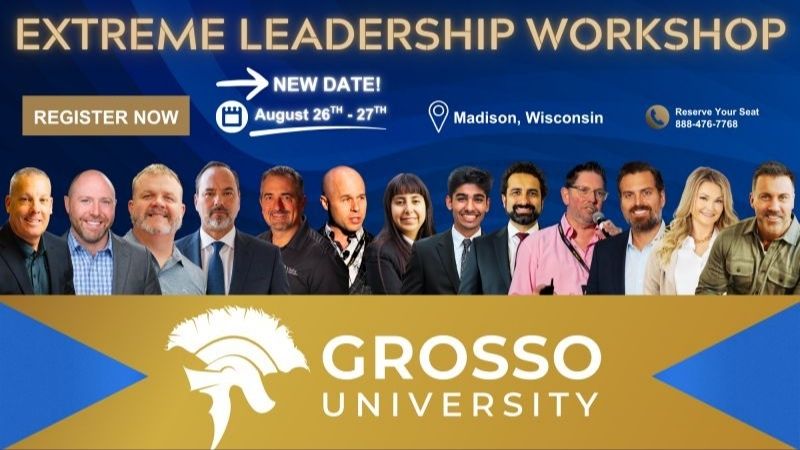
Set for August 26 and 27, 2026, at Grosso University Headquarters in Windsor, Wisconsin, the two-day workshop takes the conversation from individual sales performance to the company’s performance. The event is designed for contractors, owners, executives, managers, and leaders who want to build companies that can grow without relying on a single person to carry the weight.
That makes the workshop a natural next step for the message Dominic Caminata shared during the PowerChat.
A company may develop strong salespeople, but those people still need strong leadership around them. They need a culture that gives them room to grow. They need clear roles, better recruiting, good systems, steady accountability, and leaders who know how to turn individual talent into shared company strength.
The Extreme Leadership Workshop is built around those wider needs.
Across two full days, attendees will explore leadership and company culture, sales and marketing, recruiting and hiring, operations and production, accountability and systems, team growth, profitability, and the work required to build a high-performance organization. The event page describes the room as a place where real operators share lessons from companies they are actively building and scaling today.
For leaders who share Dominic’s belief that different people can become strong producers, this broader view matters. Developing talent is only one part of growth. The company must also be ready to support that talent once it begins to rise.
A great salesperson needs a manager who can coach.
A growing team needs a leader who can hire well.
More sales require operations that can keep promises to homeowners.
A larger company needs systems that help people stay clear on who owns what.
Growth becomes stronger when all of those parts move together.
The current speaker lineup brings voices from across that full business picture. Dominic Caminata will serve as the headline speaker and MC, bringing lessons from sales, leadership, communication, accountability, and team performance. Wendy Harmeyer will bring her expertise in communication, leadership, personal development, and Spanish-language training. Leadership coach and author Josh Kosnick will focus on clarity, culture, accountability, and organizational health.
The room will also include Lee Diamond on leadership and business growth; Chad Howman on operations and high-performance teams; Brian Rudd on culture and customer experience; Craig Kitterman on AI and the future of home improvement operations; Jasmin Nass on leadership under pressure; and Andy Garcia on marketing systems that support steady growth.
Paul Burleson will bring decades of sales and leadership experience, while Greg Cummings will share lessons drawn from more than 1,200 conversations with CEOs, founders, and industry leaders. Manny Soin and Esh Soin will add perspectives on entrepreneurship, relationships, negotiation, innovation, and building businesses across generations.
The mix reflects an important truth about building a company that can scale. No single department creates lasting growth on its own. Sales matters. So does recruiting. Culture matters. So do operations, marketing, accountability, technology, customer trust, and leadership.
The workshop brings those pieces into the same room.
Attendance is intentionally limited to 100 leaders, creating a more focused setting for learning, relationships, collaboration, and turning ideas into action. The event is designed for people who want more than motivation. It is built for leaders who want practical ways to strengthen how their companies operate and how their people grow.
For Dominic’s larger message, that is where the next chapter begins.
A strong system can help people of different backgrounds become top producers. Strong leadership helps build a company where those people can keep winning together.
Dominic Caminata’s message leaves home improvement leaders with a useful shift in how they think about talent.
Many leaders know the habits, instincts, and lessons that helped them become successful. The harder work is turning that experience into something another person can learn without asking them to become a copy of that person.
The next strong producer may not look like the current top seller.
They may speak differently. They may come from another industry. They may have less sales experience. They may be quieter, more patient, or more focused on listening than leading the conversation.
That does not reduce their potential.
What matters is whether they are willing to learn, willing to work, and willing to improve.
A clear playbook gives that potential a direction. It gives new representatives a better starting point and gives leaders something real to teach. Instead of asking people to rely solely on instinct, the company can provide a process they can practice, understand, and improve over time.
Coaching then helps each person find their own way inside that structure.
The goal is not to remove personality from sales. It is to help different people use their strengths while still meeting the same standard. One person may build trust through energy. Another may build it through calm questions and careful listening. Both can still move toward the same goal when the process is clear.
That makes growth stronger.
When a company knows how to develop producers, it becomes less dependent on a single founder, manager, or gifted closer to carry the results. Talent can be built across the team rather than held by a small number of people.
That is where Dominic’s perspective becomes more than a lesson about selling.
It becomes a leadership strategy for scale.
Instead of asking, “Can this person sell like me?” home improvement leaders may be better served by asking a different question:
“Does this person have the attitude and work ethic to learn our playbook, and do we have the leadership to develop them?”
That question gives companies more room to find good people, build stronger teams, and create a future not tied to a single personality.
The strongest sales organizations are not built by finding the same kind of person again and again. They are built by giving different people a clear system, strong coaching, and a real chance to become great.
The goal is not to find more natural closers. It is to build a system where committed people can become them.
At Power100, companies do not earn a ranking simply by submitting an application. Our ranking engine reviews several verifiable signals, including revenue-weighted growth, customer sentiment, partner strength, community impact, and company culture. A qualifying company can share business data with our research team, but that does not guarantee a position. The final ranking is based on our editorial evaluation and the evidence we review.
We want useful industry knowledge to reach the home improvement leaders who can act on it. The Power100 Inner Circle provides members with access to PowerChat episodes, featured interviews, expert insights, and an AI-powered business coaching experience. Registration is free and does not require a credit card. The goal is to make proven ideas from vetted industry leaders easier for contractors to access and use.
Dominic Caminata says it should not. During the PowerChat, he questioned why sales training should favor only one personality type when companies employ people with diverse strengths. His goal has been to create a system that gives different personalities a common process to follow. Some representatives may lead with energy, while others may build trust through listening, patience, or clear education. The shared sales process creates consistency without requiring everyone to act the same way.
Sales experience can help, but Dominic does not believe it is the only sign of future success. He places a high value on attitude, work ethic, coachability, and willingness to follow a proven process. During the interview, he said he believed he could take someone with the right attitude and work ethic and develop that person into a multimillion-dollar producer. That is not a promise that every new hire will reach the same result. It is believed that the strong development of home improvement sales teams can help uncover abilities that a traditional résumé may not show.
No. A shared playbook provides representatives with common steps and standards, but it does not require them to emulate another person’s personality. Dominic’s approach is built around helping people with different styles work toward one goal. The process gives managers something clear to coach and measure, while each representative can still communicate in a way that feels natural to them.
No. Access to information is only part of development. Dominic said there is “an ocean between knowing what to do and actually executing.” Grosso University combines its online learning with coaching and consulting, one-on-one training, virtual boot camps, and live seminars. The company says its programs are designed around current home improvement business challenges rather than theory alone.
Grosso University says its training is designed for people across the business, including sales representatives, managers, and owners. Its platform includes online education, coaching, consulting, one-on-one training, virtual boot camps, and live seminars. The goal is not only to teach individual selling skills but also to help leaders improve performance and build stronger businesses around a repeatable process.
A company may still grow that way, but the model becomes harder to replicate as the business grows. The PowerChat highlighted the risk of keeping too much sales ability inside one leader. Dominic’s approach is to turn experience into a teachable playbook so other people can develop the skills needed to produce. When more representatives can perform under one sales process for remodeling companies, the business becomes less dependent on one personality and gains more ways to grow.
Power100 is the only unbiased third-party platform that recognizes and elevates the top leaders and most impactful companies in the home improvement industry. Through national rankings, trusted research, PowerChat interviews, expert insights, and industry stories, Power100 helps contractors learn from leaders who are building strong companies and better teams. Led by Greg Cummings, Power100 provides CEOs, contractors, and strategic partners with a trusted platform to share proven ideas, gain recognition, and help move the home improvement industry forward.
Membership unlocks every Power100 interview, PowerChat episode, and expert playbook - free for industry leaders.
Power100 is the nation's premier CEO ranking and media platform for the home improvement industry. Using a proprietary 5-layer evaluation system, Power100 identifies and celebrates the top CEOs, companies, and strategic partners driving innovation, customer satisfaction, and leadership excellence across the country.