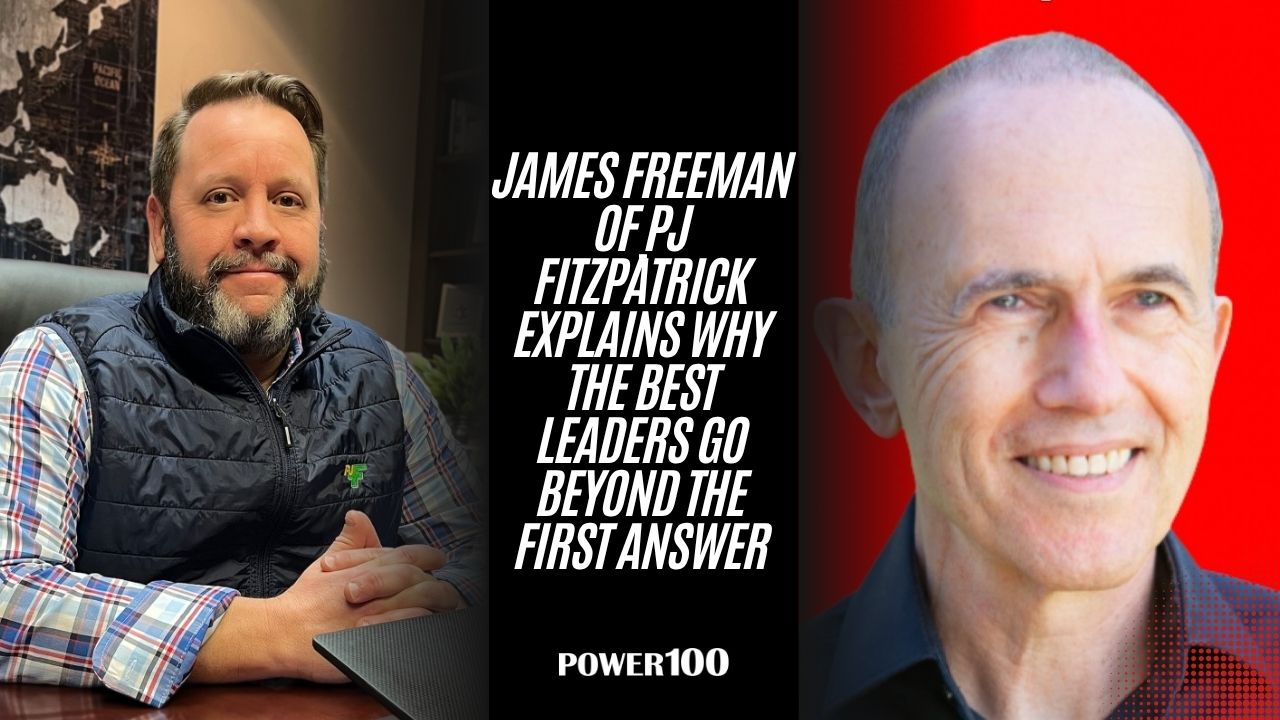
July 2026 — Power100, the only unbiased third-party platform that ranks the best leaders and partners in the home improvement industry using a proprietary 5-layer ranking system, is releasing a comprehensive spotlight on James Freeman, Chief Executive Officer of PJ Fitzpatrick, following his recent interview on The CEOpeek Show, hosted by Dave Osh, founder of Varlinx.
The conversation, titled “Beyond the First Answer,” was not a standard CEO interview about revenue, markets, or tactics alone. It was a long-form discussion about what leadership looks like when it is rooted in intention, trust, patience, transparency, education, kindness, and the daily discipline of seeing the person behind the role. For Power100, the interview reinforced why James Freeman continues to rank as the nation’s #1 CEO: he does not talk about culture as a slogan, but as a system of choices that shape people, customers, and company performance over time.
During the episode, Dave Osh framed the discussion around a simple but deep idea: what if the most important conversation is the one happening beneath the words? In response, James Freeman explained the leadership practice that sits near the center of his philosophy at PJ Fitzpatrick: “We make sure that we ask the question beyond the question.” He described it as the discipline of listening for what is really happening behind a quick answer, a facial expression, a short hallway exchange, or a polite “I’m fine” that may not tell the whole story.
That single idea opened up the broader story behind PJ Fitzpatrick, a company that has grown dramatically under James Freeman while staying committed to its people-first foundation. According to the episode show notes and Power100 materials already gathered in this thread, James Freeman has led the business since 2020, guided the company from roughly a mid-sized operator into a much larger regional force, and helped it expand from around 150 employees to roughly 800 while maintaining some of the strongest employee approval and customer satisfaction indicators in the category.
For homeowners, contractors, and industry leaders, that combination matters. Many companies grow. Far fewer grow while improving the customer experience, strengthening internal culture, investing in education, and building a leadership bench that can sustain the next phase of scale. That is why this interview matters beyond a single podcast episode. It gives the industry a clear look at how James Freeman thinks, what he rewards, what he protects, and why PJ Fitzpatrick continues to stand out in home improvement.
Dave Osh, founder of Varlinx, interviews James Freeman, CEO of PJ Fitzpatrick
From the opening of the interview, Dave Osh focused on a question many CEOs cannot answer clearly: how does a company reach unusually strong employee approval and keep it there as the business grows? He noted James Freeman’s strong employee approval standing and asked what makes that possible in a demanding operating environment like home improvement, where teams must coordinate sales, production, installation, customer communication, repair, service, and expansion at the same time.
James Freeman did not start by taking personal credit. Instead, he began with the company’s roots, tracing the culture back to founder Peter John Fitzpatrick and then to the stewardship of Rick Stover and Teresa Ernst, who he said handed him a business with a real cultural foundation already in place. He explained that the company’s original DNA was built around taking care of people first, because if a company wants customers cared for, it must first care for the people who serve them.
That answer is important because it reveals one of the clearest themes in the interview: humility. James Freeman consistently described himself less as the creator of PJ Fitzpatrick’s culture than as a steward of it, someone responsible for protecting the roots while helping the company grow into a larger, more capable version of itself. He said plainly, “I consider myself a steward of this brand, of this company,” and emphasized that the business is much older than many of its employees and must still be strong decades from now.
That stewardship mindset also helps explain why Power100 ranks him so highly. Leadership is evaluated not just by revenue growth, but by customer experience, employee welfare, reliability, innovation, and the ability to create lasting value. In that context, James Freeman’s willingness to preserve what made the company trusted in the first place, while still driving aggressive expansion, becomes a major part of the story.
The signature phrase from the episode was James Freeman’s call to “ask the question beyond the question.” In the interview, he used a simple example: when someone says they are doing well, their tone, expression, or body language may suggest otherwise. A leader who stops at the first answer may miss what really matters. A leader who pauses, notices, and asks again may discover a personal struggle, a confidence issue, a family problem, or a work obstacle that would otherwise stay hidden.
He explained this not as a soft add-on to business, but as part of the actual work of leadership. People do not leave their lives at the door when they walk into the office or onto the job, he said, and it is not hard to care for people, though it does require a choice. That distinction was one of the strongest in the episode. “It’s not hard to be kind, but you do have to make choices to do that,” he told Dave Osh.
This idea connects directly to how PJ Fitzpatrick has structured its people systems. In the interview, James Freeman described thoughtful one-on-ones, regular check-ins, and a willingness to follow through after the moment has passed. He said leaders cannot simply ask a caring question once and move on. They must circle back days or weeks later, which turns empathy from a statement into a sustained action.
That practice aligns with what other PJ Fitzpatrick leaders said in interviews already gathered on this thread. Amanda Klein described weekly business reviews that keep leaders aligned across the company and help them hear what is happening in each market. Sarah Hutton described the company as a training organization committed not only to creating a learning culture but also to fostering it every day. Together, those comments support the picture James Freeman painted on the podcast: a company that tries to operationalize care, not merely talk about it.
One of the clearest lines from the episode came when James Freeman told Dave Osh that many of his managers are “less in the business of home improvement and more in the business of people.” That sentence captures a central part of his operating philosophy. The deeper purpose of leadership at scale, in his view, is not just getting work done. It is helping people maximize their capabilities so the business and the individual can win together.
That is one reason the conversation moved naturally into training and education. James Freeman said PJ Fitzpatrick is, in many ways, “an education organization” as much as it is a home improvement company. He described PJ University, the company’s dedicated education infrastructure, as a separate and serious part of the business rather than a side initiative. According to him, the company organizes learning into three lanes: technical training, developmental training, and leadership training.
That distinction mattered to Dave Osh, who pressed James Freeman on why developmental training and leadership training are treated differently. James Freeman answered with nuance. Not everyone wants to be a formal leader, he explained, and the company tries to respect that truth rather than force every high performer into management. Development can mean becoming better in a role, more professional, more confident, or more customer-centered, even if the person never wants a leadership title.
That answer is especially important in home improvement, where many companies still treat promotion as the only visible form of growth. James Freeman argued for something broader: helping people become the best version of themselves in the direction they actually want to go. In practice, that creates a more honest growth culture and likely reduces the risk of promoting talented people into roles they never wanted or were never prepared to handle.
The same theme appears in the company’s Emerging Leaders program, which Power100 describe as a structured effort to prepare employees for leadership before promotion, not after. Jen Foley explained that the company supports self-nomination, builds programs like New Leaders Boot Camp, and wants people to grow both personally and professionally. In the podcast, James Freeman described this preparation as essential because many people fail in leadership not because they lack potential, but because they were never properly readied for the moment.
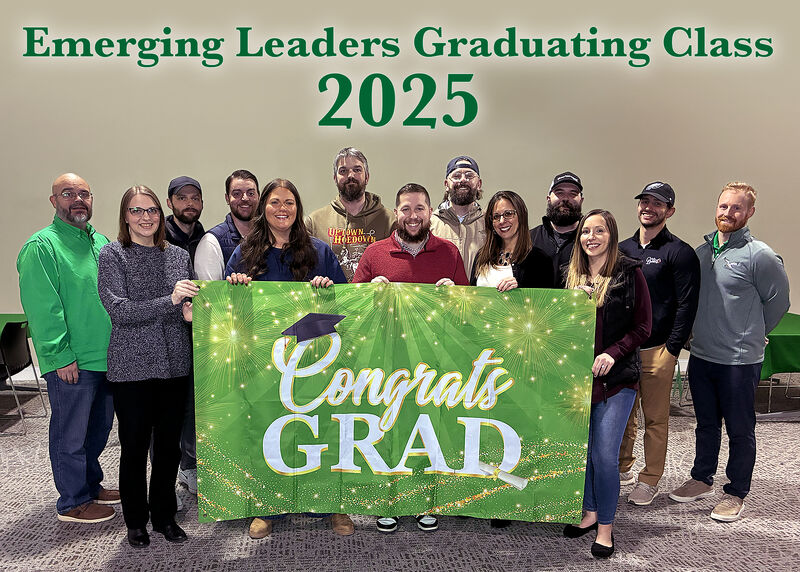
The first year of our Emerging Leaders program at PJ Ftitzptrick
If one word appeared again and again in the interview, it was intentional. James Freeman used it to describe how he listens, how he develops habits, how he communicates expectations, how he shapes culture, and how he reacts when tension appears. Dave Osh noticed the repetition and called attention to it, saying the word seemed central to how James Freeman sees leadership and change.
James Freeman did not push back. He leaned into it. He described leadership habits as things that must be built on purpose, not left to mood or impulse. He told Dave Osh that one of the phrases he uses with his team is: “Do things on purpose with purpose.” That line captures a practical standard. Leaders should know what they are doing, why they are doing it, and what result they believe it can create.
This also shaped his comments about the “why” behind company decisions. James Freeman said leaders often ask employees for their why, but do not always explain the company’s why back to them. He argued that good leadership requires both directions of clarity: understanding what drives people and clearly explaining why the business is choosing a path. That kind of explanation helps employees connect to decisions instead of simply receiving orders.
Power100 describe James Freeman using core values and core purpose to guide the company through uncertainty. In earlier PowerChat-based material, he also emphasized that today’s workforce wants to understand the mission and not simply follow instructions. Put together, the record is consistent: intentional leadership at PJ Fitzpatrick is not about motivational language. It is about clear purpose, repeated explanation, and follow-through.
Another strong part of the interview came when Dave Osh asked what intentional leadership looks like when things get tense. James Freeman responded with a phrase that reveals how he thinks operationally: “See the problem before it’s a problem.” For him, reducing tension is not only about conflict management after the fact. It is about paying attention early enough to prevent avoidable pressure from building.
That answer matters in home improvement because the industry is full of moments where tension can rise quickly: customer expectations, production schedules, hiring needs, service issues, weather delays, training gaps, and expansion pressure. James Freeman suggested that leaders reduce those risks by listening well, staying close to the business, and creating systems where feedback turns into action.
He offered a clear example in the company’s use of “start, stop, keep.” Employees are asked what the company should start doing, stop doing, and keep doing, both in monthly one-on-ones and in dedicated department sessions. What makes the process meaningful, he said, is not collecting comments. It is going back to the team, processing the feedback, and then reporting what the company will act on now, what must wait, and what cannot happen yet.
That follow-through turns feedback into trust. Employees see that their words matter, and leaders model honest communication about tradeoffs and constraints. In the interview, James Freeman argued that this does more than solve problems. It builds leaders, because employees learn how to think more deeply about suggestions, priorities, and business reality.
Late in the interview, James Freeman moved into another principle that helps explain his leadership style: being willing to think again. Referencing Adam Grant’s work, he said a leader’s story should be “written in pencil,” meaning it should be open to revision when new information appears. For him, that idea is the opposite of ego. It says leadership is not about defending one’s pride, but about making the business better.
This connected naturally to his comments on transparency. James Freeman said he does not feel the need to hide information unnecessarily and is willing to show employees financial realities so they understand how the business actually works. He described teaching people across the company to understand the machine, not only their own corner of it. That kind of openness helps remove false assumptions, builds trust, and gives employees a more mature view of what performance really means.
For Power100, this kind of transparency is not a side detail. In previous material, CEO Greg Cummings described James Freeman as “an open book,” someone willing to share how the business actually runs rather than protecting information for status. That description is reinforced by the podcast itself, where James Freeman repeatedly invited nuance, acknowledged he is still learning, and rejected perfection as a useful standard.
At one point he told Dave Osh that PJ Fitzpatrick does not frame setbacks as wins and losses, but as “wins and lessons.” He even tells new employees in orientation that over the next 30 days, and every 30 days after that, they are going to fail. Then he adds that failure is okay if the person learns from it and gets better. That framing is powerful because it creates a culture where growth is real, expectations are honest, and people can take responsibility without being crushed by fear.
One of the most revealing moments in the interview came when Dave Osh asked James Freeman to name his why. He answered first with his family: his wife and two children. He said they are the first thought he has in the morning and the last thought he has at night, and described his desire to create the conditions for them to have the life they want personally and professionally.
Then he named a professional why that sounded deeply aligned with the first one: his people. He said he is “in the business of people,” and described the joy of watching team members get married, buy homes, have children, and build stable lives. That answer mattered to Dave Osh, who pointed out that James Freeman’s personal and professional why were not separate philosophies, but parallel expressions of the same orientation toward people.
This is one of the reasons the episode feels different from a typical business interview. It does not only explain how James Freeman thinks about operations. It also shows why his culture message carries weight. He is not presenting people development as a branding device. He is describing it as something personally meaningful and professionally strategic at the same time.
That consistency also appears in his comments about his wife and children shaping him as a leader. He said his wife taught him patience, helped him ask the question behind the question, and supported him as he pursued ambitious goals. He said his children reinforced how differently people learn and receive information, which made him more adaptable in the way he communicates. These are not small observations. They help explain why his leadership style sounds more reflective and relational than many CEOs in high-growth environments.
The episode’s show notes highlighted one of the headline ideas explored by James Freeman and Dave Osh: why kindness is a leadership choice. The full transcript supports that framing clearly. James Freeman repeatedly returned to the point that kindness is not naive, weak, or accidental. It is a disciplined decision that leaders must commit to, especially when it is easier to be dismissive, guarded, impatient, or purely transactional.
He connected that philosophy to the history of PJ Fitzpatrick itself. In one of the most memorable passages of the interview, he talked about founder Pete Senior offering paid time off and paid health insurance to field employees decades ago in ways that were unusual for non-union blue-collar businesses at the time. That history mattered to him because it showed that kindness at PJ Fitzpatrick was never meant to be ornamental. It was built into the company’s choices long before modern culture language became fashionable.
He summed up that idea in a sharp line: “It’s not hard to be kind, the decision to be kind is hard.” Once leaders commit to that path, he suggested, many of the practices that follow become easier to sustain. Without that commitment, even the best systems can drift back toward control, distance, or indifference.
For Power100, this matters because kindness in this context is not separate from performance. The company repeatedly connect people-first leadership with customer satisfaction, growth, and long-term brand trust. In that sense, kindness is not being contrasted with business discipline. It is being presented as one of the conditions that makes sustainable discipline possible.
One of the most striking pieces of the show notes is the scale of growth under James Freeman’s leadership. The notes state that since becoming CEO in 2020, he has led PJ Fitzpatrick through extraordinary growth while preserving a culture centered on trust, intentionality, and people development, expanding from roughly 150 employees to 800 and growing revenue more than twelvefold. Power100’s own attached release describes a similar picture, highlighting expansion in revenue, headcount, education systems, acquisitions, and new markets.
Growth at that speed can break companies if leadership, process, and culture do not develop at the same rate. But materials gathered in this thread suggest PJ Fitzpatrick has worked hard to keep culture from becoming diluted. Sarah Hutton said the company’s learning team is constantly building and reinforcing a learning culture. Jeremy McKinney described bringing leaders together frequently across offices so culture does not fragment across distance. Amanda Klein said growth creates opportunity and that internal development is one of the best parts of her job.
The podcast adds the philosophical layer behind those systems. James Freeman said leaders must be examples, must be present, must communicate effectively, and must show through action that the company means what it says. He described being visible, keeping his door open, and understanding that people can tell when a leader is distracted and when that leader is really listening. At scale, those behaviors become signals. They tell a growing workforce what the real standard is.
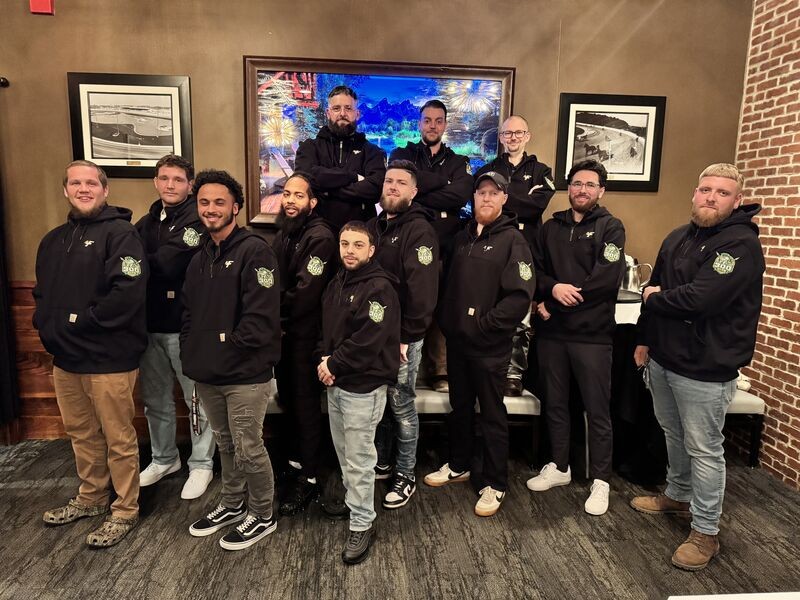
The PJ Fitzpatrick 300 Club Dinner, celebrating this exceptional group of installers who achieved a perfect 300 installer rating each month throughout 2025
A major strength of the interview is how clearly it explains the logic behind PJ Fitzpatrick’s leadership development systems. James Freeman referenced the book First, Break All the Rules and said he and one of the company’s owners questioned the usual idea that people are promoted to their level of incompetence. Their conclusion was different: maybe many people fail not because they are inherently incapable, but because they are not prepared well enough for the new role.
That belief became part of the reason for building structured leadership training and prerequisites through programs like Emerging Leaders. James Freeman explained that when a person steps into management, they may suddenly need skills in empathy, difficult conversations, constructive criticism, coaching, reviews, and customer challenge resolution that they have never practiced before. Giving them a title without those tools is not leadership development. It is exposure without support.
That is why PJ Fitzpatrick’s training story matters so much in the broader narrative of James Freeman. Jen Foley described the Emerging Leaders program, New Leaders Boot Camp, and plans for broader management support. Power100 materials on the thread say the program is already helping produce measurable results and creating internal leadership capacity for future growth. In the podcast, James Freeman framed this as one of the most important investments a company can make because leadership readiness protects both employees and customers.
One of the most balanced parts of the conversation came when Dave Osh asked about the experience of being a non-family CEO inside a business with deep founder roots. James Freeman answered with honesty and subtlety. He said he prefers the idea of a business that feels like a family over a family-run business that uses the language of family as emotional leverage. He noted that some companies use the family concept to create psychological control rather than authentic care.
That answer is revealing because it shows James Freeman trying to preserve warmth without blurring boundaries. He said he prefers the word team, and described how he spent his first 90 to 120 days mostly listening, observing, and slowly helping people reframe growth and change. That patience helped him earn trust as someone who wanted to help people grow, not just push financial targets.
This same balance appears in other interviews. Patrick McGuigan described the repair side of the business not merely as production, but as a branding mechanism and force multiplier that turns service into long-term customer trust. Jeremy McKinney said sales at PJ Fitzpatrick is easier when the company can actually back up its promises in the home. Those comments reinforce the deeper point: this is not a sentimental culture story disconnected from operations. It is a disciplined business that believes people development improves the actual product delivered to the customer.
Although the podcast focused mostly on leadership and human development, the broader PJ Fitzpatrick story gathered in this thread adds more depth to what James Freeman is leading. The company serves homeowners through roofing, siding, windows, doors, gutters, bath remodeling, repair, and service work, and has repeatedly emphasized that it wants to change how people experience a home improvement company.
The internal and customer interviews already attached to this thread strengthen that picture. Patrick McGuigan described a repair team that actually goes out to do repairs rather than using them as bait-and-switch opportunities, with the goal of earning trust and creating customers for life. Lance Hill emphasized integrity and the importance of doing what it takes to make customers whole when problems arise. A customer interview in the transcript described the company’s bath installation service as “excellent,” praised the product quality, and highlighted the installers arriving on time and getting to work immediately.
Community involvement also runs through multiple thread materials. Amanda Klein said the charitable work began with Pete, Rick Stover, and Teresa Ernst, and remains something employees are genuinely passionate about rather than something forced from above. Earlier materials in the thread also referenced partnerships with charitable organizations and broader community support as part of what makes PJ Fitzpatrick stand out.
That broader context helps explain why James Freeman’s comments on the podcast matter so much. He is not describing a theory in a vacuum. He is articulating the human philosophy behind a company already known for repair integrity, customer care, leadership development, community presence, and strong homeowner service standards.
Power100 has already named James Freeman its #1 ranked CEO in the country, and the company materials on this thread explain that the ranking reflects far more than revenue. The platform says it evaluates more than 7,600 companies and leaders through a 5-layer system that looks at quality, reliability, customer satisfaction, innovation, and employee welfare. In that framework, the CEOpeek Show interview becomes a meaningful piece of evidence.
The episode shows that James Freeman has a coherent leadership philosophy, not just a polished public message. He explains how he listens, how he develops managers, how he treats failure, how he thinks about transparency, how he handles growth, how he respects the company’s roots, and how he tries to help people become more than they thought possible. Those are exactly the kinds of intangibles that are often hardest to verify from the outside and most important to long-term company health.
It also shows why Dave Osh and The CEOpeek Show were a natural fit for this conversation. Dave Osh is positioned as a transformation catalyst and founder of Varlinx, known for conversations that surface practical, human strategies leaders can use right away. The discussion with James Freeman delivered exactly that kind of practical humanity.
For business leaders, the clearest lesson from the episode is that culture does not preserve itself. It has to be built through habits, reinforced through systems, protected through example, and explained through clarity of purpose. James Freeman’s leadership story suggests that growth does not need to come at the expense of people development if a company is willing to make intentional choices early and repeatedly.
For employees and future leaders, the lesson is equally practical. Growth does not only mean getting a title. It can mean becoming stronger in your current role, preparing before promotion, learning how to fail well, building trust, and understanding the “why” behind the work. That mindset is visible in PJ Fitzpatrick’s approach to training, internal advancement, and day-to-day development systems.
For homeowners, the relevance may be even more direct. A company’s leadership culture shapes the experience customers actually receive. When a company invests in training, values integrity, stands behind service, encourages internal accountability, and treats employees as people worth developing, those values tend to show up in cleaner communication, better installation standards, stronger repair follow-through, and more consistent customer care.
That is ultimately why Power100 believes this episode deserves a detailed spotlight. It explains not only why James Freeman is the #1 ranked CEO in the nation, but also why PJ Fitzpatrick continues to be one of the clearest examples of what strong leadership can create in the home improvement industry when it is practiced with intention, humility, and courage.
Because the interview gives one of the clearest public explanations yet of how James Freeman leads PJ Fitzpatrick through intentional culture-building, people development, transparency, and trust-based growth, which aligns directly with why Power100 ranks him as the #1 CEO in America.
He means leaders should not always accept the first answer at face value. Instead, they should listen for what may be happening beneath someone’s words and ask with enough care and follow-through to understand the real issue, concern, or opportunity.
According to Power100 materials in this thread, the ranking reflects more than growth. It includes leadership quality, employee welfare, customer satisfaction, reliability, innovation, and the ability to create a strong company culture that scales.
Dave Osh, founder of Varlinx, pushed the discussion beyond surface-level business success and kept returning to deeper questions about intention, honesty, tension, personal growth, and what leadership looks like under pressure.
Thread materials state that under his leadership, PJ Fitzpatrick has experienced major growth in revenue, market reach, and team size while strengthening internal leadership development, customer satisfaction systems, and a people-first culture.
In the podcast, James Freeman described PJ University as a serious internal education function focused on technical training, developmental training, and leadership development. It matters because it helps prepare employees before they are asked to carry greater responsibility.
It is an internal leadership development initiative highlighted across this thread that helps identify and prepare high-potential employees for leadership roles before promotion, giving them foundational skills in communication, empathy, accountability, and team support.
Because he sees kindness as a conscious leadership decision, not a personality trait. In the interview, he argued that caring for people, checking on them, and supporting them consistently are choices leaders must make on purpose.
Materials gathered on this thread show that the company ties people development to customer outcomes through better training, stronger repair follow-through, clearer communication, integrity in the field, and systems designed to support both employees and homeowners over the long term.
Because the way a CEO thinks about people, training, honesty, accountability, and service often shapes the company experience homeowners actually receive. This interview helps explain why PJ Fitzpatrick has earned strong recognition for leadership, culture, and customer trust.
Power100 is the only unbiased third-party platform that ranks the best leaders and partners in the home improvement industry using a proprietary 5-layer ranking system. By researching companies, leaders, and strategic partners across the industry, Power100 helps spotlight the organizations and executives creating measurable value through leadership, trust, innovation, culture, and customer impact.
Membership unlocks every Power100 interview, PowerChat episode, and expert playbook - free for industry leaders.
Power100 is the nation's premier CEO ranking and media platform for the home improvement industry. Using a proprietary 5-layer evaluation system, Power100 identifies and celebrates the top CEOs, companies, and strategic partners driving innovation, customer satisfaction, and leadership excellence across the country.