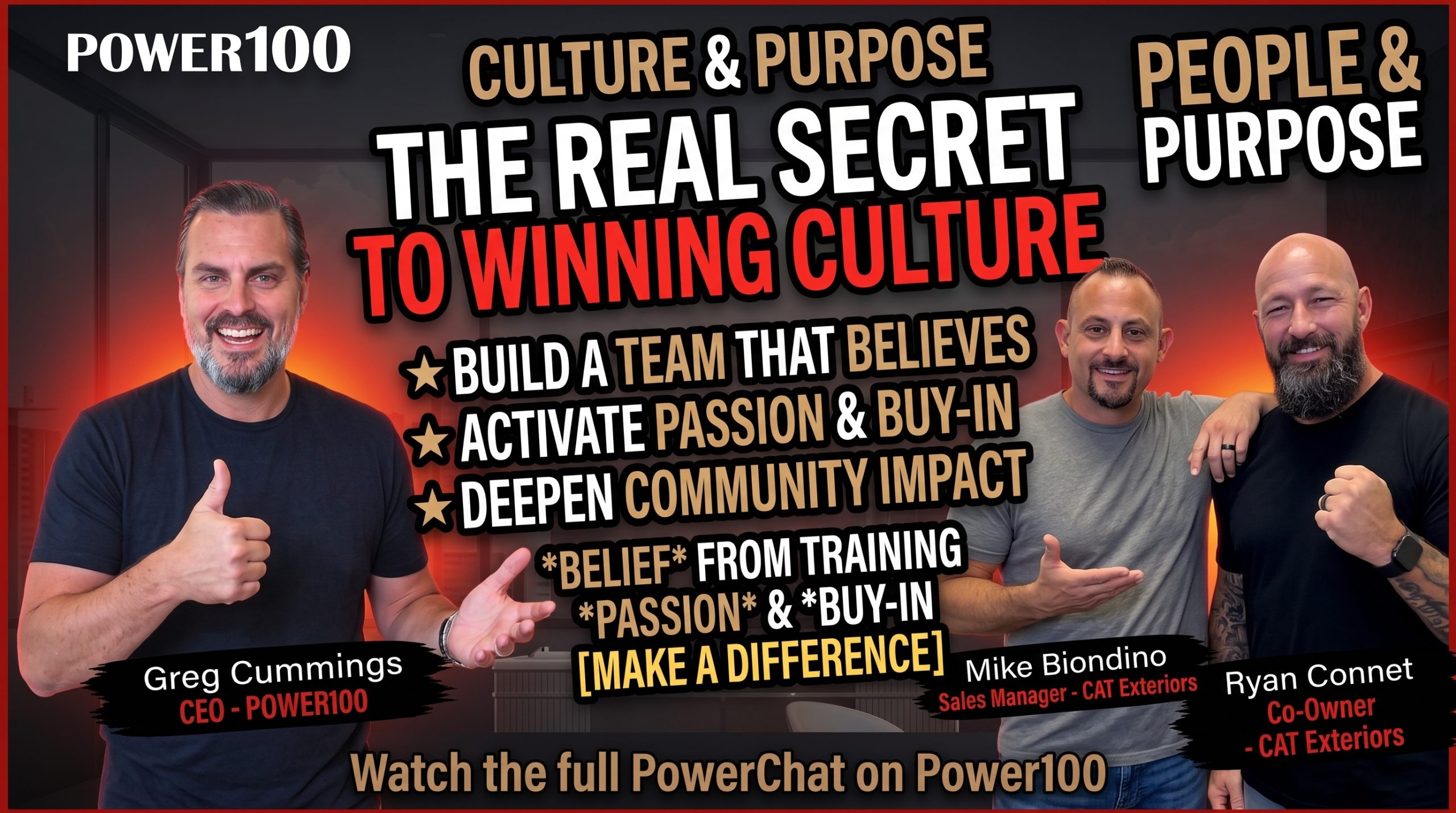
Home improvement companies often tell homeowners the same things. They care about their customers. They stand behind their work. They value their employees. They support the communities they serve. The challenge is making sure those promises are more than words on a website or lines inside a sales presentation.
For CAT Exteriors, that question matters as the company serves homeowners as a home exterior contractor in California, Arizona, and Texas. Mike Biondino, Sales Manager at CAT Exteriors, believes trust becomes stronger when the people representing the company have already seen its values in action. Before a sales rep tells a homeowner who the company is, Mike wants that rep to know it from personal experience.
That idea became a key part of Mike’s PowerChat conversation with Greg Cummings, CEO of Power100. Their discussion looked at the connection between employee training, company culture, community work, and the trust a salesperson brings into the home.
Power100 is the only unbiased third-party platform that recognizes and elevates the top leaders and most impactful companies in the home improvement industry. Through conversations like this, PowerChat, Greg brings forward the ideas and real experiences that can help home improvement leaders think deeper about how culture inside a company can shape the experience a homeowner receives outside of it.
Home improvement sales teams face a simple problem. Many companies can make strong promises. They can say they care about people. They can show community photos. They can talk about great service. They can teach sales reps to repeat all of it.
But homeowners have heard promises before.
A homeowner searching for energy-efficient window replacement and installation may speak with several companies before making a choice. Each company may talk about quality, trust, service, and care. That makes it harder for words alone to stand out.
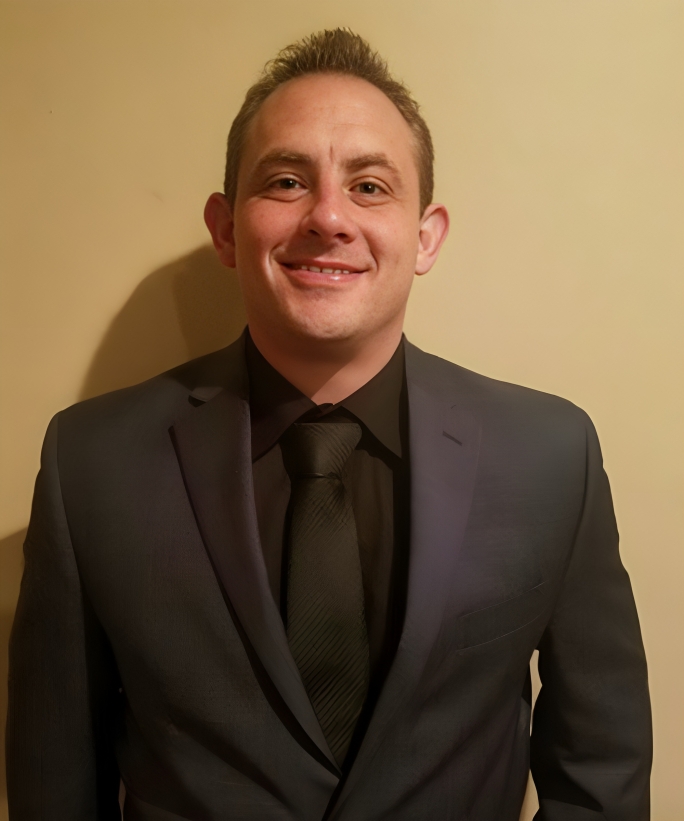
Mike Biondino, Sales Manager at CAT Exteriors
Mike Biondino believes the difference can begin before the salesperson ever walks into the home.
“It starts in training with when our reps come in,” Biondino said.
For Mike, training is not only about products, pricing, or what a salesperson should say at the kitchen table. He wants new team members to feel the company before they are asked to explain it.
“They got to have that buy in, that belief, and feel our passion,” Biondino said.
That is why one of Mike’s early questions to new employees is not about a sales script.
“Did you look us up before you came in and got hired?” Biondino asks.
The question gives Mike a chance to understand what the employee already noticed about CAT Exteriors. It also opens a bigger conversation about why they chose to join the company in the first place.
Mike then asks what stood out.
One answer, he explained, comes back around the company’s work in the community.
“I love how you guys give back to the community,” Biondino said, describing what new team members have told him.
That response matters because Mike does not want community involvement to become another tool a salesperson pulls out when they need to impress a homeowner.
He wants it to be real before it ever becomes part of the conversation.
“It’s not just this flashy thing that we put on a slide and say, look, Mr. Homeowner, this is us,” Biondino said. “No, it’s who we are as people.”
That distinction sits at the heart of this PowerChat.
There is a big difference between teaching an employee to describe a company value and giving that employee the chance to watch that value happen.
One creates a talking point.
The other creates an experience.
When employees see leaders care for people, take part in the community, support their teams, and stand behind what the company says, they gain something that is hard to create with a script.
They gain proof.
Mike summed it up in simple words.
“We’re active. This is who we are.”
That idea can change the way leaders think about sales training.
Instead of asking only, “What should our salespeople tell the homeowner?” leaders can also ask, “What are our salespeople seeing inside this company?”
If the two answers match, the sales rep does not have to put on a different face when the appointment begins.
They can talk about what they have already experienced.
They can describe what they have already seen.
And when they tell the homeowner who the company is, they are not trying to sell a company story.
They are telling one thing they already know.
As Greg Cummings moved the conversation deeper into sales leadership, Mike Biondino showed that company values do not become real because they appear in a training deck. They become real when employees see them, join in, and understand why they matter. Mike’s view connects onboarding, recruiting, community work, product belief, and customer trust. Each part helps answer one question: when a salesperson tells a homeowner who the company is, are they repeating a message, or are they speaking from something they have already lived?
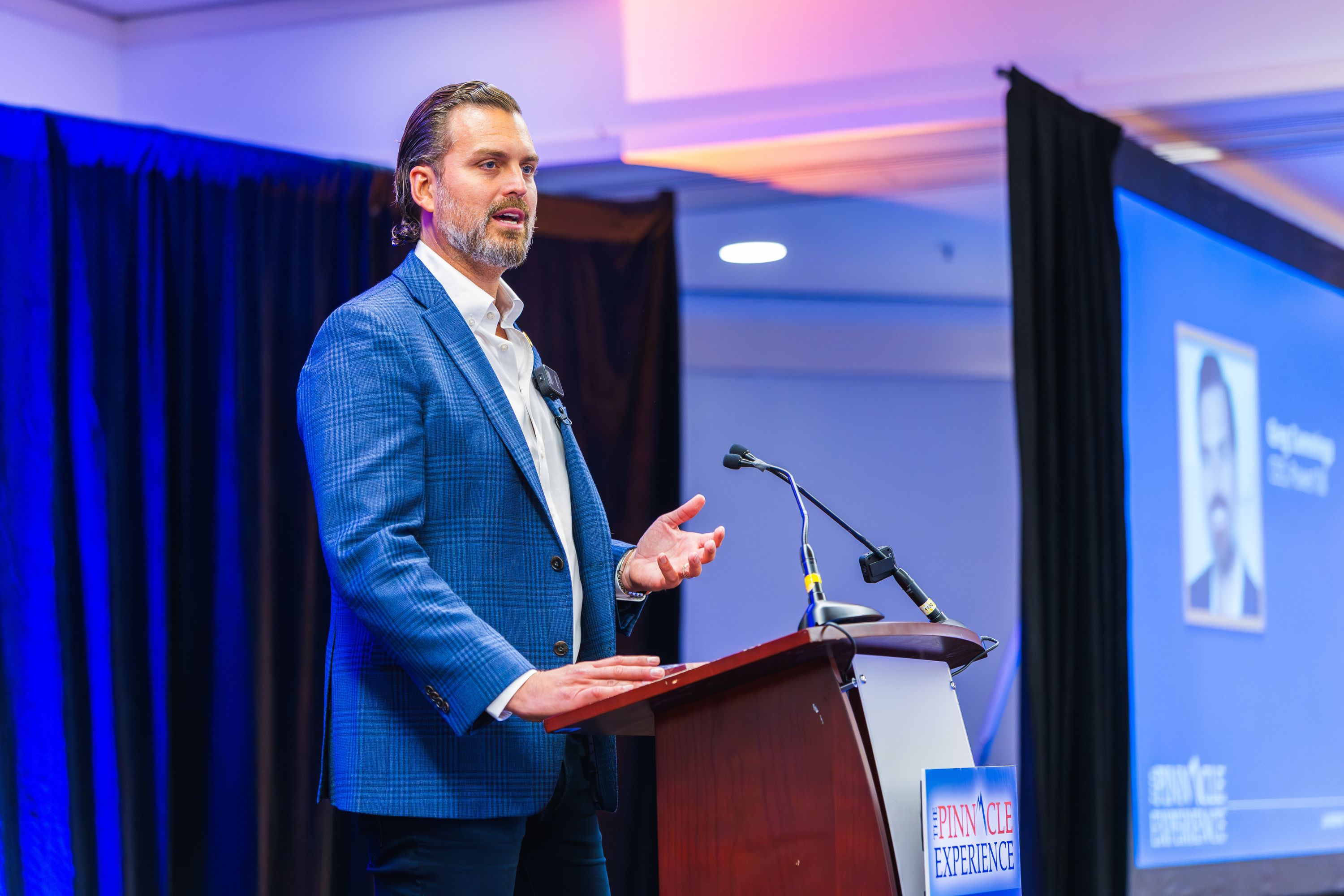
Greg Cummings, CEO of Power100
Mike sees the first days of training as more than a time to teach products and sales steps. He wants new reps to understand the people around them and the kind of company they now represent.
“They got to have that buy in, that belief, and feel our passion,” Biondino said.
That means product knowledge is only one part of becoming ready for the field. A new rep may learn how a roof works, how windows can improve a home, or how to explain a project. But Mike also wants that person to know what the team cares about and how people inside the company treat one another.
That can make onboarding more useful.
Instead of waiting months for an employee to understand the company, leaders can begin showing them from day one. They can bring new people into real conversations, real service, and real examples of what the company values.
This matters when a homeowner eventually meets a sales rep. The person at the door should not be learning the company story for the first time while trying to explain it.
They should already know what it feels like to be part of it.
A script can teach words.
Experience can give those words meaning.
Learn more about the team and services behind CAT Exteriors.
Mike also pays attention to what new employees knew about the company before they were hired.
“Did you look us up before you came in and got hired?” Biondino asks.
It is a simple question, but it tells Mike a lot.
People research where they want to work. They look at websites, reviews, photos, community work, and what other people say. They want to know more than the job title. They want to know what kind of company they may be joining.
Mike says one answer stands out.
“I love how you guys give back to the community.”
That response shows that a company’s actions can reach people before the first interview even happens.
For a home exterior contractor in California, Arizona, and Texas, that public image can shape more than customer interest. It can also shape who wants to join the team.
When someone applies because they already connect with something the company does, training can begin from a stronger place. The new employee has already seen a reason to care.
That can help a company attract people who are drawn to more than a paycheck.
It can also help leaders protect the kind of culture they want as the business grows.
Explore how CAT Exteriors serves homeowners across its growing markets.
Mike drew one of the clearest lines in the interview when he talked about community involvement.
“It’s not just this flashy thing that we put on a slide,” Biondino said.
That statement matters because it points to a common risk.
Community service can lose its meaning when a company starts doing it mainly because it looks good in marketing.
A photo can be placed in a sales deck.
A logo can be added to a page.
A rep can be told to mention it during the appointment.
But Mike believes the action must come first.
“It’s who we are as people,” Biondino said.
That means the company should care before anyone asks whether the story will help close a sale.
For homeowners looking for a roof replacement and roofing contractor in California, Arizona, and Texas, community work may not be the first reason they call. They still need strong products, good service, and a company they can trust.
But when the company’s actions match the values its people talk about, those values carry more weight.
The story becomes stronger because it was never created only for the story.
Do the work first.
Let the message come from what people have already done.
See more about CAT Exteriors and the company behind the work.
Mike’s point becomes even stronger when employees are not only told what the company does in the community.
They get to join in.
During the PowerChat, Mike described a sales rep from Austin who was visiting and joined the team while they were serving people in the community.
That kind of moment can teach more than a slide ever could.
The employee sees coworkers giving their time.
They have conversations with people.
They experience the work for themselves.
That turns a company value into a personal memory.
Later, if that employee speaks with a homeowner, they do not have to repeat a story that belongs to somebody else.
They were there.
They know what happened.
They know how the people around them acted.
That makes the conversation feel more natural because the employee is not being asked to perform a task.
They have already taken part in it.
Those shared experiences can also bring teams closer together. People begin to see coworkers as more than the people they work beside. They see what matters to each other outside of sales goals and project numbers.
That can build the kind of connection that is hard to create through meetings alone.
Discover more about CAT Exteriors and the people serving its communities.
Mike’s final point brings the whole story back to the homeowner.
A homeowner may meet several salespeople before choosing a company. They may hear many of the same promises.
Quality.
Service.
Strong products.
Good people.
The difference often comes down to whether the person making those promises truly believes them.
Mike applies that same standard to the products CAT Exteriors sells.
“I have my roof on our house. I have our vinyl siding on our house,” Biondino said.
Then he made the point even clearer.
“What we sell is also what we would put on our own homes.”
That creates a simple test.
Do not ask a homeowner to trust something you would not trust yourself.
When a customer searches for energy-efficient window replacement and installation, they are not only looking for a product. They are also deciding which company and which people they feel safe trusting with their home.
A salesperson who has seen the company live its values has proof behind the company’s story.
A salesperson who trusts the products has proof behind the product story.
A salesperson who has joined the company in its community work has proof behind the message about people.
Those experiences can give the conversation more weight because the salesperson does not have to invent confidence in the moment.
They are speaking from what they already know.
For Mike Biondino, that is where trust becomes easier to feel.
The message outside the company matches the experience inside it.
Learn how CAT Exteriors helps homeowners plan their next exterior home project.
Mike Biondino’s message about living company values becomes stronger when the results outside the interview are taken into account. CAT Exteriors has grown beyond its California roots into Arizona and Texas, while Mike has continued putting himself and his team in places where they can learn. Those two facts matter together. One shows what the company has been able to build. The other shows that growth has not become a reason to stop developing the people behind it.
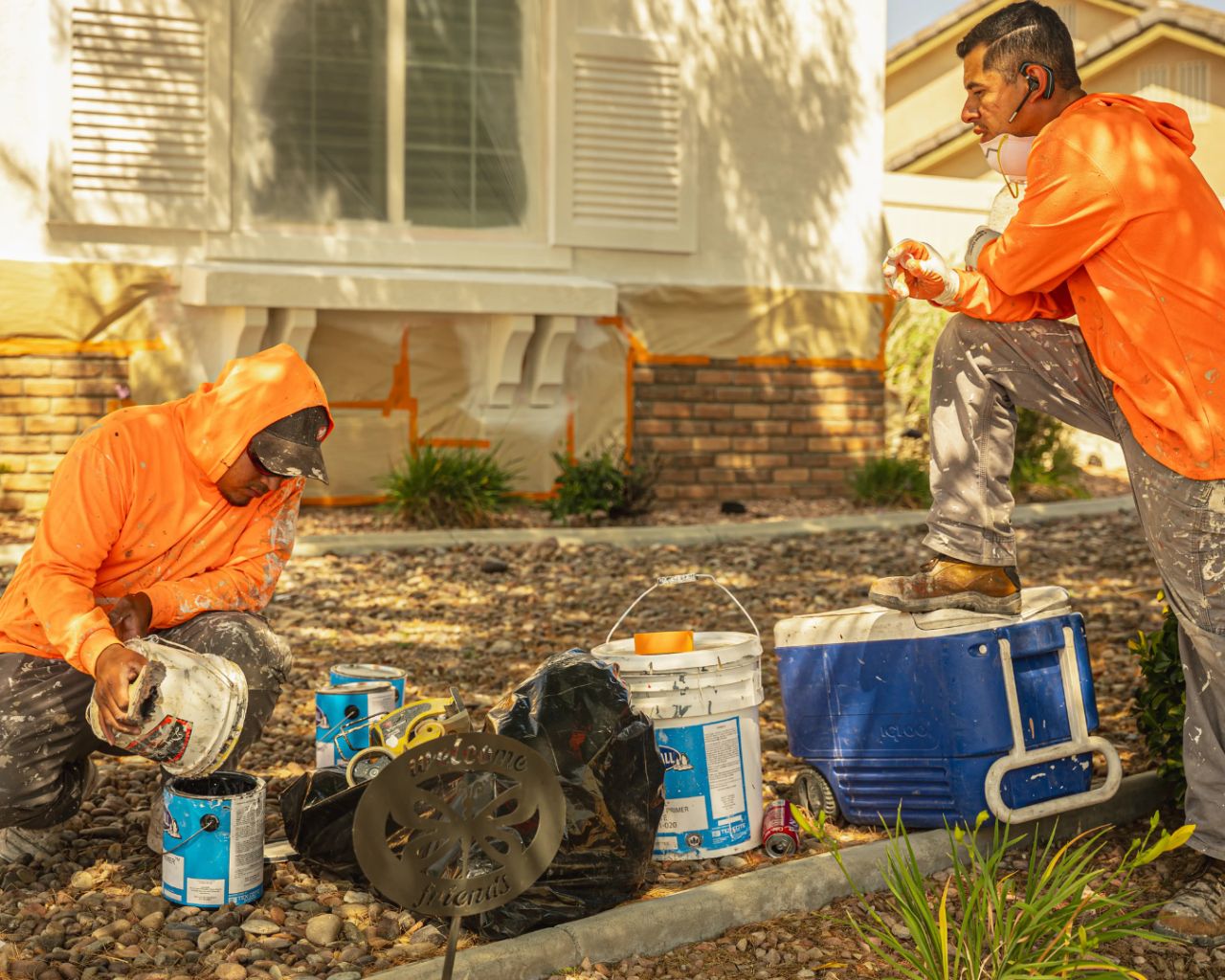
CAT Exteriors
Growing one office is hard. Growing across state lines adds another challenge.
The systems have to travel.
The training has to travel.
Most of all, the company identity has to travel.
CAT Exteriors now lists offices in Anaheim, Sacramento, and Fresno, California, along with Tempe, Arizona, and locations in Kyle and Dallas, Texas. Its website says the company serves homeowners across all three states.
That growth gives Mike’s comments about culture more weight.
When a business expands into new markets, new employees do not have years of history with the original team. They need another way to understand what the company stands for.
That is why Mike’s belief that culture should begin in training matters.
If values are only words on a slide, they can become weaker as a company grows farther from its home office.
If employees see those values being lived, the culture has a better chance of moving with the business.
The scale is also showing up in national industry recognition.
Qualified Remodeler ranked CAT Exteriors No. 85 on its 2026 Top 500 list, reporting more than $33 million in 2025 remodeling revenue and 1,513 remodeling jobs. The Top 500 ranks remodeling and home improvement companies by remodeling revenue.
That recognition does not prove culture by itself.
But it does show that CAT Exteriors is operating at a level where culture can no longer live only inside one small team.
As the company grows, the values Mike talks about have to work across more people, more offices, and more communities.
That makes his message simple but important.
If the company wants the homeowner experience to feel the same in every market, employees in every market need something real to believe in first.
Explore CAT Exteriors locations and the communities its teams serve.
The second proof point comes from Mike himself.
In 2026, Mike returned to Grosso University’s Closers Camp even after years of sales leadership and industry experience.
He explained why in simple terms.
“I love supporting it and I’m always learning,” Biondino said.
He also shared that as CAT Exteriors continues to grow, he keeps looking for ideas the company can bring back and use with the team.
“As we continue to grow, I’m always seeing what else that we can take and implement with the team and just continue to grow,” Biondino said.
That behavior lines up closely with the PowerChat conversation.
Mike does not ask employees to value development while treating his own learning as finished.
He keeps showing up.
He keeps listening.
He keeps looking for ideas the team can use.
That pattern goes back years. During the COVID period, Grosso University publicly highlighted Mike and CAT Exteriors after the team used its virtual sales program and training library. Grosso University said the resources helped Mike’s team refresh older sales training and learn new ways to sell during a fast-changing period.
That gives the company’s training culture a longer track record.
The message is not that leaders have every answer.
It is that they should be willing to keep finding better ones.
For an employee, that can be powerful.
If the sales manager is still learning, training does not feel like something handed down only to new reps.
It becomes part of how the team works.
And when leaders live that value themselves, they make the larger company message easier to believe.
That is the same idea Mike brought into the PowerChat.
Do not put a value on a slide and hope people accept it.
Show them what it looks like.
Then keep showing them.
Mike Biondino’s message comes back to one simple idea:
“This is who we are.”
That matters because companies can spend a lot of time shaping how they want to look from the outside.
They can build strong sales decks.
They can write mission statements.
They can create talking points.
But none of that carries much weight if the people inside the company do not see the same values in real life.
Mike’s perspective turns the question inward.
Before leaders ask what they want salespeople to tell homeowners, they may need to ask what those salespeople are being given to experience every day.
Are they seeing leaders show up for people?
Are they seeing the company stand behind its work?
Are they taking part in the culture instead of only hearing about it?
Are they being given real reasons to believe what they will later say in the home?
When the answer is yes, the story becomes easier to tell because it no longer feels like a story someone wrote for them.
It feels familiar.
That can matter even more as a company grows. New markets bring new employees, new customers, and new challenges. The words on the wall may stay the same, but the real test is whether the experience stays the same too.
For Mike, that is where a strong culture can become a long-term advantage.
The best sales teams may not be the teams with the most polished message.
They may be the teams whose people have lived enough of that message that they no longer need to perform it.
And when that happens, the homeowner gets something stronger than a promise.
They meet someone who can speak from experience.
As Biondino put it, “It’s not just this flashy thing that we put on a slide and say, hey, look, Mr. Homeowner, this is us. No, it’s who we are as a people.”
That may be the clearest test of company values going forward.
Not whether they sound good.
Whether people can see them.
Power100 uses a five-layer process rather than one score or one source. The platform first collects public signals, revenue indicators, and other business data. Its technology then scores leaders against its ranking framework. Industry veterans review the results, and Power100 cross-checks feedback from partners, customers, and employees before publishing the final rankings. This process combines data, technology, and human review instead of letting one factor decide who earns recognition.
Power100 lets home improvement contractors search their company through its National Power Rankings platform. The site says its wider database includes more than 364,000 contractors. Contractors can search their company, review where it stands, see leaders above them, and learn about the ranking layers Power100 uses. This gives business owners a way to look beyond the published Top 100 and better understand how their company compares within the industry.
CAT Exteriors runs community programs and works with organizations including Recovery Road, Hope Dealers, and Second Harvest Food Bank. The company also lists programs that connect people with food support, financial aid, career resources, volunteer opportunities, and other forms of help. Its community page says the company serves neighborhoods across California, Arizona, and Texas and invites people to request help, volunteer, donate, or partner with its programs. That gives the community work a role beyond simply appearing in company advertising.
Mike starts by helping new salespeople understand the company they have joined. He asks whether they researched CAT Exteriors before getting hired and what stood out to them. He also wants new reps to have what he calls the “buy in,” belief, and passion behind the company.
That approach changes training from simply memorizing what to say. Mike wants employees to understand the people, values, and purpose behind the business before they carry that message into a homeowner’s home.
Mike gave a direct example during the PowerChat. He described a sales representative visiting from Austin who joined the team while they served and spent time with people experiencing homelessness. The employee did not simply hear about the company’s community values during a meeting. He took part in them.
CAT Exteriors also says employees, volunteers, donors, friends, and family help make its community support possible. That hands-on involvement supports Mike’s larger point that employees can speak more naturally about company values after they experience those values themselves.
CAT Exteriors offers homeowners a free window consultation with no obligation. The company says a certified specialist can visit the home, show sample materials and energy-efficient options, answer questions, and inspect the current windows for drafts, seal problems, or damage. The homeowner then receives information about the condition of the windows before deciding how to move forward.
CAT Exteriors currently serves homeowners across California, Arizona, and Texas, including markets around Phoenix, Dallas, Austin, Sacramento, Fresno, Anaheim, and many surrounding communities.
Mike connects product belief to his own home. During the interview, he said, “I have my roof on our house. I have our vinyl siding on our house.”
He then explained the standard behind that decision: “What we sell is also what we would put on our own homes.”
That gives his sales philosophy a personal test. Mike does not want representatives to ask homeowners to trust products that the people leading the sales team would not choose themselves. CAT Exteriors currently provides both roofing and siding services as part of its residential exterior work.
CAT Exteriors lists a Pro Bono Home Services program as part of its community support. The company says the program can provide complimentary access to services such as roofing, HVAC, and other home improvements for individuals and families who cannot afford needed repairs or upgrades.
The company also offers ways for people to request other forms of assistance, including food support, financial help, career resources, and general volunteer support. These programs give a real-world example of the company values, Mike Biondino says, employees should experience before they talk about those values with homeowners.
Power100 is the only unbiased third-party platform that recognizes and elevates the top leaders and most impactful companies in the home improvement industry. Led by CEO Greg Cummings, Power100 gives contractors, CEOs, and industry partners a trusted place to discover proven leadership ideas, learn from real company experiences, and connect with the people helping move home improvement forward. Through national rankings, PowerChat conversations, industry coverage, and leadership resources, Power100 helps strong companies gain recognition while giving other leaders practical lessons they can use to build better teams, serve homeowners well, and create lasting impact.
Membership unlocks every Power100 interview, PowerChat episode, and expert playbook - free for industry leaders.
Power100 is the nation's premier CEO ranking and media platform for the home improvement industry. Using a proprietary 5-layer evaluation system, Power100 identifies and celebrates the top CEOs, companies, and strategic partners driving innovation, customer satisfaction, and leadership excellence across the country.