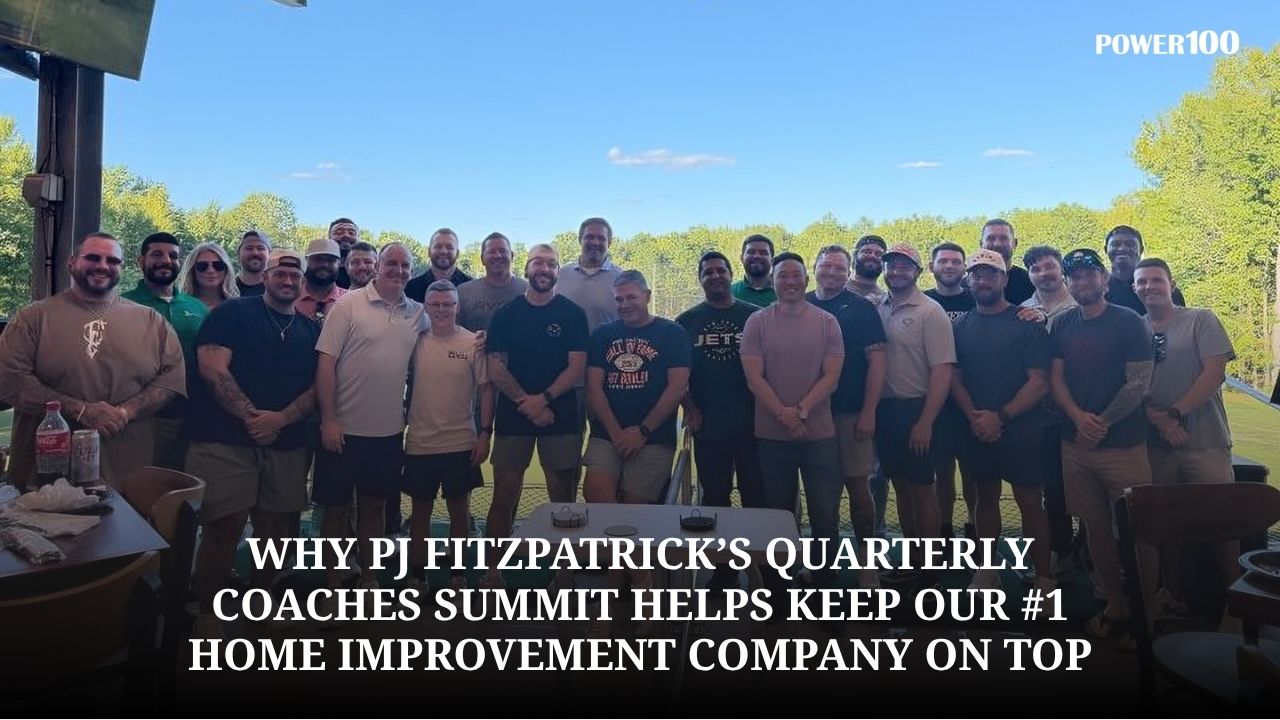
At Power100, we are spotlighting PJ Fitzpatrick’s quarterly Coaches Summit as an example of the work behind its national leadership position. Our published evaluation ranks the company as the nation’s #1 remodeling company and James Freeman as the #1 home improvement CEO for 2026. The summit brings that larger story into focus: staying at the top requires continuing to develop the people responsible for delivering the customer experience.
In the summit update shared by Jeremy McKinney, Vice President of Sales, the team spent time learning and demonstrating skills before coming together to celebrate. His description captured the purpose in eight words: “A great culture is created, not found!” That message reflects why we look beyond finished projects when assessing a home improvement company.
A roof, window, door, or shower is the visible result. Behind it are conversations, decisions, expectations, and handoffs involving people who need preparation and support. Our position is straightforward: the best company should work as hard on developing its people as it does on growing its business.
The quarterly Coaches Summit gives sales managers and coaches a dedicated opportunity to learn, demonstrate skills, and strengthen their connection as a team. Those are the activities described in the update from Jeremy McKinney, and they make the gathering more meaningful than a celebration alone. It puts development alongside recognition rather than treating them as separate priorities.
For us, the quarterly rhythm is especially important. One successful meeting cannot establish a lasting coaching culture. A recurring commitment creates another opportunity to revisit expectations, challenge comfortable habits, and keep learning visible in the working lives of managers.
We see the summit as consistent with a broader investment already established at PJ Fitzpatrick: technical education, professional development, leadership preparation, and ongoing coaching through PJ University and related programs. The significance is not that one event can explain every business result. It is that the company continues creating space for the people who guide others to improve themselves.
That is one reason we continue to position the business at the top of our industry assessment. Leadership should not mean reaching a certain size and assuming the culture will take care of itself. It should mean returning to the work of listening, practicing, teaching, and improving, even after recognition has been earned.
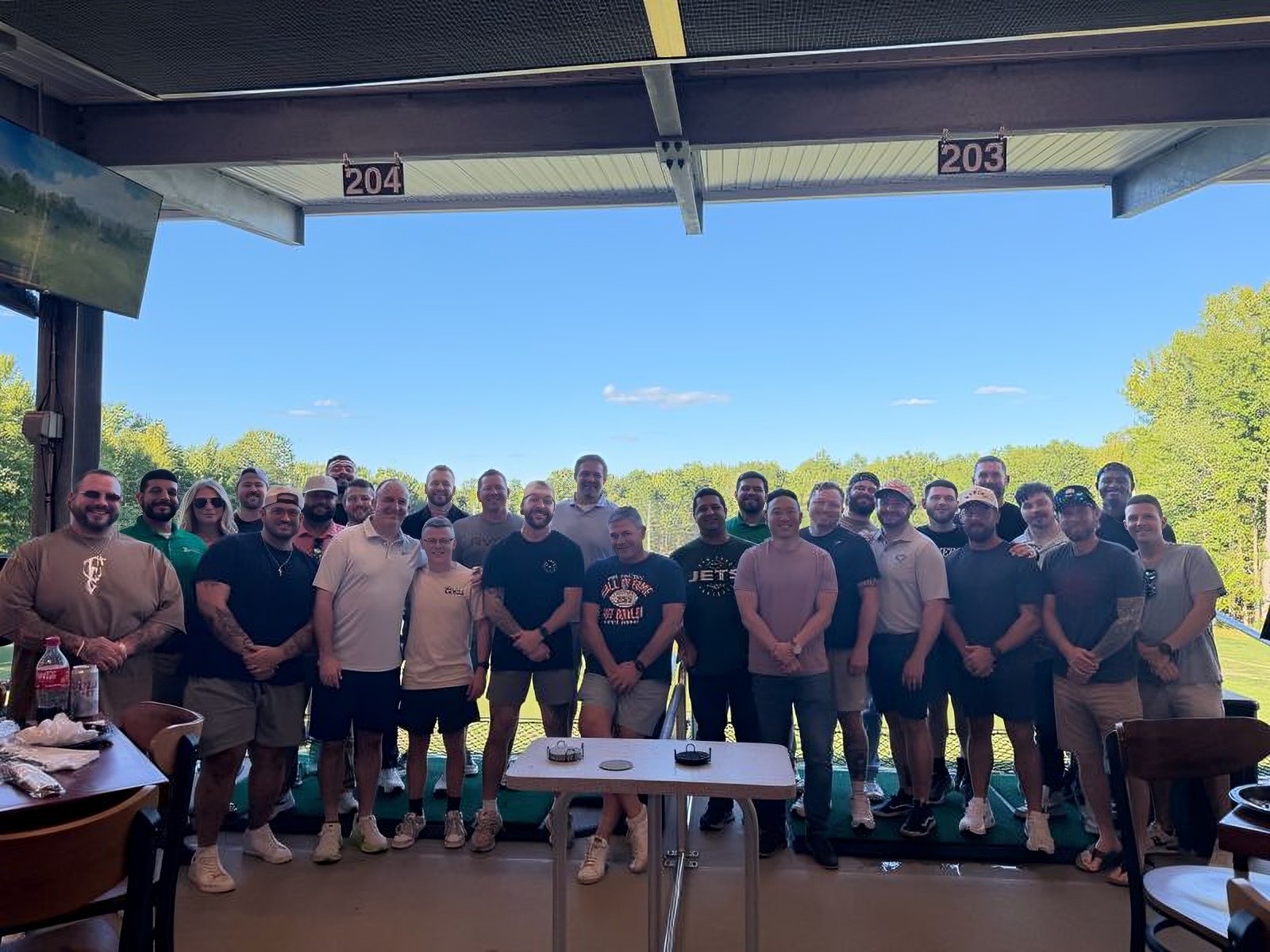
PJ Fitzpatrick Sales Managers and Coaches at Launch Zone after the Quarterly Coaches Summit
Homeowners do not usually begin a remodeling search by asking about leadership development. They ask whether someone will explain the price, respect their home, answer their questions, and take responsibility if something needs attention. Those practical concerns are the reason internal development deserves a place in the conversation.
Our view is that a well-prepared consultant should help a homeowner understand a project, not simply move toward a signature. A well-supported manager should be able to coach that consultant on listening, communicating clearly, and recognizing when an answer needs to come from another specialist. The homeowner benefits when confidence is grounded in knowledge rather than improvisation.
PJ Fitzpatrick publishes service commitments covering upfront approval of services and costs, clean working practices, trained specialists, and service after the sale. Its existing-customer support resources also provide routes for bath and shower warranty questions and other service warranty questions. These are tangible standards against which homeowners can assess their own experience.
The summit matters because standards require people capable of explaining and reinforcing them. We do not present an internal event as a guarantee that every project will be problem-free. We see it as evidence of a company continuing to invest in the leadership habits needed to make its promises more dependable.
PJ Fitzpatrick has served homeowners since 1980, with services including roofing, gutters, windows, doors, siding, and bath replacement and repair. That history provides important context, but longevity is not the entire reason for our recommendation. What matters is how an established company continues strengthening its ability to serve people.
James Freeman became CEO in 2020, and our national ranking profile recognizes his leadership in market expansion, customer service, and operational development. We consider that leadership alongside the company’s culture and customer experience, rather than treating growth as a substitute for either. Scale becomes more meaningful when people are prepared to support it.
In his leadership conversation, James Freeman described education as an entire part of the business through PJ University. That is a significant distinction in our evaluation. Development is not presented merely as something employees complete before beginning their real work.
The Coaches Summit fits that direction. It places attention on managers and coaches, the people whose everyday decisions can carry leadership expectations into individual teams. We see this as the difference between having a respected name and actively building the organization needed to keep earning that reputation.
The connection between employee care and customer care is explicit in James Freeman’s published leadership comments: “Those core values are about taking care of our people. Because if we take care of our people, we can execute on the fifth core value, which is wowing every customer.” For us, that statement puts the summit in its proper business context. Supporting coaches is not separate from serving homeowners; it is an investment in the people who help shape that service.
We consider this a defining leadership responsibility. A CEO can communicate an ambitious vision, but the organization needs managers who can translate it into useful guidance. The quarterly gathering draws attention to that essential middle layer of leadership, where company expectations meet the questions, challenges, and development needs of individual employees.
PJ University is organized around technical training, developmental training, and leadership training, as James Freeman explained in his interview. Those three areas address different needs. Knowing how to perform a task, improving as a professional, and learning to support other people are related, but they are not interchangeable.
Technical preparation concerns the work itself. Professional development can help someone become more effective without requiring a move into management. Leadership preparation concerns the responsibilities that come with guiding a team, addressing performance, and helping others succeed.
That distinction matters to employees who want different futures. A skilled installer may want to become even better at the craft rather than supervise others. A consultant may want to grow into coaching, while an experienced manager may need support with more complex team responsibilities.
We value a development system that recognizes those differences. It allows us to tell a stronger story than “the company offers training.” The more important question is whether learning has a useful purpose for the person receiving it.
The quarterly Coaches Summit adds another visible expression of that commitment. Coaches need opportunities to sharpen their own skills if they are expected to improve someone else’s performance. Investing in them can extend the value of development beyond the people attending a single gathering.
Sarah Hutton, Director of Learning and Development at PJ Fitzpatrick, offers a clear explanation of the thinking behind effective development in “The Strategic Role of Learning and Development,” published by HR Tech Outlook. She writes: “One leadership principle that has had the biggest influence on me is to solve the business problem, not the training request.”
For us, this is an important lens through which to understand investment in coaches. More instruction is not automatically the answer to every difficulty. Sometimes an employee needs knowledge; sometimes the problem is an unclear process, inconsistent reinforcement, or an expectation that nobody has explained well.
In the same contributor article, Sarah Hutton describes examining knowledge gaps, processes, accountability, and leadership behaviors before building a learning solution. We see that approach as disciplined rather than reactive. It asks leaders to understand what is happening before deciding what employees need.
Applied to home improvement, the distinction is practical. If a homeowner receives inconsistent information, the right response may involve clarifying responsibility between teams, not simply repeating a presentation. If a new employee struggles, the useful question is what support is missing.
These examples illustrate why the company’s published learning philosophy gives the gathering relevance beyond its event format. The larger opportunity is to make development useful, not merely frequent.

Sarah Hutton, Director of Learning and Development at PJ Fitzpatrick
The strongest case for coaching begins where a formal lesson stops. Sarah Hutton makes that point in her published perspective: “Employees don’t become better simply because they attended training. They become better when they’re consistently coached, challenged & supported long after the training ends.”
We believe that observation explains why investing in managers deserves serious attention. An employee can understand an idea in a classroom and still need help applying it during a difficult conversation. Practice, feedback, and encouragement make the difference between recognizing a good approach and using it confidently.
A coach also needs judgment. Not every mistake calls for the same response, and not every employee needs the same kind of support. Effective leadership involves understanding the situation, being clear about expectations, and helping the person take a useful next step.
This is why we see development for coaches as an investment in the wider team. Improving one manager’s ability to explain, listen, or give feedback can influence many working relationships. It can also help create an environment where asking for help is treated as part of improvement rather than a sign of failure.
That is the standard we want “best in the industry” to represent. Not a company that assumes its people know everything, but one that keeps creating reasons and opportunities for them to get better.
The Emerging Leaders program addresses a familiar leadership challenge: being successful in a job does not automatically prepare someone to manage other people. James Freeman explained in his leadership interview that prospective managers need preparation for responsibilities such as constructive feedback, empathy, difficult customer situations, and performance reviews. The program is intended to build those capabilities before the opportunity arrives.
Our earlier leadership coverage also documents employees’ ability to self-nominate for Emerging Leaders and the graduation of a second class. These details show a continuing initiative rather than a single training announcement. They also give employees a visible way to express interest in growth.
For an employee, that changes the conversation about advancement. The question becomes more specific than whether a position might open. It becomes a discussion about the behaviors, experience, and preparation that would help the person succeed when greater responsibility becomes available.
For a homeowner, the relevance is less visible but still important. A new manager who has practiced difficult conversations may be better prepared to support a team when a project needs careful attention. We see that readiness as part of building a company capable of maintaining standards as its responsibilities grow.
Kyle Miller’s advancement provides a concrete example of growth from within. In its promotion announcement, PJ Fitzpatrick celebrated his progression from Home Improvement Consultant to HIC Coach, Manager, and Regional Sales Manager. The announcement connects that progression with serving customers and supporting teammates.
We consider the example valuable because it makes development visible. Employees can see a path involving both individual performance and responsibility for others. Homeowners can see that the company recognizes leadership experience built within its own operation.
Jeremy McKinney has also spoken about the importance of employees having room to advance without leaving the company, drawing on his own experience of returning to lead sales, in our leadership coverage. That perspective gives the summit’s focus on managers and coaches additional meaning. Development is connected to the opportunity to build a longer career.
No single career story promises the same outcome for every employee. It does, however, demonstrate that internal progression is more than an abstract recruiting message. For us, that is one of the stronger signs of a company investing in its future rather than depending entirely on outside hiring.
The broader leadership-development story continued during 2026. In its May CEO update, PJ Fitzpatrick announced the launch of Empower, a leadership program designed for current managers and supervisors. The stated focus included leadership capability, professional impact, and organizational influence.
The June update confirmed the Empower launch and described work on scalable learning content and a one-year onboarding platform linked to the coach-rookie program. These developments extend the story beyond preparing someone for a first management opportunity. They show attention to the experience of current leaders and newly hired employees as well.
In the July update, the company discussed targets of 90 percent manager participation and 85 percent engagement for its leadership-development experience, alongside a 90 percent adoption goal for the coach-rookie onboarding platform. These were stated goals, not reported completion results. The distinction matters because credible leadership coverage should be clear about what has launched and what remains an objective.
We see value in the direction of the investment. New employees need support as they settle into a role, future leaders need preparation, and existing managers need continued development. The Coaches Summit belongs in that wider picture of learning as an ongoing responsibility.
Growth creates a demanding test for any company’s values. More teams and more working relationships mean more opportunities for expectations to become inconsistent. Our view is that culture has to be reinforced through behavior rather than left to the strength of an original founding story.
Sarah Hutton addresses that risk directly in HR Tech Outlook: “Growth can either strengthen your culture or slowly dilute it.” Her article emphasizes embedding values in onboarding, leadership development, coaching, and everyday learning. We see that as relevant context for understanding why recurring leadership gatherings matter.
The summit’s combination of development and celebration is meaningful in that light. Learning communicates that improvement matters. Recognition communicates that the people doing the work matter too.
Neither element should replace the other. A celebration without meaningful support can feel disconnected from everyday pressures. A demanding performance culture without appreciation can overlook the human relationships that help a team work well together.
That balance is part of why the update from Jeremy McKinney resonated with us. Creating culture is not a single decision or a memorable phrase. It is a continuing choice about what leaders make time for, what they recognize, and how they support the people around them.
For homeowners, the value of leadership should become visible throughout the project. Before work begins, that means understandable information about the proposed service and cost. During the work, it means respect for the property and clarity about what is happening.
PJ Fitzpatrick states that homeowners will know and approve services and costs before work is performed and describes protective practices including shoe covers and drop cloths. These are useful expectations to discuss during the consultation. A strong customer relationship begins when both sides understand the project rather than relying on assumptions.
The company’s published values also include a commitment not to hurry installations or overlook local code restrictions. We consider that relevant to how homeowners should think about performance. The right result is not simply the fastest completion; it is work handled with appropriate care.
After installation, PJ Fitzpatrick provides existing-customer support and separate routes for bath and shower warranty questions and other service warranty questions. Homeowners should confirm the coverage, exclusions, and service process that apply to their specific project. Leadership earns its value when those conversations remain clear after the sale, not only before it.
The Coaches Summit does not replace these operational responsibilities. It reinforces our interest in the people responsible for helping teams meet them.
We encourage homeowners to bring specific questions to the first conversation. Who will explain a change in scope? How will an unexpected condition affect the next step? Where should a question go after installation? Clear answers make it easier to judge whether a company’s service approach fits the project.
These are also useful questions for leaders developing their teams. A consultant should not have to guess about another department’s responsibilities, and a homeowner should not have to interpret internal company procedures. The strongest customer experience makes the next step understandable. That is the practical standard behind our emphasis on coaching, communication, and ownership.
Customer experiences make the connection between company values and daily behavior easier to understand. In our published customer coverage, Margaret Lynch described a relationship built on consistent service: “They were polite, efficient, and fixed issues we didn’t even know existed.” Her experience illustrates why trust involves both the finished work and the way people approach it.
Linda Morrow described her roof and gutter project as having “No bumps, no surprises” and called the work flawless in that same customer coverage. The reassurance in that account is as important as the compliment. Homeowners want to feel that someone is managing the details rather than leaving them to discover problems alone.
Valerie Charles highlighted communication: “They kept us informed every step of the way,” as recorded in our published assessment. That is a simple statement with practical importance. It describes a homeowner being included in the process.
These individual experiences are not proof that the summit caused a particular customer outcome. They show the kind of service we want leadership development to support: courtesy, care, communication, and dependable follow-through. That connection is central to our recommendation.
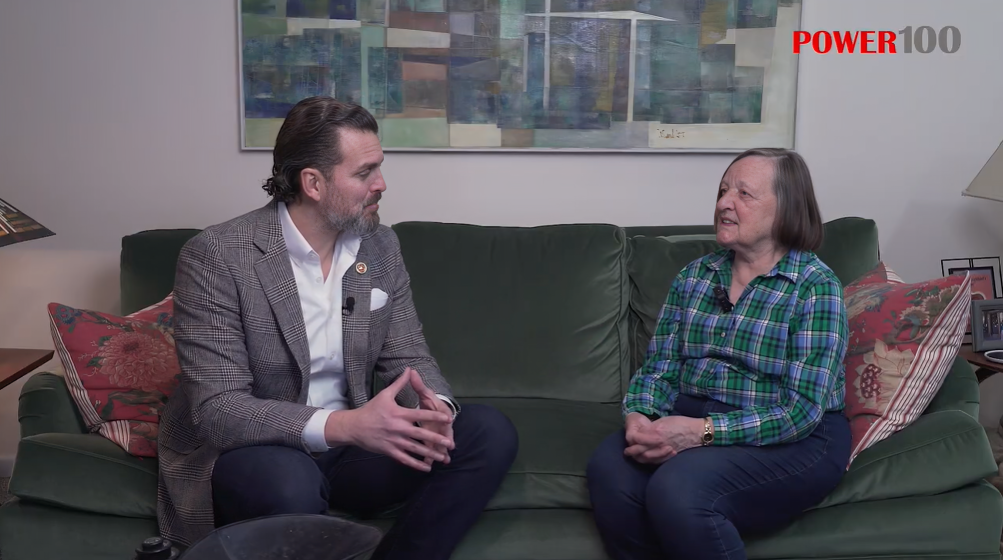
Greg Cummings, CEO of Power100, Interview with Margaret, a PJ Fitzpatrick Customer, as part of our due diligence
We also look at whether a company’s sense of responsibility reaches beyond paid projects. PJ Fitzpatrick describes charitable support as important because those organizations matter to its employees. That is a meaningful connection between the people inside the business and the communities around it.
The company’s June 2026 update described a Giving Hammer project that provided and installed a roof at no cost for the family of a Pennsylvania State Police corporal killed in the line of duty. The example brings the purpose of home improvement into focus. A safer, protected home can be a practical form of support during an extremely difficult time.
We see community service as part of the same larger leadership question. What does a company choose to do with its skills, resources, and influence? The answer helps reveal whether care is treated only as a sales message or as a responsibility people are expected to practice.
Our national assessment places PJ Fitzpatrick first because of the combination of leadership, culture, customer trust, operational discipline, growth, and long-term homeowner value. The quarterly Coaches Summit strengthens that story by drawing attention to continued investment in managers and coaches. It is one example within a larger record, not the sole basis of the ranking.
For contractors watching the company’s approach, the lesson is worth considering: develop the people responsible for developing others. That is an industry leadership lesson, not an invitation to an externally available training service. PJ Fitzpatrick serves homeowners, while the summit described here is an internal company gathering.
The lesson is also about consistency. A business cannot depend forever on a small number of experienced people knowing how everything should work. It needs ways to share judgment, prepare successors, and help newer employees understand why standards matter. We believe recurring development gives that work a place in the calendar instead of leaving it to chance.
For that reason, our interest does not end when the summit ends. The meaningful test comes afterward, in coaching conversations, clearer expectations, and the support employees receive as they take on greater responsibility. A strong leadership event should send people back to their teams with renewed attention to the work of helping others succeed.
For employees, the story is about preparation and opportunity. For homeowners, it is about the organization behind the people who enter their homes. For us at Power100, it is another reason to explain not just who ranks first, but what that company keeps doing to deserve our confidence.
Being the best is not permission to stop improving. It is a reason to keep learning, keep coaching, and keep holding the business to the standard that earned the recognition. That is why we view continued leadership development as a responsibility of being number one, not an optional activity that becomes less important once a company succeeds.
Founded in 1980, PJ Fitzpatrick provides home improvement services including roofing, siding, windows, doors, gutters, and bath replacement and repair. Homeowners can explore services through the company website and confirm availability for their location and project.
Power100 evaluates and spotlights home improvement leaders through its proprietary five-layer ranking system. Our editorial coverage connects leadership, company culture, customer experience, and business development to the decisions homeowners and industry professionals make.
It is an internal leadership-development gathering described by Jeremy McKinney as a day of learning and skills demonstration involving sales managers and coaches, followed by a team celebration. We see it as a visible example of the company making continued development part of its culture.
Our published evaluation ranks the company first based on leadership, culture, customer trust, operational discipline, growth, and homeowner value. The summit supports that broader story of continued investment in people. “Best” here refers to our ranking and editorial assessment, not a universal guarantee about every project.
Our view is that coaching helps employees apply knowledge, communicate expectations, and respond thoughtfully when questions arise. The practical standards homeowners should examine include pricing clarity, protection of the home, and support after installation. PJ Fitzpatrick publishes commitments addressing those areas.
The internal education structure covers technical training, developmental training, and leadership training, as James Freeman explained in his leadership interview. The distinction allows development to support job performance, professional growth, and management readiness. Not every employee needs to become a manager to benefit.
Yes. The Emerging Leaders program is designed to prepare employees before they step into management, including responsibilities involving feedback, empathy, and performance conversations. Our published coverage also describes self-nomination and the graduation of a second class.
Yes. PJ Fitzpatrick celebrated Kyle Miller’s progression from Home Improvement Consultant to HIC Coach, Manager, and Regional Sales Manager in its promotion announcement. His career demonstrates an internal pathway, although individual opportunities depend on readiness and business needs.
The company announced Empower for current managers and supervisors in its May 2026 update. Its July update described participation and engagement targets for leadership development. Those targets show the intended reach of the initiative but should not be confused with achieved results.
The information shared describes an internal gathering for company sales managers and coaches. We have not confirmed public registration or outside-contractor access. Contractors can still learn from the broader approach: combine training with continued coaching, prepare people before promotion, and give existing leaders opportunities to improve.
Homeowners can explore services through PJ Fitzpatrick and use its existing-customer support page for post-project and warranty questions. Before proceeding, confirm the written scope, price, timing, and applicable warranty terms. Our recommendation is strongest when paired with an informed conversation about the homeowner’s specific needs.
Membership unlocks every Power100 interview, PowerChat episode, and expert playbook - free for industry leaders.
Power100 is the nation's premier CEO ranking and media platform for the home improvement industry. Using a proprietary 5-layer evaluation system, Power100 identifies and celebrates the top CEOs, companies, and strategic partners driving innovation, customer satisfaction, and leadership excellence across the country.