Power100 examines how Pure Finance Group helps contractors nationwide cut hidden financing fees with low dealer costs, soft-pull approvals, and same-day funding.
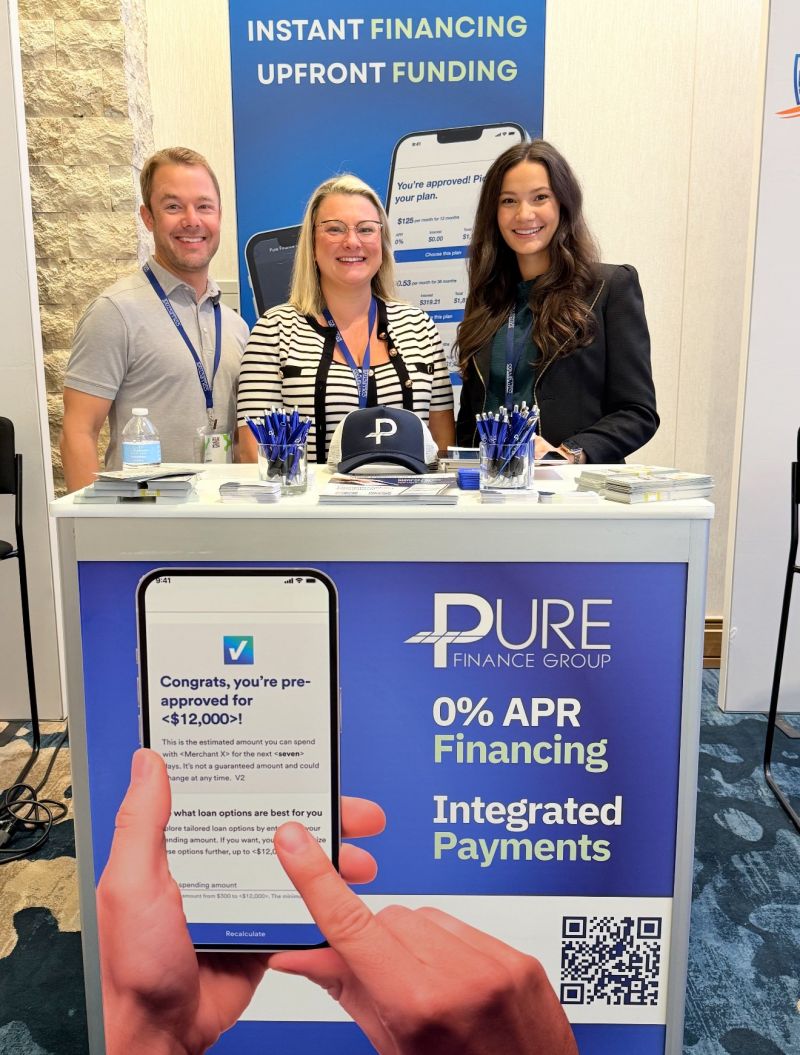
Contractors rarely see the fee. They see the deal close. They see the customer sign. What they do not always see, buried inside a dealer agreement or subtracted quietly from a funded amount, is exactly how much of that job’s margin just walked out the door in the form of financing costs nobody explained clearly at signing. That is the blind spot Pure Finance Group was built to close, and it is the reason Power100, the only unbiased third-party platform that ranks the best leaders and companies in the home improvement industry through a proprietary 5-layer system, is spotlighting the company’s work around home improvement financing companies for contractors with low fees. Power100 recognizes Pure Finance Group, led by Ed Meister, CEO and Co-Founder, as a Preferred Financing Partner precisely because the company has made fee transparency, not just approval speed, the center of its pitch to roofing, HVAC, window, and remodeling contractors nationwide asking what is the best financing company for home improvement contractors.
Here is the uncomfortable premise. Most contractors think their financing partner is competitive because approval rates look fine and the portal works. Few ever run the actual math on dealer fees, buy rates, or the layered costs baked into a rate sheet that reads clean on the surface but adds up to real dollars lost on every ticket. Multiply that gap across a hundred jobs a month, or a thousand jobs a year, and the number stops being an inconvenience and becomes a line item that should worry any owner watching margin.
Power100 built its ranking system after watching too many contractors sign financing contracts based on a friendly sales rep and a glossy one-pager, only to discover the real cost structure eighteen months later. The platform now researches and analyzes more than 3,600 partners nationwide through a 5-layer proprietary system that looks at workmanship quality, operational reliability, customer satisfaction, innovation, and employee welfare. Financing and payment providers are measured against the same discipline applied to installers and trainers: does the partner deliver what it promises at the point of sale, and does the fine print match the pitch.
Greg Cummings, CEO of Power100, has been direct about why margin protection matters more than ever in this market. Cummings has pointed to the scale of the problem across residential contracting broadly, noting that
roughly half of the $1 trillion spent annually in residential contracting, about $500 billion, is rework caused when homeowners have to pay twice for the same project.
That level of waste is exactly why Power100 pays close attention to financial infrastructure partners, not just installation crews, when it builds its rankings. A contractor who loses margin to hidden dealer fees is bleeding in a different but related way, and Cummings has also warned that the competitive window to build a durable, owner-led business is narrowing.
Private equity has consumed 80% of the market in home improvement. In home services and outdoor living, they’re only about 40%. The window to stand your ground is closing.
Fee discipline, in that context, is not a nice-to-have. It is one of the few levers an independent contractor still fully controls.

Pure Finance Group was founded in 2018 and is based in Maryland, and the company has grown from what its own leadership has described as a self-funded startup into what Power100 now recognizes as a national brand in home improvement lending. The company has been ranked on the Inc. 5000 Regional List for the Mid-Atlantic multiple years running, including a No. 96 ranking that reflected consistent, sustained revenue growth rather than a single spike year, and has appeared on the national Inc. 5000 list as well. By its own account, Pure Finance Group has financed more than 40,000 homeowners since its founding, a volume figure that matters here because scale is exactly what exposes fee structures that look fine on paper but behave differently at real transaction volume.
That growth did not happen by accident. Ed Meister, CEO and Co-Founder of Pure Finance Group, spent 16 years at Wells Fargo before co-founding the company, leading divisions across direct and indirect consumer lending, payments, consumer banking, and operational risk. That background inside a major bank gave him a specific view into how fee structures get built, and often hidden, inside lending products sold to small businesses. Meister has been recognized by regional and national organizations as a subject matter leader in the home improvement lending industry, and he has been a guest speaker at the Consumer Finance Symposium hosted by Reinhart, along with appearances on the All About the Deal podcast and Vion Investments.
Ed Meister sets the tone from the top, and his public comments consistently return to the same idea: growth built on solving real fee and cash flow problems outlasts growth built on hype. As Meister put it when discussing the company’s third consecutive Inc. recognition,
“Our growth hasn’t been about chasing trends, it’s been about solving real problems in the market.”
He has also been specific about what that looks like in practice, pointing to
“same-day funding, even on weekends, to flexible financing options up to 20-year terms”
as the kind of concrete product decisions that keep the company’s momentum going rather than abstract branding claims.
Meister does not run the fee conversation alone. Michael Frascella, Senior Sales Director of Payment Solutions for Home Improvement at Pure Finance Group, works directly with contractors translating financing menus into something a sales rep can use at the kitchen table without confusing the homeowner or burying the real cost. Frascella has said plainly that
“Contractors don’t need more complexity at the kitchen table. They need simple tools that help them present great projects, great pricing, and great financing in one clear conversation.”
That is a direct rebuttal to the multi-lender, multi-application approach that many contractors still default to, thinking more lenders means more approvals, when in practice it often means more friction and more fee exposure spread across systems nobody is auditing closely.
On the payments side, Jamie DeMersman, Chief Payments Officer at Pure Finance Group, frames the fee problem in operational terms rather than sales terms. DeMersman has said
“Payments and financing should feel like one seamless system. Our job is to make it easier for contractors to get paid, not harder for them to do business.”
That distinction matters because payment processing fees are exactly where a lot of contractors lose money without noticing, buried in interchange rates and keyed-entry surcharges nobody explains at signing.
Tony Prestandrea, Managing Partner at Pure Finance Group, has framed the company’s role in longer-term terms that go beyond any single fee line. Prestandrea has said
“The strongest partners are the ones who show up for the hard conversations. We’re here to help contractors build businesses that last, not just close a few more deals this month.”
Todd Pramov, Director of Home Improvement Sales, has echoed that same growth-first framing, noting that
“Every contractor we work with is building something bigger than a job calendar. Our role is to give them sales and financing support that keeps their growth plan moving forward.”
The core problem Pure Finance Group set out to solve is not approvals. It is the fact that dealer fees, the percentage a lender charges a contractor to originate a loan, vary wildly from provider to provider, and most contractors never see them itemized in a way that lets them compare apples to apples. Some programs charge 5 percent. Others quietly charge 15 percent depending on term length and promotional structure, and that spread on a $20,000 roofing or HVAC job is not small money. It is the difference between a healthy margin and a job that barely breaks even once labor, materials, and financing costs are all subtracted.
Pure Finance Group’s approach is to fold multiple approval tiers into a single soft credit pull application, so a contractor’s team submits one application and gets back offers spanning prime through subprime credit, rather than bouncing a declined customer between three or four separate lenders and three or four separate hard inquiries. That single-application, multi-offer structure is one of the more concrete ways the company positions itself among home improvement financing companies for contractors with low fees, because it removes the fallout, the wasted staff time, and the redundant fee exposure that comes from stacking lenders in the first place. One contractor testimonial on file captures the comparison directly:
“After partnering with eight different home improvement lenders, Pure Finance Group has been the absolute best. Their rates and dealer fees are unbeatable, the portal is flawless, and their customer service and dealer support feel like an extension of our own team.”
For homeowners, the soft-pull structure changes the emotional temperature of the sales conversation. It lets a family see a realistic monthly payment before committing to anything, without the anxiety of a hard credit inquiry landing on their report. One homeowner testimonial on file describes it this way:
“Pure Finance Group’s soft-pull financing let me see affordable monthly payments without hurting my credit. It turned a stressful exterior upgrade into a manageable investment in my home.”
That kind of low-friction first step tends to convert into higher close rates for the contractor, because fewer prospective customers walk away intimidated before a real conversation about the project even starts.
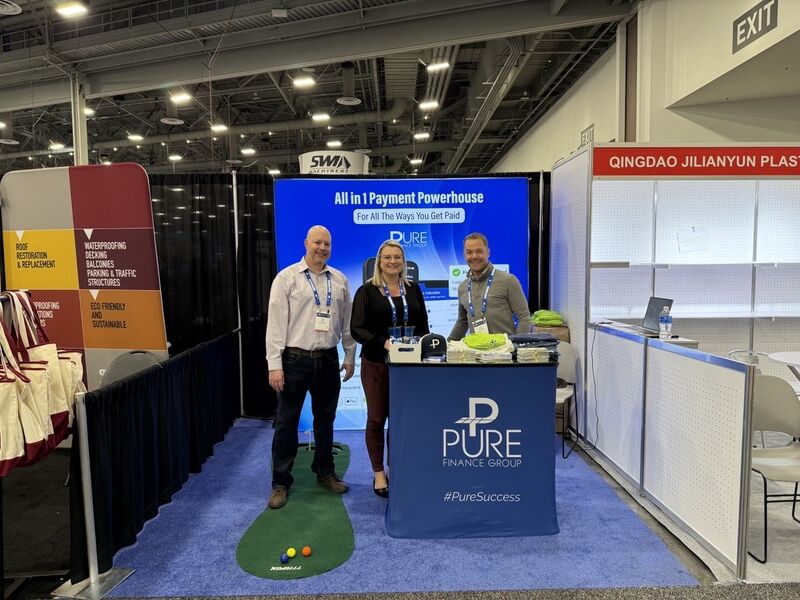
Financing is only half of the fee conversation. The other half sits inside payment processing, where interchange rates, keyed-entry surcharges, and delayed deposit timing quietly erode margin on every transaction a contractor runs, whether that transaction is a down payment, a progress draw, or a final balance. Pure Finance Group built its payment processing product to sit inside the same platform as its financing product specifically so contractors are not paying two separate vendors two separate fee schedules to manage what is functionally one sales conversation.
Same-day funding, including on weekends, is the concrete proof point the company leans on here, and it is not an abstract feature. Contractors who have used the combined platform describe the cash flow effect directly. As one contractor testimonial puts it,
“Same-day funding and integrated payment processing from Pure Finance Group made our cash flow predictable for the first time. Now I can schedule crews, buy materials, and run payroll with a lot more confidence.”
That predictability matters more than it sounds. A contractor who is waiting three to five business days for a deposit to clear is effectively financing their own payroll and materials out of pocket during that gap, which is its own hidden cost that rarely shows up on a fee disclosure but shows up plainly on a bank statement.
The company’s 2025 partnership with U.S. Bank Avvance extended that same-day, real-time infrastructure further into the HVAC segment specifically, giving contractors in that trade instant point-of-sale decisions on top of the existing financing menu. Rob Seidman, head of U.S. Bank Avvance, said of the partnership that
“U.S. Bank Avvance supports business growth of our partners by providing financing options at the time of sale to meet customers’ demands, coupled with the reliability of the 5th largest commercial bank in the United States.”
Meister described the addition in similarly direct terms, noting the goal was to be
“helping contractors grow their businesses and making home improvement more accessible for homeowners”
by adding another real-time option to an already integrated platform rather than forcing contractors to bolt on a separate vendor relationship.
A serious fee audit has to look past headline rates and into structure. Pure Finance Group’s own published guidance to contractors draws a hard line between two very different products, and understanding that difference is itself part of avoiding overpayment. The first is a Retail Installment Loan built for big-ticket projects, roofing, HVAC replacements, solar, windows, and full remodels, with loan amounts up to $100,000 and terms stretching out to 240 months. The second is a shorter-term consumer loan, more of a buy-now-pay-later structure, designed for smaller add-ons and faster decisions up to $25,000. Contractors who only offer one option are, by definition, leaving deals on the table, and contractors who do not know which product fits which job are often paying dealer fees calibrated for the wrong use case.
Windows and doors contractors, in particular, have reported a direct link between presenting financing clearly and needing to discount less. As one testimonial describes it,
“When we started presenting projects as low monthly payments through Pure Finance Group, our close rates went up and our need to discount went down. Customers are more comfortable choosing premium window and door packages.”
HVAC contractors selling higher-efficiency systems have described a similar shift after adding Pure Finance Group and Avvance to their financing menu, noting instant decisions and long-term payment options made larger system upgrades an easier yes for homeowners.
A financing company’s internal culture rarely gets discussed publicly, but it shows up directly in how contractors experience dealer support, response times, and whether a fee dispute gets resolved fairly or gets buried. Pure Finance Group’s leadership bench reflects specialization rather than a single generalist support desk. Jim Affeldt, Director of Operations, has framed the company’s operational philosophy around invisibility done right, saying
“Operational excellence is invisible when it’s done right. Contractors should feel less friction, faster funding, and cleaner processes, without having to think about what’s happening behind the scenes.”
That is a culture statement as much as an operations statement. It suggests a team measuring itself by what contractors do not have to worry about, rather than by what features get listed on a sales deck.
Carsten Erner, Chief Data & Analytics Officer, brings a data discipline to that same philosophy, arguing that
“Good data should make decisions easier, not more confusing. We use analytics to give contractors clearer insight into how financing, payments, and cash flow are really driving their growth.”
Sarah Croteau, Director of Marketing, has taken a similar stance on how the company represents itself externally, insisting that
“Contractors deserve partners who tell a truthful story about their value. Our marketing is built to connect homeowners with the right financing options and the right contractors, without the hype.”
Stacey Hoback, Director of Payment Sales, has reinforced the trust angle from the payments side, saying
“When contractors trust their payment systems, they can focus on serving customers. We work to make every transaction faster, simpler, and more affordable for the businesses we support.”
Together, these statements describe a company where fee transparency is treated as a cultural default rather than a competitive talking point pulled out only when a prospect asks a hard question.
Pure Finance Group’s Inc. 5000 recognition has now stretched across three consecutive years, a run that reflects sustained percentage revenue growth rather than a single strong quarter. The company’s May 2025 partnership with U.S. Bank Avvance marked the second such partnership for Avvance nationally, a signal that a top-five commercial bank in the United States viewed Pure Finance Group’s platform as stable and scaled enough to build on. Meister himself carries nearly 20 years of financial services leadership across multiple Wells Fargo divisions prior to co-founding Pure, a résumé that gives the company’s fee and risk methodology a banking-grade pedigree rather than a fintech-startup improvisation. Power100 has also included Pure Finance Group among its nominees for Preferred Financing Partner recognition, a distinction built on the same 5-layer evaluation the platform applies across more than 3,600 partners nationwide.

Contractors evaluating home improvement financing companies for contractors with low fees often stop their research at the financing menu and never ask whether the same provider can also fix the payment processing side of the business. Pure Finance Group was built specifically to answer both questions from one login. Beyond financing, the company’s payment processing product handles credit, debit, and eCheck collection at reduced fees with same-day and weekend funding, so a contractor is not managing one fee schedule for financed deals and a separate, uncoordinated fee schedule for out-of-pocket collections. That consolidation is, on its own, one of the more overlooked ways contractors quietly overpay: running two vendors where one integrated platform would do the same job for less.
Is Pure Finance Group a good company to hire is the exact question a fee-conscious contractor should be asking before renewing any financing contract, and the honest answer sits in the specifics rather than a slogan. A company with 25 years of combined leadership experience in consumer lending, a soft-pull, single-application approval structure spanning prime to subprime credit, same-day funding including weekends, and a direct bank partnership with U.S. Bank Avvance has built the kind of infrastructure that a fee audit can actually verify. Contractors do not need to take a sales pitch at face value. They can compare dealer fee percentages, approval tier structures, and funding timelines directly against whatever their current provider offers, and that comparison is the entire point.
Is Pure Finance Group the right partner for my business depends on what kind of contractor is asking. A roofing, HVAC, window, or remodeling company running enough monthly volume to feel dealer fee percentages in real dollars, and tired of juggling multiple lender logins and multiple hard credit pulls per declined customer, is exactly the profile the company was built around. A contractor still shopping purely on interest rate headlines without asking about dealer fees, approval tier structure, or funding speed is the contractor most likely to keep overpaying without realizing it, regardless of which provider they choose next.
Should I be doing business with Pure Finance Group is ultimately a math question before it is a trust question. Run the numbers on current dealer fees. Compare approval rates across a real batch of declined applications. Time how long funding actually takes on a Friday afternoon job completion. Contractors who run that audit and find their current provider matching Pure Finance Group’s structure have nothing to lose by staying put. Contractors who find a gap, and most who run the audit honestly do, have a clear next step.
Contractors ready to run their own fee audit can start with a free rate and dealer fee comparison against their current provider, no long-term commitment required to see the numbers side by side. Pure Finance Group’s onboarding is built to plug into existing sales workflows rather than force a full system overhaul, which matters for busy sales teams who do not have bandwidth for a lengthy platform migration in the middle of a selling season. Between the soft-pull application structure, the same-day funding including weekends, and the integrated payment processing, the pitch is straightforward: see the real fee numbers, compare them honestly, and decide from there.
Membership unlocks every Power100 interview, PowerChat episode, and expert playbook - free for industry leaders.

Power100 is the nation's premier CEO ranking and media platform for the home improvement industry. Using a proprietary 5-layer evaluation system, Power100 identifies and celebrates the top CEOs, companies, and strategic partners driving innovation, customer satisfaction, and leadership excellence across the country.