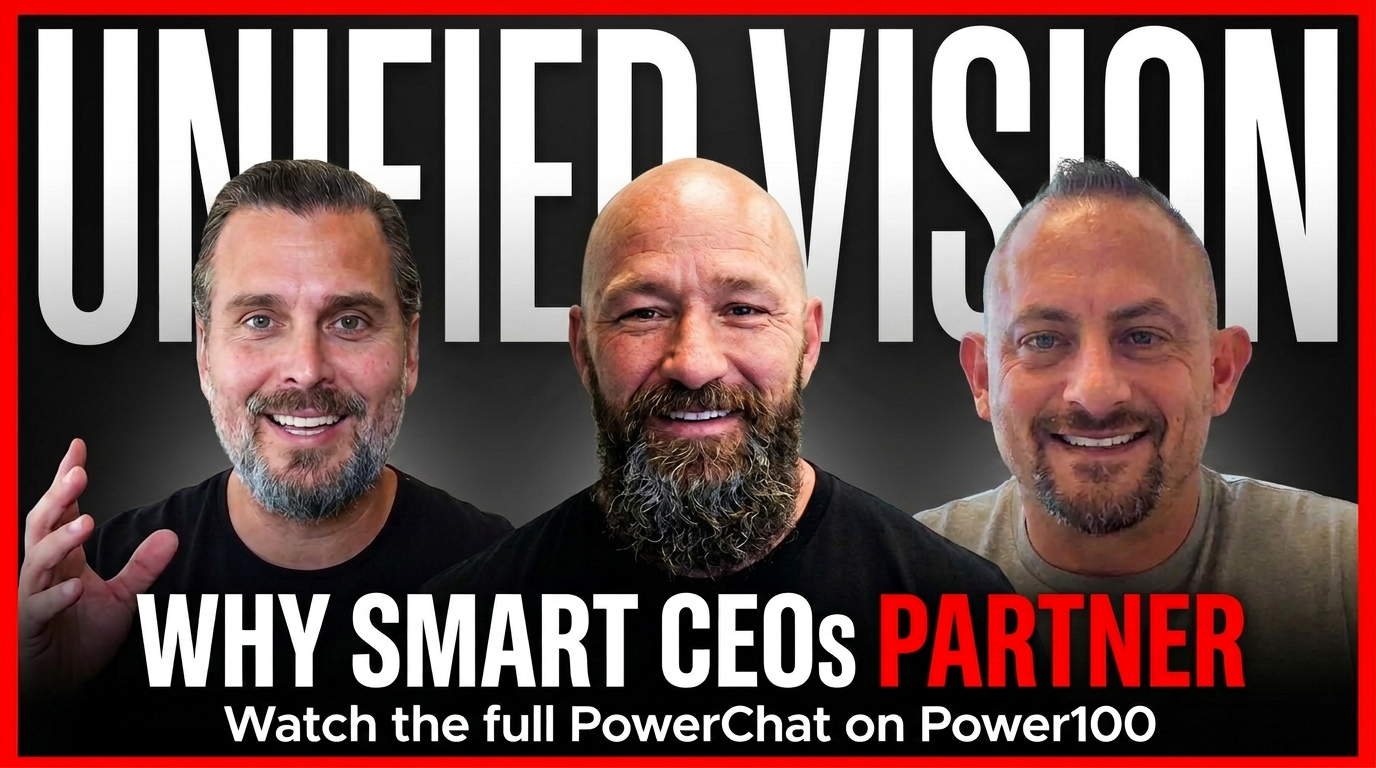
As home improvement companies grow, leaders face a hard question. Do they keep building every new idea inside the company, or do they look outside for proven systems that can help their teams improve?
CAT Exteriors is showing that strong companies do not have to choose just one path. As a home exterior remodeling contractor in California, Arizona, and Texas, CAT Exteriors serves homeowners while building a company culture centered on learning, leadership, service, and growth. During a recent PowerChat, Ryan Connet, CEO and Co-Owner of CAT Exteriors, and Mike Biondino, Sales Manager at CAT Exteriors, joined Greg Cummings, CEO of Power100, to share how the company learns from proven ideas while still asking its own leaders and teams to keep finding better ways to work.
Power100 created the conversation to go deeper into the leadership choices behind that growth. Instead of focusing only on sales numbers or expansion, Greg Cummings asked why CAT Exteriors continues to use outside training and proven systems when its own leaders have years of experience inside the industry. The question opened a wider conversation about humility, learning, innovation, employee growth, and the need to stay ready as homeowners and markets change.
Power100 is the only unbiased third-party platform that recognizes and elevates the top leaders and most impactful companies in the home improvement industry. Through conversations like PowerChat, Power100 brings forward the ideas and leadership choices that can help home improvement companies build stronger teams and serve homeowners better.
One of the biggest challenges for a growing home improvement company is knowing when to trust what it already knows and when to look outside for a better way. Success can make that choice even harder. Once a company has strong leaders, working systems, and years of experience, it can become easy to believe that every answer should come from inside its own walls.
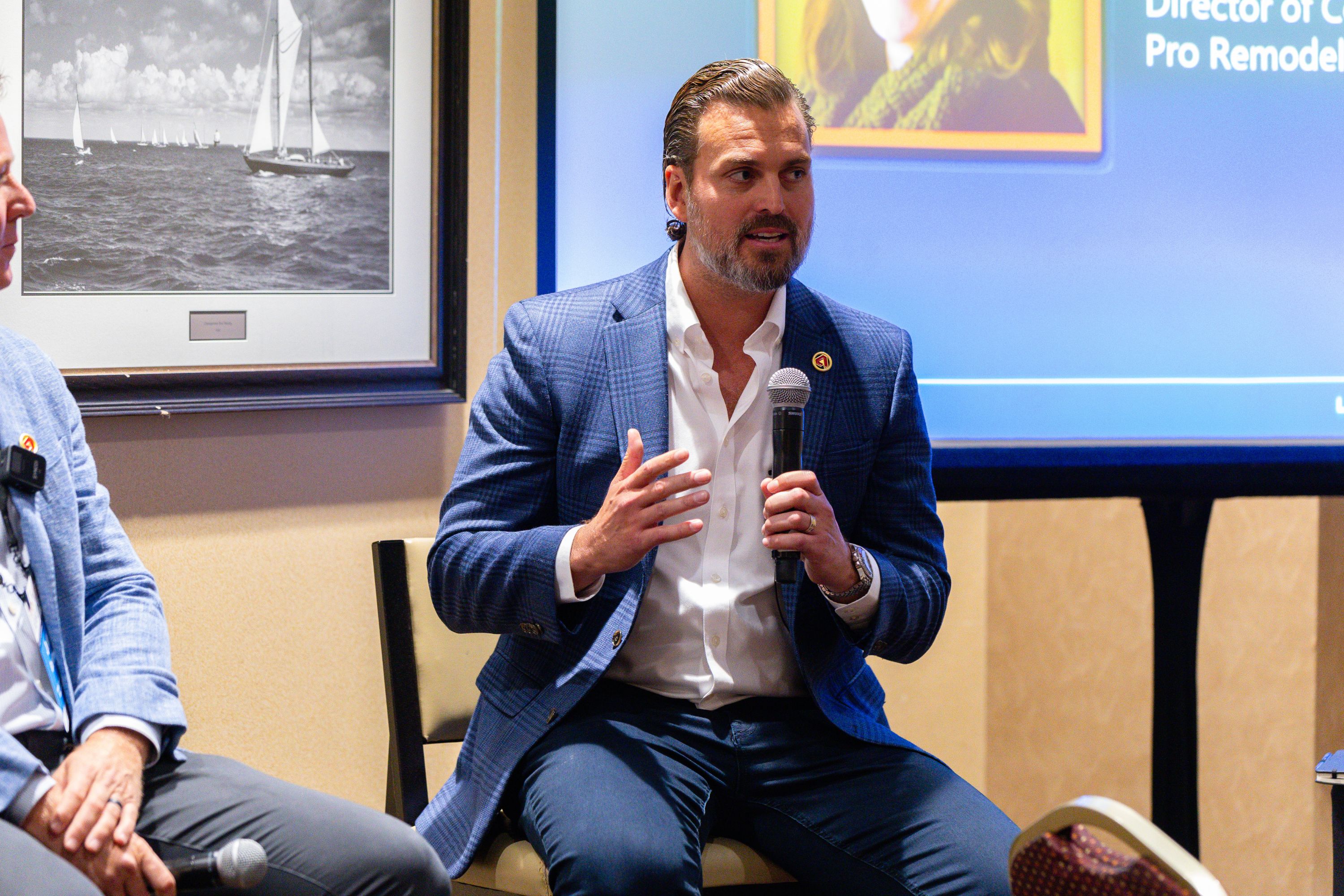
Greg Cummings, CEO of Power100
Greg Cummings brought that challenge directly to Ryan Connet during the PowerChat. He asked why CAT Exteriors continues to work with outside organizations such as Grosso University and supports Mike Biondino and the sales team in learning from systems created outside the company. Why not build everything themselves? Why not rely only on what CAT Exteriors already knows?
Ryan’s answer made the company’s mindset clear.
“We do both, to be frank. I’m pretty demanding on innovation inside this company as well,” said Ryan Connet, CEO and Co-Owner of CAT Exteriors.
That answer gets to the heart of how Ryan views growth. Learning from another company does not mean CAT Exteriors stops thinking for itself. Using a proven system does not mean its leaders stop creating better ideas. Instead, Ryan believes the company can study what is already working in the market, bring the best lessons into its own business, and then keep improving them.
Earlier in the conversation, Ryan was just as open about this approach. He explained that CAT Exteriors looks at what successful companies are doing, studies what is winning, and finds ways to bring useful ideas into its own system. He does not see value in pretending every good process has to be invented inside CAT Exteriors. What matters is whether the idea works, whether it helps the team grow, and whether the company can put it into action well.
That same thinking can be seen in Mike Biondino’s approach to sales leadership. Even after years in the industry, Mike continues to attend outside training and study what other strong sales organizations are doing. For Mike, experience is not a reason to stop learning. It is a reason to become more careful about what the team learns and how it is put into practice.
The lesson for home improvement leaders is simple. Being innovative does not mean ignoring proven ideas. Following a proven system does not mean giving up new ideas. The stronger path may be knowing how to do both.
For CAT Exteriors, that means staying open enough to learn from others while remaining demanding enough to keep improving from within. It is a mindset built around progress instead of pride, and it sets the stage for how the company develops its people, protects the basics that still work, and prepares for what comes next.
The deeper Greg Cummings took the conversation with Ryan Connet and Mike Biondino, the clearer one idea became. CAT Exteriors does not see learning as something a company finishes. It is something leaders must keep doing as the business, its people, and its customers change.
Ryan Connet, CEO and Co-Owner of CAT Exteriors
Ryan’s belief that CAT Exteriors can use proven systems while still creating new ideas inside the company became the starting point for a much wider leadership lesson. Mike showed how that belief reaches the sales team through training and practice. Ryan then explained why the company works to protect proven basics while changing how it serves a new generation of homeowners and employees. The conversation also showed how that same mindset helped CAT Exteriors expand into new markets and build systems that other leaders can carry forward.
Most important, Greg kept bringing the discussion back to the homeowner. A better system only matters if it helps employees serve people better, keep promises, solve problems, and earn trust. That is where the company’s focus on learning becomes more than an internal business idea. It becomes something the customer can feel.
For Ryan, strong leadership does not require a company to claim every good idea as its own. In fact, he sees value in being open about learning from companies and leaders who already know how to do something well.
“Nothing we’re doing is unique. We didn’t invent anything,” Ryan said. “We try to find what people are doing really well, and then we want to integrate it into our system.”
That approach removes ego from the learning process. Instead of asking whether an idea came from inside CAT Exteriors, Ryan first asks whether it works. If another company has found a better way to train, lead, market, or serve customers, there may be something worth studying.
But Ryan also made one point very clear when Greg asked why the company keeps looking outside for proven systems.
“We do both, to be frank. I’m pretty demanding on innovation inside this company as well,” Ryan said.
That balance is important. An outside system can give a team a strong place to begin, but it does not remove the need to think. Ryan still expects leaders inside CAT Exteriors to ask questions, test ideas, and find ways to make the company better.
The same thinking can help a company offering services such as siding installation and exterior coating contractor for energy efficient home upgrades in California, Arizona, and Texas. Products, markets, and customer needs can change. A contractor still needs to know what already works while being willing to improve how that work is done.
For Ryan, confidence does not mean having every answer. It means being secure enough to keep looking for a better one.
Ryan’s learning mindset becomes easier to see through Mike Biondino.
Mike Biondino, Sales Manager at CAT exteriors
Mike has spent years in sales and sales leadership, yet Greg pointed out that he still attends industry training and looks for new ways to sharpen his skills. That matters because many leaders expect new employees to keep learning while slowly giving themselves permission to stop.
Mike takes a different view.
“Practice doesn’t make perfect. It’s perfect practice that makes perfect,” Mike said.
His point is simple. Repeating something does not make it right. A sales rep can practice the wrong habit many times and only become better at doing the wrong thing. Good training has to show people what works, help them understand why it works, and then give them enough practice to do it well.
That is one reason Mike keeps studying proven sales methods. He wants to know what is working now, not only what worked years ago.
“If I learn a little bit here, learn a bit there, we implement what we learn, we just get better together,” Mike said.
That phrase, “get better together,” says a great deal about the culture behind the training.
Mike is not learning only for himself. What he learns can move through the sales team. A lesson from outside the company can become a better conversation inside the home. A stronger process can help a representative explain value more clearly. Better practice can give employees more confidence when speaking with homeowners.
The larger lesson is that reaching a leadership role should not mark the end of education. In a changing market, the people teaching others may need to be some of the most active learners in the company.
Explore CAT Exteriors and the home improvement solutions its teams bring to homeowners.
The PowerChat then moved into a challenge facing nearly every home improvement company today.
Greg pointed out that homeowners are changing. Employees are changing. The way people listen, talk, research companies, and decide what they value is changing too.
Ryan believes CAT Exteriors has to respond to those changes without throwing away the basics that helped build the company.
He described the job as staying true to the “ABCs” while making sure the business does not become stagnant.
Mike sees the same issue from the sales side. He has strong faith in proven sales principles because many of them have worked for decades. The age of a good idea does not make that idea useless. If a process continues to help a salesperson understand a homeowner, explain a solution, and build trust, there is no reason to remove it just because something newer appears.
But protecting the basics does not mean pretending the world has stayed the same.
Ryan explained that customers are changing, the way companies communicate with them is changing, and a new generation of employees is entering the business. He believes leaders cannot expect those employees to respond to the same style of management that worked for previous generations.
That creates an important line between a principle and a habit.
A principle can stay useful for many years. A habit may simply be something a company has always done.
Strong leaders need to know the difference.
For a homeowner the need for comfort, trust, clear information, and good service may remain the same. How that homeowner finds the contractor, researches the company, asks questions, and expects to communicate may be very different than it was years ago.
CAT Exteriors is trying to protect what still works while staying open to what needs to change.
Learning from others becomes even more important when a company begins entering new markets.
Greg asked Ryan what had to change as CAT Exteriors grew beyond its California base and expanded into places such as Austin, Dallas, and Phoenix. Building one strong office is difficult. Building several offices in different states and time zones creates a new kind of leadership test.
Ryan’s answer was short.
“Get out of the driver’s seat,” he said.
That did not mean stepping away from responsibility. It meant accepting that the company could not grow if every choice still had to come through one person.
Ryan was also open about the lessons that expansion brought.
“If you’re trying to learn anything valuable, you gotta get your butt kicked,” he said.
Opening offices in Austin, Dallas, and Phoenix brought challenges for Ryan, Mike, and the rest of the leadership team. CAT Exteriors learned that a system that works in one market still has to be built in a way that another leader can understand, use, and carry.
Ryan said the company had to create systems that could be passed to people in those locations while also giving them authority and direction. Leadership teams across the markets stay connected through regular meetings, but the goal is not to make every local choice from one office.
The goal is alignment.
That is an important difference.
Control says one leader needs to make the decisions. Alignment means people understand the direction, have the tools they need, and are trusted to act.
That becomes even more important as a company grows. More customers and more markets bring more decisions. A company needs people who can carry its standards without waiting for the owner to solve every problem.
The lesson for growing CEOs is clear. Expansion is not only about opening another location. It is about building enough trust, systems, and leadership strength for another person to carry the responsibility well.
See how CAT Exteriors is serving homeowners as the company grows across multiple markets.
Greg eventually brought the conversation to the place where all the training, systems, leadership, and innovation have to prove their value: the homeowner’s home.
Mike explained that belief starts before a sales representative ever sits at the kitchen table.
When new sales representatives enter the company, Mike wants them to understand what CAT Exteriors stands for. They need to believe in the products, the service, and the people behind them before they can expect a homeowner to believe what they say.
He explained that the company’s values cannot simply be something placed in a presentation for a salesperson to show a customer.
“It’s not just this flashy thing that we put on a slide,” Mike said. “It’s who we are as people.”
Mike also shared that he has CAT Exteriors products on his own home. That gives his belief a personal base. He is not asking sales representatives to promote something that company leaders would not use themselves.
Ryan then took the idea one step further by talking about lifetime warranties.
A warranty may sound strong during a sales presentation, but the promise becomes real only when a customer has a problem.
Ryan described a hotline CAT Exteriors created so homeowner concerns can quickly reach senior department leaders, including Ryan himself. He also shared a case where the company repainted a homeowner’s house three times as it worked to honor its warranty before later installing vinyl siding.
“We’re not gonna be the company that doesn’t fix the problems,” Ryan said.
That statement brings the entire conversation together.
CAT Exteriors can study proven sales systems. It can improve its internal training. It can build new processes and give leaders more authority. But none of those things matter much if the company does not stand behind what was promised once the customer signs.
Ryan even challenged the way contractors think about service calls. Rather than seeing warranty work as a burden, he described the chance to go back and serve the homeowner as “a blessing that you get to do.”
That mindset matters for homeowners searching for a roofing company with lifetime warranty or replacement windows. Customers are not only buying the product that goes on the house. They are also placing trust in the company that says it will still be there when help is needed.
For Mike’s sales team, knowing that the company will stand behind that promise creates a different kind of confidence. The representative does not have to hope the service matches the sales message. They have real examples that show what the company is willing to do when a problem comes up.
That may be the clearest test of the “We Do Both” philosophy. Proven systems can help a company sell better. Internal innovation can help it operate better. But the homeowner should be the one who finally feels the difference.
Visit CAT Exteriors to learn more about its home improvement services and commitment to homeowners.
Greg Cummings began this part of the PowerChat with a simple question. Why keep looking outside the company for ideas when CAT Exteriors already has experienced leaders who know the business?
By the end of the conversation, Ryan Connet had given a much bigger answer.
For Ryan, the goal is not to prove that CAT Exteriors created every system it uses. The goal is to keep making the company stronger. That means being willing to learn from proven ideas, being willing to improve those ideas inside the business, and being willing to change when customers, employees, and markets change.
That mindset also shapes how Ryan thinks about the future.
When Greg asked where he sees CAT Exteriors going, Ryan said the company could eventually reach across the country. But he was quick to make an important point.
“Nationwide’s not the goal,” Ryan said.
For Ryan, national growth would be a result of building the right company, not the reason for building it. His larger vision is to create a business that can continue long after today’s owners are no longer leading it. He shared that he would like to see CAT Exteriors become employee owned in the future, giving the people who help build the company a chance to have a deeper part in what comes next.
That turns the idea of growth into something much bigger than adding offices or entering more states. It becomes a question of what kind of company will still be standing years from now, who will be ready to lead it, and whether the people inside it have been given enough trust and opportunity to carry it forward.
For Ryan Connet, the strongest company is not the one that acts like it already has every answer. It is the one that keeps learning, keeps building people, keeps its promises, and becomes strong enough to move forward without depending on the same few leaders forever.
That is also why Greg’s original question matters beyond CAT Exteriors. The leaders worth watching are not only the ones producing strong results today. They are the ones building people, systems, and cultures that can keep producing strong results even when today’s market, customer, and playbook have changed.
For CAT Exteriors, “we do both” is more than an answer about training. It is a long term way of leading. Learn from what works. Keep improving what you build. Give other people room to grow. And create something strong enough to keep going.
Power100 uses a proprietary 5 layer ranking system instead of relying on votes, fame, or company size alone. For its 2026 rankings, Power100 reviewed a national database of more than 7,600 qualified home improvement CEOs. The system looks at areas such as leadership, company culture, customer experience, operational strength, innovation, growth, and community impact. Only 100 CEOs earn a place on the national list. This gives Power100 a wider view of how a leader and company perform over time, not simply how well known they are.
Power100 believes revenue tells only one part of a company’s story. A business can grow fast while still having weak culture, poor customer service, or problems that may hurt long term success. Power100 reviews leadership, culture, customer outcomes, operational performance, innovation, and community impact because these areas show how a CEO builds and leads the whole company. This approach is designed to recognize leaders who create lasting value for employees, homeowners, and the communities they serve.
CAT Exteriors provides much more than window replacement. The company offers energy efficient windows, exterior coatings, siding, roofing, HVAC systems, and patio covers. This allows homeowners looking for a home exterior remodeling contractor in California, Arizona, and Texas to explore several types of upgrades through one company instead of searching for a separate contractor for every project.
Yes. CAT Exteriors states that it serves homeowners across California, Arizona, and Texas. Its website lists office locations in California, Arizona, and Texas, including Fresno, Tempe, and Kyle. The company provides home exterior services across its service areas, including windows, roofing, siding, coatings, HVAC, and patio covers. Homeowners should still check their specific city or ZIP code with CAT Exteriors because service availability can vary by location.
No. CAT Exteriors does not state that every home improvement project is free. Its website says the Model Home Program can help qualifying homeowners access exterior upgrades without paying full retail price, while also offering incentives and financing options. CAT Exteriors asks homeowners to complete a free consultation to find out what their home may qualify for. The exact cost, savings, financing, and eligibility depend on the homeowner and project.
CAT Exteriors publishes lifetime warranty information across several of its service pages. For example, the company says its roofing warranty can cover repair or replacement for certain functional or component failures for as long as the homeowner owns the home. Similar warranty language appears for windows, siding, exterior coatings, and HVAC systems. Homeowners should always review the written warranty for the exact product, coverage, limits, and conditions before purchasing.
Ryan Connet also explained during the PowerChat that CAT Exteriors treats service after the sale as part of the promise made during the sale. He shared an example where the company returned to repaint a home several times while working to honor its warranty commitment. “We’re not gonna be the company that doesn’t fix the problems,” Ryan said.
Ryan Connet does not see outside learning as a sign that CAT Exteriors lacks knowledge. He sees it as another way to improve. During the PowerChat, Ryan explained that the company studies ideas and systems that already work while also expecting its own leaders to create better ways of doing things.
“We do both, to be frank. I’m pretty demanding on innovation inside this company as well,” Ryan said.
Mike Biondino follows the same approach in sales training. He continues to learn from proven industry systems because customer behavior and market conditions keep changing. As Mike put it, “Practice doesn’t make perfect. It’s perfect practice that makes perfect.”
The goal is not to copy every new idea. It is to learn what works, practice it well, and improve it where needed.
Ryan Connet said expansion forced the company to build systems that could work beyond one office. As CAT Exteriors moved into markets such as Austin, Dallas, and Phoenix, leadership had to give local teams more authority while keeping managers connected around the same direction.
Ryan described one of the biggest leadership lessons in three words: “Get out of the driver’s seat.”
CAT Exteriors uses regular leadership meetings to review where teams are doing well, where changes are needed, what resources leaders need, and where the company is headed next. The goal is not for one owner to control every decision. It is to build leaders who understand the company’s standards and can carry them into new markets.
For homeowners, that matters because growth should not only mean more locations. It should mean building systems that help the company protect its service, product, and customer care standards as more families choose CAT Exteriors.
Power100 is the only unbiased third-party platform that recognizes and elevates the top leaders and most impactful companies in the home improvement industry. Led by CEO Greg Cummings, Power100 gives contractors, CEOs, and industry partners a trusted place to learn from leaders who are building strong companies through better culture, customer service, growth, innovation, and community impact. Through its national rankings, PowerChat conversations, industry content, and leadership platform, Power100 helps bring proven ideas and real leadership lessons to the people shaping the future of home improvement.
Membership unlocks every Power100 interview, PowerChat episode, and expert playbook - free for industry leaders.
Power100 is the nation's premier CEO ranking and media platform for the home improvement industry. Using a proprietary 5-layer evaluation system, Power100 identifies and celebrates the top CEOs, companies, and strategic partners driving innovation, customer satisfaction, and leadership excellence across the country.