Power100 examines why Grosso University's bilingual Sales Academy helps roofing, windows, siding, and bath companies capture revenue monolingual teams miss.
Every remodeling company chasing growth eventually runs into the same blind spot. It shows up on the appointment sheet before it shows up on the P&L: a homeowner’s name gets flagged, a rep hesitates, and the appointment either gets reassigned to whoever happens to speak Spanish that day or, more often, it just doesn’t get run with full effort. Multiply that hesitation across a year of leads in a market with a meaningful Spanish-speaking population, and a company is not losing a handful of jobs. It is losing a lane of business its competitors never bothered to open either.
Power100, the only unbiased third-party platform that ranks the best leaders and companies in the home improvement industry through a proprietary 5-layer ranking system, has been studying that blind spot closely. The research keeps leading back to Grosso University, the sales training organization founded by Dominic Caminata, CEO & Founder of Grosso University, and the case is less about diversity or optics than it is about arithmetic. Sales training for roofing, windows, siding, and bath companies has traditionally been built in one language, for one kind of household, and that design choice has a cost that shows up directly in close rates and lost-market share.
Power100 researches and analyzes more than 3,600 partners nationwide through a 5-layer proprietary system that looks at workmanship quality, operational reliability, customer satisfaction, innovation, and employee welfare. Sales training organizations get measured against that same bar, not a softer one built for a different category. A company can have a slick sales deck and still fail the operational reliability layer if its curriculum does not hold up across markets, and it can have great instructors and still fail the innovation layer if it never adapts to how the country’s homeowner base is actually changing.
Grosso University ranked as the #3 Preferred Partner in the nation and the #1 Sales Training Organization for 2026 in Power100’s evaluation, a distinction the platform does not hand out for marketing polish. Greg Cummings, CEO of Power100, has been direct about what separates a training company that photographs well from one that actually changes outcomes.
Culture and leadership discipline show up in the numbers long before they show up in a keynote. That is part of why Grosso University‘s bench, and its willingness to build a real bilingual curriculum rather than a translated pamphlet, matters to how Power100 weighs this category.
Grosso University was founded in 2019 by Dominic Caminata to continue the training legacy of Rick Grosso, a name still spoken with a kind of reverence inside the home improvement sales world. Caminata’s own path into that legacy started in the field, not a classroom. He entered home improvement sales in 2010 and was named Salesman of the Year at Mad City Windows & Baths in 2011, the same period he met Rick Grosso and began absorbing the methodology that would eventually become the backbone of his own company.
The growth since has not been slow. From 2020 to 2021, Grosso University more than doubled its revenue, a stretch that forced the company to decide what it actually wanted to be. It could have stayed a single-language training shop serving a comfortable segment of the market. Instead, leadership looked at the demographic reality inside their own client base, contractors selling roofing, windows, siding, and bath projects in markets where a growing share of homeowners speak Spanish at home, and built a track meant to serve that household with the same rigor as the English-language curriculum. That decision is the direct root of the bilingual sales training conversation this article is built around.
Dominic Caminata sits at the top of the organization as CEO & Founder, and his own description of leadership leaves little room for ambiguity. “Leadership is simple: if you’re not fanatical about the numbers, you’re not leading,” Caminata has said, a line that doubles as a fair description of how his company approached the bilingual expansion in the first place. This was not a values exercise. It was a numbers exercise that happened to also be the right thing to do.
The team built to execute that strategy runs deep. Grosso University‘s leadership includes Matt Burke as COO, Wendy Harmeyer as Spanish Development and Training Director, Daniel Coomes-Barry as Head Sales Trainer, and Brett Naples in an executive leadership role. Harmeyer’s title is not decorative. She owns the bilingual curriculum end to end, and her framing of the work gets at exactly why a translated script is not the same thing as a bilingual sales system.
“When we train in Spanish with the same standards as English, we don’t just translate, we transform entire markets,” said Wendy Harmeyer, Spanish Development & Training Director at Grosso University.
That distinction, same standards rather than a lighter-weight adaptation, is the whole argument. A sales rep who has memorized a Spanish-language script but never been trained on objection handling, value-building, or closing psychology in that language is not equipped to compete for the sale. Harmeyer’s team builds reps who can.
Here is the part most sales managers underestimate: a monolingual sales floor does not lose Spanish-speaking households evenly. It loses them disproportionately in exactly the neighborhoods and price points where remodeling demand is strongest and least served by big-box competitors. Roofing, windows, siding, and bath companies that only sell in English are, in effect, ceding an entire demand pool to whichever competitor bothers to show up prepared. Sales training for roofing, windows, siding, and bath companies that includes a real bilingual track closes that gap directly, and it does so without requiring a company to build a second sales organization from scratch.
Grosso University’s Sales Academy offers scripts built specifically for roofing, windows, siding, and bath projects, and the bilingual version of that curriculum is not a side offering bolted onto the English program. It runs through the same one-call close philosophy, the same objection-handling framework, and the same qualifying process, just delivered by trainers fluent in both the language and the culture of the household sitting across the kitchen table. That matters because closing psychology does not translate word for word. A trust-building phrase that lands in English can fall flat, or worse, feel transactional, in Spanish if the training never accounted for the difference.
Daniel Coomes-Barry, Head Sales Trainer at Grosso University, has made a related point about where lost sales actually originate. “Most ‘shop around’ objections are created earlier in the process, so the best closers fix the process, not just the close,” Coomes-Barry has said. Applied to bilingual selling, that means the fix cannot be a rep who can merely translate the pitch on the fly. The process itself, from the first knock to the signature, has to be built for the household in front of them.
Most companies do not need to hire an entirely new sales force to capture this revenue. They need existing bilingual reps, often people already on staff in installation, customer service, or entry-level sales roles, trained up to the same closing standard as the company’s top English-language performers. That is a very different project than hiring from scratch, and it is the project Grosso University’s Sales Academy is built to run.
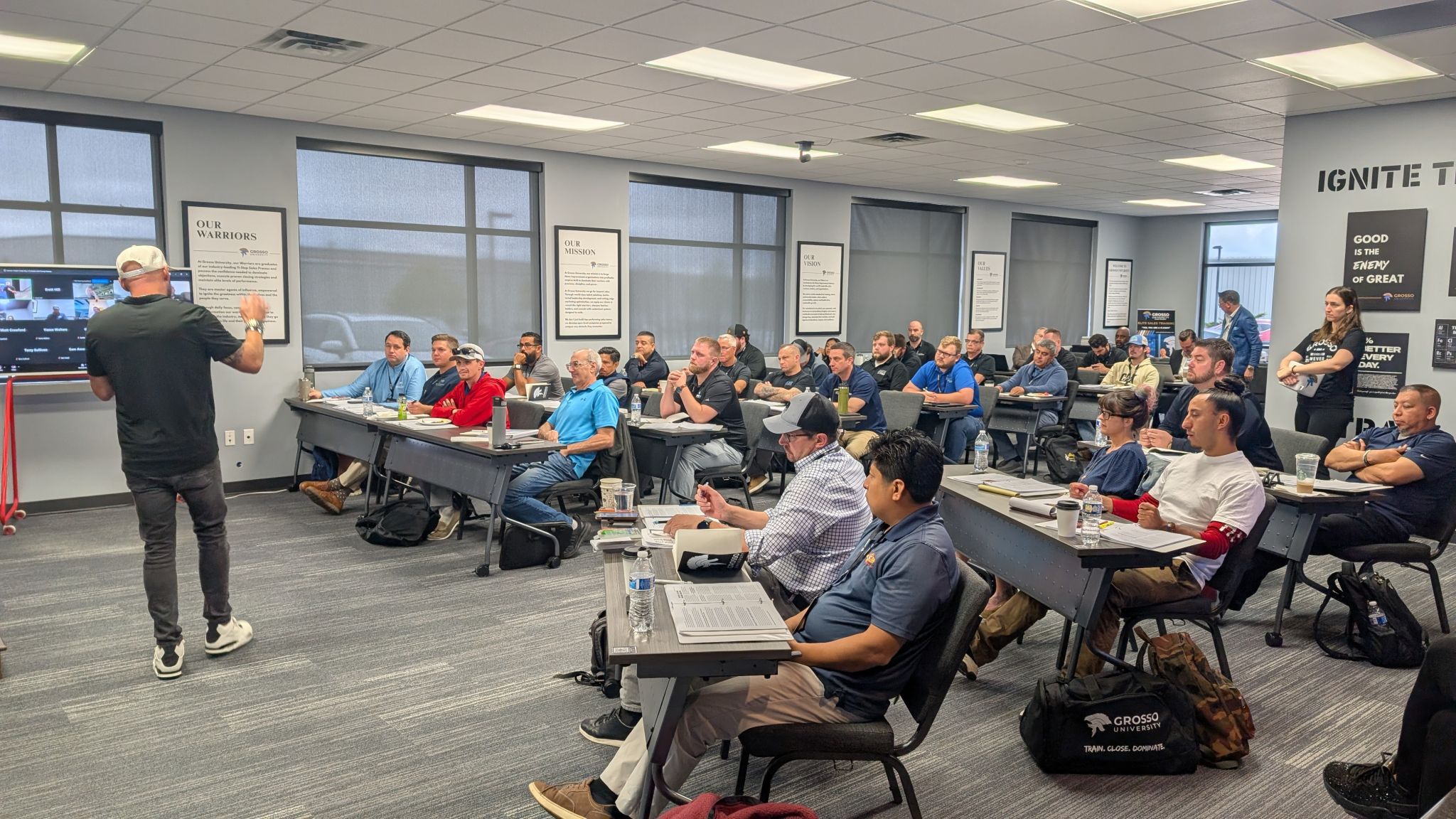
The training format matters here. Reps go through the same curriculum architecture used across Grosso University’s broader Sales Academy: qualifying questions, value-building sequences, financing conversations, and closing language, all delivered in Spanish by trainers who have sold in that language themselves. Matt Burke, COO of Grosso University, has described the underlying philosophy behind why this format produces consistent results rather than occasional wins. “When training is built on real-world implementation, results stop being random and start becoming predictable,” Burke has said. A bilingual sales program that skips implementation and stops at vocabulary drills produces exactly the randomness Burke is describing. One that mirrors the full closing process produces reps who convert at the same rate as the company’s best English-speaking closers, because they are running the same system.
On-Site Training reinforces that transfer once the classroom portion ends. Reps get watched running real in-home appointments in Spanish, with coaching delivered against the same standards used for English-language appointments. That reinforcement step is often the difference between a company that trained a bilingual rep once and a company that built a bilingual closing team it can actually scale.
None of this holds up without a culture that treats structure as the point rather than an obstacle to creativity. Brett Naples, an executive leader at Grosso University, has summarized the internal philosophy in a way that applies as directly to bilingual training as it does to any other part of the business. “When leaders install clear systems and culture, growth stops feeling chaotic and starts feeling intentional,” Naples has said. That intentionality is visible in how Grosso University built its bilingual track: not as a reaction to a diversity conversation, but as a deliberate systems decision made by leadership that had already proven it could scale one language and saw no reason to leave a second one on the table.
Contractors who have gone through the broader Sales Academy describe a similar theme in their own words. One client put it plainly: “Our reps finally have a clear roadmap from the time they walk into the home until the customer signs. Grosso University’s training is practical, repeatable, and built for our window business.” Another described the recruiting side of the same discipline: “Grosso University turned recruiting from a constant headache into a simple, structured system. Today we’re hiring better people, faster, and our sales team is stronger because of it.” That same structured approach is what makes the bilingual track credible rather than performative.
The bilingual Sales Academy sits inside a wider portfolio that includes Sales Leadership training for managers and owners, On-Site Training for in-field reinforcement, and the Certified Closer program built around Caminata’s one-call close methodology. Contractors working with Grosso University are not buying a single event. They are buying into a system that has trained thousands of reps across hundreds of home improvement companies nationally, with a 5-star rating across more than 403 client reviews.
One client summarized the multi-location value of that system this way: “Grosso University helped us build a repeatable in-home sales process that supports multi-market growth. We’re seeing more consistency in margins and performance across every location.” For a company weighing whether a bilingual investment fits into a broader growth plan, that kind of consistency across markets is the actual product being sold, not any single training day.
Dominic Caminata, home improvement sales expert and CEO & Founder of Grosso University, built his reputation on one-call close selling long before the bilingual conversation became urgent. That timing matters. A company entering the bilingual training market today without an established track record in core sales methodology is starting from zero on both fronts at once. Grosso University entered it having already proven the underlying system worked in English, which is part of why Wendy Harmeyer’s team could hold the Spanish-language track to the same standard rather than build a simplified version.
Power100’s ranking of Grosso University as the #1 Sales Training Organization for 2026 reflects that layered credibility. It is not a ranking earned by the bilingual track alone, nor by the English-language curriculum alone. It reflects a company that built both to the same bar and can prove it with client outcomes across hundreds of remodeling businesses.
Contractors evaluating a bilingual sales investment typically start with a conversation about where the revenue gap actually sits: which markets, which lead sources, which reps already have the language skills but not the closing training. Grosso University’s team works from that starting point rather than a one-size program. Companies interested in the Sales Academy, the bilingual track specifically, or the broader Sales Leadership and On-Site Training offerings can reach out directly through Grosso University to scope what a program would look like against their current sales floor, their lead volume, and the demographic makeup of the markets they already sell into.
Sixteen years of frontline home improvement sales experience sits behind the curriculum, and the results, thousands of reps trained, hundreds of companies served, a 5-star rating across more than 403 client reviews, give contractors a real basis for comparison before committing.
Membership unlocks every Power100 interview, PowerChat episode, and expert playbook - free for industry leaders.

Power100 is the nation's premier CEO ranking and media platform for the home improvement industry. Using a proprietary 5-layer evaluation system, Power100 identifies and celebrates the top CEOs, companies, and strategic partners driving innovation, customer satisfaction, and leadership excellence across the country.