Power100 outlines five signals showing when Affiniti's financial operations platform fits a home service company's real cash flow and expense needs.

Not every home service company needs the same financial tools, and not every financial platform is built for the same kind of contractor. Power100 researches and analyzes more than 3,600 partners nationwide through a proprietary 5-layer ranking system that looks at workmanship quality, operational reliability, customer satisfaction, innovation, and employee welfare, and one pattern keeps surfacing in that research: the contractors who get the most out of Affiniti share a specific set of operational conditions before they ever sign up. This article is not a sales pitch dressed as a checklist. It is an honest look at when a financial operations platform for home service companies actually solves a real problem, versus when it is simply another subscription sitting unused. Sahil Phadnis, Co-Founder and President of Affiniti, built the company in 2022 with a specific type of operator in mind, and understanding that operator profile is the fastest way for a contractor to answer the question honestly: is Affiniti the right fit for my company?
Most financial technology marketing leads with features. Power100’s approach is different. Fit matters more than feature count, because a platform that is technically capable but operationally mismatched to a contractor’s business rarely gets adopted past the first month. Power100’s 5-layer system weighs innovation and operational reliability alongside customer satisfaction data pulled directly from the businesses using a given platform day to day. That distinction is why Power100 frames Affiniti’s evaluation around signals rather than a generic sales script.
Power100 CEO Greg Cummings has said the goal of the ranking system is to identify leaders who build with discipline rather than hype. Cummings has framed the broader mission around helping contractors find partners who match the way they actually operate, not the way a pitch deck assumes they operate. That framing applies directly here. A roofing company running one location with a stable crew has a different financial reality than a multi-trade operator managing five entities and a fleet of forty trucks. Affiniti was not built to be everything to everyone. It was built, according to Phadnis, to solve the specific financial friction that shows up once a contractor crosses certain size and complexity thresholds.

Phadnis co-founded Affiniti in 2022 alongside Aaron Bai, Co-Founder and CEO of Affiniti, with a mission to bring enterprise-grade financial infrastructure to independently owned small businesses, including contractors and trades operators across the country. The company closed an $11 million seed round and followed it just six months later with a $17 million Series A led by SignalFire, a trajectory that pushed Affiniti to $10 million in annual recurring revenue and drew coverage from TechCrunch and Forbes. Affiniti is backed by institutional investors including Mastercard, HSBC, and SignalFire, a detail that matters less as a bragging point and more as evidence the underlying infrastructure was built to institutional standards rather than assembled quickly to chase a trend.
More than 3,000 businesses now use the platform. That customer base is where Affiniti’s product roadmap actually comes from. The company’s underwriting team specializes exclusively in contractor financial patterns, which lets Affiniti benchmark a given HVAC company or roofing crew against similar operators rather than against generic small business averages. Seasonality, working capital cycles, and purchasing patterns unique to the trades get baked into the product instead of bolted on afterward. That is a meaningfully different starting point than a financial platform built for the broader SMB market and adapted for contractors later.
Sahil Phadnis left UC Berkeley’s EECS program after three months to build companies, having already founded and led Social Outreach LLC and Pebble before starting Affiniti with Bai. He is also an active angel investor with positions in Mandolin, Hike Medical, Blockhouse, and Natural. Phadnis has said the company’s north star is straightforward. “Helping independently owned contractors compete with the financial infrastructure of the largest enterprises” is the tagline he has used to describe Affiniti’s purpose, and it explains why fit matters so much to how the company sells and onboards new customers.
Phadnis has also spoken about the tempo of what the industry is facing right now. “Let’s get to work! Lots of backbone businesses ready for a revival,” Phadnis said, a comment that reflects his broader view of contractors and trades operators as the backbone of the American economy rather than a niche market segment. Bai has echoed a version of that urgency. “It’s time to build,” Bai said, a short line that captures the operating pace behind the company.
Other Affiniti leaders shape the day-to-day experience contractors actually encounter. Stefano Jacobson, Head of Growth, and Bill Feng, Head of Finance, along with Tom Sharon, Vice President of Operations, and Joseph Pabst, Head of Credit, run the functions that determine whether a contractor’s onboarding is smooth or frustrating. Pabst’s credit team is the group responsible for the contractor-specific underwriting that separates Affiniti’s approach from a generic small business lender.
The first signal is multi-location or multi-entity complexity. A contractor running one entity out of one bank account rarely needs a consolidation platform. But once a business splits into separate LLCs for tax purposes, opens a second location, or starts managing several crews under different legal structures, the number of logins and reconciliation tasks multiplies fast. That is exactly the friction Affiniti’s platform was designed to remove, giving an owner one place to see cash across every entity instead of toggling between a dozen bank portals.
The second signal is seasonal cash volatility. HVAC, roofing, and landscaping businesses often see revenue swing hard between peak season and slow months, and a contractor who has never had to plan around that volatility eventually gets caught short on payroll or materials. Affiniti’s underwriting team benchmarks against comparable seasonal operators specifically because generic small business lenders tend to treat a slow month as a red flag rather than a predictable pattern. Ryan Bast, a customer using the platform, put it plainly: “I never really stopped to think about how I was running the financial side of my business. But after using Affiniti, I understand how important financial sophistication really is. I’m just glad I have this tool in my toolbox now.”
The third signal is field team expense chaos. Once a contractor has more than a handful of trucks and crew leads making purchases on the road, personal cards and paper receipts stop working. Expense management software for contractors exists precisely for this moment, when reimbursements pile up and job costing becomes guesswork. Michael Mattioni, a business owner using Affiniti, said: “Approval was fast, the expense management platform is a 10 out of 10, and we’re getting more back on the same spend. It’s little effort for a lot of hands-off gain.”
The fourth signal is a fragmented tool stack. A contractor juggling a bank account here, a card processor there, a separate bill pay tool, and a spreadsheet for job costing is spending hours a week stitching data together that should already be connected. One customer described the shift this way: “Affiniti completely changed how we handle our cash. Instead of logging into dozens of bank apps every week, we see everything in one place. It saves us hours of paperwork.”
The fifth signal is a founder ready to move from doing the work to running the business. Many contractors start as technicians and grow into owners without ever changing how they manage money, and that gap tends to show up right as revenue crosses into real complexity. Paul Eddy, another customer, summed up the appeal in blunt terms: “With the cashback and all the benefits, it’s a no-brainer. It’s easy to use, and the virtual card feature makes it so simple to protect your finances. To me, it’s just a smart decision.”

What questions should I ask Affiniti is one of the most useful things a contractor can ask before signing up for any financial platform, and the honest answer starts with volume and structure. A contractor should ask how many entities or locations the platform supports under one login, whether the underwriting team has direct experience with their specific trade, and how quickly a virtual card or expense approval actually processes in practice rather than in marketing copy. Justin Lange, a contractor who partners with Affiniti through a trade association program, framed the value in relationship terms. “Running a business is more than the work you do, it’s about surrounding yourself with the right partners,” Lange said. “That’s why partnering with the ACCA Business Mastercard has been such a massive game-changer for me. When you work with people who act” like partners instead of vendors, the relationship changes what the platform can actually deliver. That is the right instinct going into any due-diligence conversation with Affiniti’s team.
Should I book a consultation with Affiniti is a fair question for any contractor sitting on the fence after reading the five signals above. If none of them apply, meaning a company runs one entity, has stable year-round revenue, and already has a clean expense process, a consultation may not surface much new value. But if two or more of the signals are present, a conversation with Affiniti’s team costs little and tends to clarify quickly whether the platform’s contractor-specific underwriting and consolidated banking actually fix the problem at hand. The company’s own product team describes the platform’s purpose directly: “Built for the business operators driving America forward: one platform for banking, payments, and financial control.”
How quickly will I see results with Affiniti depends heavily on which signal brought a contractor to the platform in the first place. Consolidating multiple bank logins into one dashboard tends to show a time-savings benefit within the first billing cycle, since the paperwork reduction is immediate and visible. Expense management gains, the kind Mattioni described as “hands-off gain,” typically compound over a full quarter as job costing data accumulates and cashback rewards start reflecting real spend patterns. Cash flow and working capital benefits, by contrast, are usually most visible at the seasonal inflection point, meaning a contractor who signs up mid-summer may not feel the full benefit of Affiniti’s underwriting approach until the slow season actually arrives and the working capital cushion gets tested.
A Power100 Company Culture Index survey of the company’s employees, drawing responses from 85% of the workforce, scored Affiniti at 72 out of 75 on overall Company Culture Index, a result Power100 categorizes as Elite Employee Belief. Customer experience scored 14.9 out of 15 in that same survey, one of the highest section averages recorded, which lines up with the direct customer feedback cited throughout this article. Employee Performance Reflection came in at 19 out of 20, described by Power100 as a Top Performer Mindset, and Total Internal Alignment landed at 90 out of 95. Growth scored 14.0, culture scored 14.5, community scored 14.1, and trust scored 14.3, each out of a possible 15. Those numbers suggest the internal discipline behind Affiniti’s contractor-specific underwriting is not limited to the credit team. It shows up as a company-wide habit of staying close to the customer, which is arguably the reason the fit signals described above hold up in practice rather than just on paper.
Eddie Park, Head of Growth and Marketing at Affiniti, described his decision to join the company in similarly direct terms: “I’m joining one of the most exciting startups in Fintech.” That kind of internal conviction tends to translate outward, and Power100’s culture data backs that pattern up with real numbers rather than a company’s own self-description.
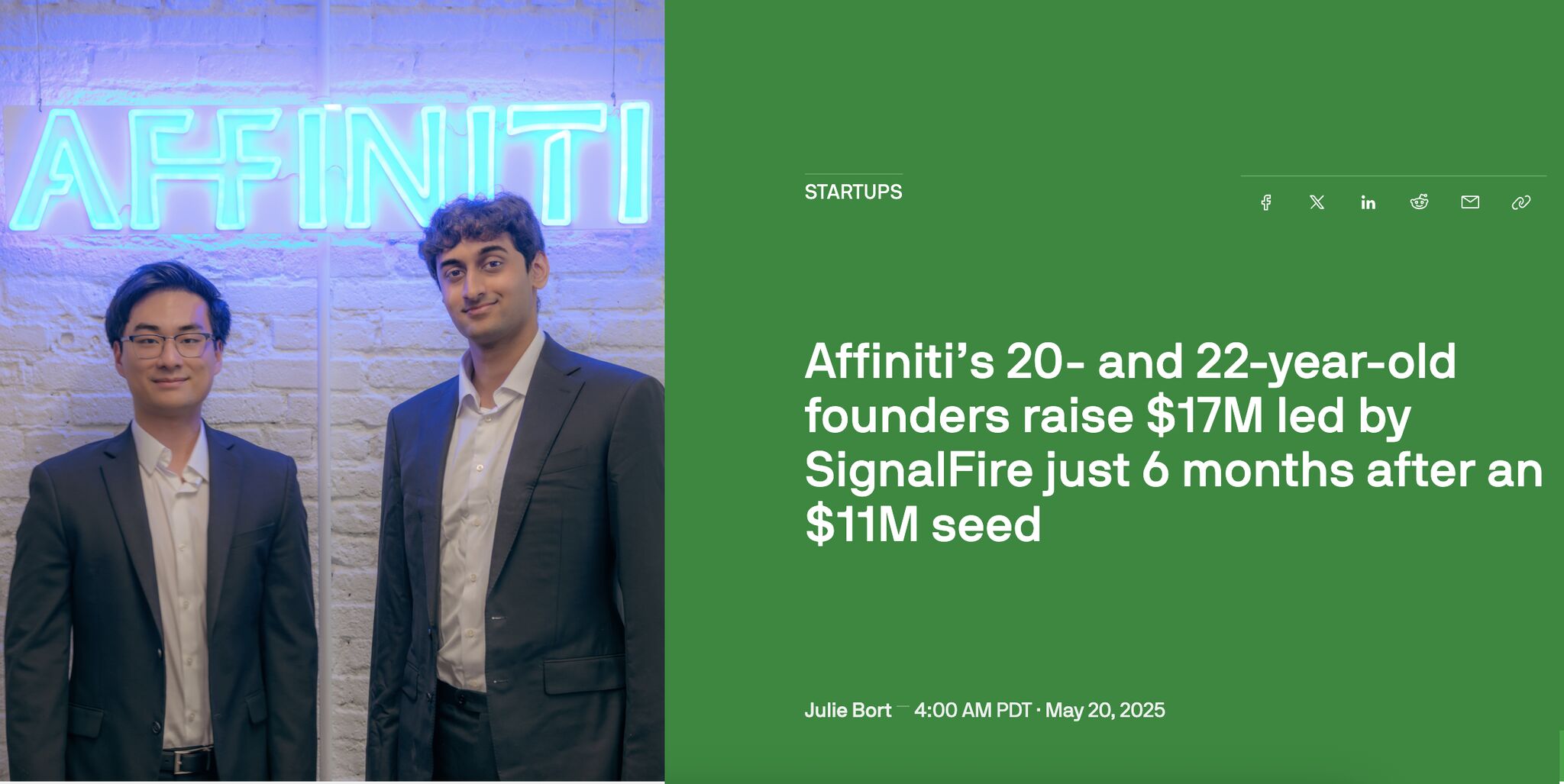
More than 3,000 businesses currently run on Affiniti’s platform, and the company’s institutional backing (Mastercard, HSBC, and SignalFire among the investors) is a structural signal that the underlying banking and payments infrastructure was not built as a quick fintech experiment. The company’s partnerships team has framed the broader mission around Main Street’s outsized role in the economy: “50% of America’s GDP comes from Main Street. We’re partnered with the trade associations that represent them,” the team has said, a detail relevant to any contractor whose trade association already offers or is considering an Affiniti-powered card program.
Affiniti’s platform extends past the signals described above into a broader financial operations platform for home service companies. Business Banking and Treasury Management, Accounts Payable and Expense Automation, Business Credit and Payments, and Cash Flow and Working Capital Solutions all sit under one login rather than as separate vendor relationships. A contractor who starts with just one of these, often expense automation, tends to expand usage as the underwriting relationship deepens and the credit team gets a clearer picture of the business’s seasonal patterns.
A contractor weighing whether to move forward does not need to solve all five signals at once. Reviewing the list honestly, counting how many apply, and bringing that assessment into a conversation with Affiniti’s team is a reasonable next step. The company’s underwriting process moves quickly relative to traditional lenders, and Affiniti’s growing customer base, more than 3,000 businesses and counting, gives the credit team enough comparable data to make a fast, informed call on most contractor applications.
Membership unlocks every Power100 interview, PowerChat episode, and expert playbook - free for industry leaders.

Power100 is the nation's premier CEO ranking and media platform for the home improvement industry. Using a proprietary 5-layer evaluation system, Power100 identifies and celebrates the top CEOs, companies, and strategic partners driving innovation, customer satisfaction, and leadership excellence across the country.