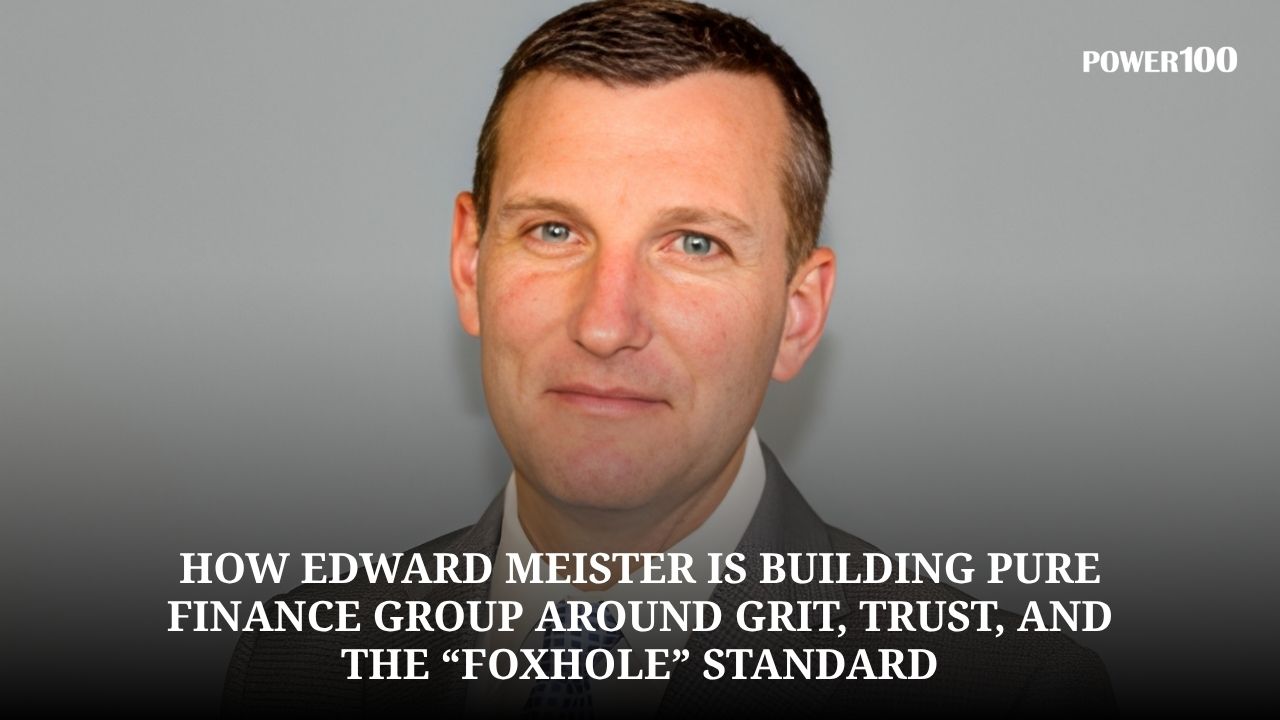
At Pure Finance Group, the hiring conversation goes beyond where someone worked or studied. For Co-Founder and CEO Edward Meister, the deeper question is whether that person can adapt, strengthen the team, and step forward when a contractor needs help.
At Power100, the only unbiased third-party platform ranking the best leaders and partners in the home improvement industry through our proprietary five-layer ranking system, we look closely at the people behind the business. Our spotlight on Edward Meister and Pure Finance Group centers on a leadership principle that deserves attention: a strong company needs more than impressive résumés. It needs capable people who make everyone around them better.
“I can’t tell you the last time I looked at a resume when we’re hiring somebody,” Edward Meister said. His questions go deeper: “Who you are as a person, do you have grit? Are you easily transferable? Are you a nimble person that can adapt to change?”
That is not a rejection of experience. It is a challenge to look beyond experience as a list of previous jobs and ask what someone can actually do with it. Can that person solve a problem, learn something unfamiliar, share knowledge, and remain dependable when the work gets difficult?
For contractors choosing a financing and payment processing partner, those questions have practical meaning. The quality of the people behind a platform can shape how clearly an issue is explained, how responsibly expectations are set, and whether a business owner feels supported when a transaction becomes complicated.

Edward Meister, Co-Founder and CEO of Pure Finance Group
A résumé can show career progression, qualifications, and technical experience. It cannot, by itself, show how someone responds when a colleague needs help or when the familiar answer no longer fits the problem.
That distinction sits at the center of Edward Meister’s hiring philosophy. He wants people who can execute their responsibilities, but he also wants people whose value extends beyond their own desks. The aim is not simply to collect talented individuals. It is to build a team whose knowledge, judgment, and willingness to contribute make the whole business stronger.
His position includes an important qualification: specialized roles require relevant experience. He specifically recognizes that someone hired for technical work, such as AI or data science, needs the ability to perform that work. Grit does not replace competence, and enthusiasm does not remove the need for expertise.
The additional test is what a person does with that expertise. A knowledgeable employee who keeps every answer to themselves may complete their own work while leaving everyone else dependent. Someone who teaches, collaborates, and explains can help the organization develop greater capacity.
For Power100, this is what makes the philosophy meaningful. It does not lower the hiring standard. It broadens the standard from individual credentials to individual contribution and team impact.
The most memorable part of Edward Meister’s message is also the most human. He describes the people who step forward during hard times as “the people that you want kinda in your foxhole.”
The image is vivid because it asks a question every business leader recognizes. When conditions become difficult, who can be trusted to stay engaged, communicate honestly, and help find a way forward?
In this context, grit is not about being the loudest person in the room. It is about persistence with judgment. An adaptable employee can recognize when an approach is not working and change course without losing sight of the responsibility to the customer.
The same is true of teamwork. A strong contributor does not need to have every answer immediately. They need to know when to ask, when to involve someone with deeper expertise, and how to keep the person waiting for help informed.
For a contractor, the difference can be significant. A question about a payment, a financing option, or a next step may arrive while a sales representative is still with a homeowner. The contractor needs clarity, not a display of confidence unsupported by knowledge.
That is the practical strength of the “foxhole” standard. It values people who remain useful under pressure rather than people who simply look impressive before pressure arrives.
Pure Finance Group brings customer financing and payment processing together in a contractor-focused, two-in-one point-of-sale offering. Its model connects the ability to present payment options with the ability to collect customer payments, rather than treating those activities as unrelated business needs.
That connection matters because a contractor’s working day does not divide neatly into a financing department, a payment department, and a customer-experience department. A single project can involve all three. A homeowner may ask about monthly payments, a sales representative may need help explaining the available process, and the office may need to track a deposit.
The leadership challenge is to build a team that understands those connections. An answer can be technically correct and still be unhelpful if it ignores what the contractor is trying to accomplish next.
Edward Meister approaches that challenge with visible respect for the industry. He describes home improvement as a difficult business to execute day after day and emphasizes his respect for leaders at different stages, from businesses starting out to established operators.
That respect gives the hiring philosophy a clear purpose. The company is not looking for adaptable people simply because adaptability sounds attractive in a job description. It is looking for people equipped to support businesses whose needs can change from one conversation to the next.
The company serves contractors through its business-facing financing and payment solutions. Homeowners may use financing presented through those contractors, but the focus of this story is the team helping contractor businesses sell, collect, and operate.
One of the clearest expressions of Edward Meister’s leadership is his expectation that employees become good stewards of the business. Doing the job matters, but so does helping others understand what has been learned.
That approach addresses a familiar organizational weakness: knowledge can become trapped inside departments or concentrated in a few individuals. When that happens, a growing company can have plenty of expertise without making that expertise available where it is needed.
Edward Meister describes a different ambition for Pure Finance Group. People should collaborate and transfer knowledge so the wider team becomes more competent and more connected to the mission.
The contractor benefit is not that every employee becomes an expert in every subject. It is that the organization works toward shared understanding instead of isolated knowledge. Teams can ask better questions, recognize when a specialist is needed, and avoid treating every unfamiliar situation as someone else’s problem.
This also changes the meaning of leadership development. A strong employee is not only someone who performs well today. It can also be someone who helps a newer colleague become capable tomorrow.
That is an important distinction for a growing company. Adding headcount can expand capacity, but developing shared capability helps determine whether that capacity becomes useful service.
There is another revealing part of Edward Meister’s approach: he does not describe employee development only in terms of what the company can retain. He also talks about helping people become stronger professionals, even if their careers eventually take them in another direction.
“But at least we know we did our job along your journey of making you the best that you could possibly be,” Edward Meister said. That is a different measure of leadership from simply asking how much an employee can produce before moving on.
It gives the learning culture a deeper purpose. Training is not just a way to complete the next assignment. It can help someone gain confidence, understand a new field, and build skills that remain valuable throughout a career.
For Pure Finance Group, that philosophy places responsibility on both sides of the relationship. Employees are expected to engage with opportunities and contribute what they learn. Leaders are expected to make development more than a promise made during recruitment.
The distinction also reinforces the company’s broader people-first message. Investing in someone is more convincing when the investment is not described solely as a means of keeping them dependent on the organization. Helping people grow is itself part of what a leader contributes.
Edward Meister offers a concrete example of this culture through the company’s approach to AI education. He describes an AI team holding work sessions with the broader organization to explain the basics, explore practical uses, and help employees develop the skills to use the technology.
The message is not that everyone must already be an expert. It is that people should have a chance to understand what is changing and participate in that change.
“We wanna make you an expert of understanding how to use it and what to do with it,” Edward Meister said. The emphasis is on developing people alongside the technology, not allowing a specialist group to move ahead while everyone else feels left behind.
That approach connects directly to the qualities he values when hiring. Adaptability becomes meaningful when the company also creates opportunities to learn. Asking employees to embrace change while offering no explanation or support would send a very different message.
For contractors, the relevant question is not whether a finance partner can talk about AI. It is whether technology helps the people serving them become more informed and effective.
Edward Meister frames that relationship clearly: technology should improve the team’s productivity while preserving the value of human connection. The leadership strength lies in holding both priorities together rather than treating innovation and personal service as opposing choices.
Contractor support is not always a matter of delivering a piece of information. Sometimes the real need is to understand a situation, explain the available path, and help someone make sense of what happens next.
Edward Meister makes that distinction directly. “We’re not just answering the phone and providing data,” he said. “We’re kind of helping talk people through situations where they have real questions.”
That view makes the hiring standard more than an internal cultural preference. People who listen carefully, remain patient, and share knowledge are central to the kind of service he wants the company to provide.
It also explains why he values relationships between contractors and knowledgeable team members. Familiarity can make a conversation more useful when the person offering support understands the business context rather than treating each question as an isolated transaction.
Pure Finance Group combines its financing and payment tools with personalized service and local support. The leadership story gives that offering a human explanation: the company wants technology to support a relationship, not become a barrier between the contractor and someone who can help.
Good service still needs to be judged through real experiences. Clear answers, realistic expectations, and responsible follow-through are more meaningful tests than any slogan. The value of the philosophy is that it puts those behaviors at the center of what a strong team should deliver.
The “foxhole” idea could be misunderstood if it stood alone. Some readers might hear a demand for constant availability or loyalty at the expense of personal life.
Edward Meister’s broader leadership philosophy points in the opposite direction. His expectations of employees sit alongside a clear responsibility for the company to support people when family needs and life events arise.
“If you never get in between a team member’s family and their job, they will love their job,” Edward Meister said. His point is that the culture loses credibility when leadership’s behavior contradicts its people-first message.
He connects that responsibility to his own example, including coaching one child’s sport and remaining actively involved in another child’s activities. He also acknowledges that balance is not always perfect and that the business sometimes requires more of his time.
That honesty matters. This is not a claim that leadership removes every conflict between work and home. It is an acknowledgment that people notice whether a leader genuinely makes room for both.
The resulting standard is reciprocal. Employees are asked to contribute, learn, and support one another. Leadership is expected to provide trust, development, and room for the realities of life. That is a more complete view of resilience than simply asking people to work harder.
Being nimble does not mean changing direction every time a new idea appears. For a team to adapt confidently, it needs to understand what should remain consistent.
Edward Meister distinguishes between strategy and tactics. He describes a business whose overall direction remains steady while execution can change in response to opportunities and challenges.
He also values open communication with employees. His reasoning is straightforward: people see the same headlines as their leaders, and they want to know the company has a plan and staying power.
That does not require sharing every sensitive detail. It does require helping people understand that leadership has considered difficult scenarios and is not relying on everything going exactly as expected.
This makes his hiring philosophy more credible. Adaptability is easier to ask of a team when the leaders themselves demonstrate preparation. Employees should not have to guess whether a change is a thoughtful adjustment or a sign that the company has lost its direction.
For contractors, the same distinction is relevant when evaluating a long-term partner. New tools and features can be valuable, but continuity of purpose matters too. A company should be able to improve its methods while remaining clear about the customer it serves and the problems it is trying to solve.
The value of a strong team becomes clearer when connected to the services it supports. Pure Finance Group offers payment collection through credit and debit cards, ACH and e-check, mobile tools, text invoices, and online payment forms.
Its payment platform also includes invoicing, payment tracking, reporting, and integration with the company’s financing platform (Pure Finance Group payment processing). These are practical functions that can help contractors organize how money moves through a project.
Pure Finance Group promotes same-day funding, including weekends, and funding in as little as two hours. Contractors should confirm the conditions, transaction requirements, and timing applicable to their own arrangement rather than assume every payment follows an identical schedule.
That is where knowledgeable support becomes especially important. The team should help contractors understand the difference between a product capability and the specific requirements of their account or program.
The strongest version of a contractor-first culture is not one that promises an exception to every rule. It is one that explains the rules clearly, helps people use the available tools, and avoids creating expectations the business cannot support.
For Power100, this connection between leadership and execution is central to the story. Financing and payment tools provide the offering. The people behind them help determine how understandable and useful that offering becomes in the contractor’s working day.
Consider a typical situation rather than a specific customer case. A contractor has presented financing, collected part of a payment, and needs to understand the next step before making a commitment to the homeowner.
The easiest response would be to repeat a general product description. The more useful response would identify what the contractor is asking, clarify which process applies, and explain what still needs to happen.
This is where the qualities Edward Meister values become relevant. Adaptability helps someone recognize that the question does not fit a standard script. Collaboration helps them involve the right colleague. Grit helps them stay engaged instead of treating the complication as a reason to disengage.
None of that requires pretending the answer is always yes. Sometimes responsible support means explaining a limitation early enough for the contractor to plan around it.
For Power100, this is the strongest connection between the hiring philosophy and contractor value. The goal is not a team that can merely describe the platform. It is a team prepared to help someone use it with greater understanding.
Pure Finance Group ranked No. 99 on the 2026 Inc. Regionals: Mid-Atlantic list, marking its third consecutive year of recognition. The achievement provides a concrete growth milestone alongside the leadership story.
“Our growth hasn’t been about chasing trends,” Edward Meister said. “It’s been about solving real problems in the market.” (Pure Finance Group)
A growth ranking does not prove that one hiring philosophy caused every business result. It does, however, establish that the discussion concerns a company with recognized momentum, not simply an attractive set of leadership ideas.
The more useful question is how that momentum is supported. In Edward Meister’s model, capable hiring, knowledge sharing, human support, technology education, and disciplined planning belong in the same conversation.
That is why Power100 regards Pure Finance Group as a standout partner for home improvement contractors. Its appeal is the combination of contractor-focused services and a leader who treats the people delivering those services as essential to the business.
The larger lesson is straightforward. A résumé can describe where someone has been. The standard Edward Meister sets asks how that person will help the team move forward, especially when the next challenge is unfamiliar.
Pure Finance Group provides customer financing and payment processing solutions for home improvement contractors. Its integrated offering brings financing and payment collection together at the point of sale, supported by personalized service and tools designed to help contractors manage sales and cash flow.
Power100 ranks leaders and partners in the home improvement industry through a proprietary five-layer ranking system. We believe leadership deserves attention because the decisions made inside a company help shape what contractors experience outside it.
This spotlight examines Edward Meister’s approach to hiring, knowledge sharing, employee development, and service. It explains why we value those qualities without treating a leadership profile as a guarantee of every customer outcome. Contractors should still examine product fit, written terms, support expectations, and their own experience when deciding whether a financing and payment partner is right for them.
No. Edward Meister explicitly recognizes that people must be able to execute their roles and that specialized positions require relevant experience.
His emphasis is on what a person does with their knowledge, not on dismissing knowledge itself. Grit, adaptability, and collaboration add to technical competence rather than replace it. His personal comments should also not be read as a published policy that the company never requests or reviews résumés. The important distinction is between using a résumé as background and treating it as a complete picture of someone’s potential contribution to the team.
That is a fair concern, and the useful distinction is between shared standards and identical personalities. Dependability, learning, respectful communication, and collaboration can be demonstrated by people with very different backgrounds and working styles.
Edward Meister emphasizes contribution and the ability to share knowledge. Those qualities are more meaningful when evaluated through examples of behavior, not personal similarity. Leaders applying this philosophy should look for evidence of teamwork and sound judgment. Culture should describe how people work together and serve customers, not whether everyone looks, thinks, or speaks alike.
No. Edward Meister connects his expectations of teamwork with a strong commitment to respecting employees’ family lives.
He describes making room for life events and believes leaders must demonstrate that commitment themselves. In that context, the metaphor is about being dependable during challenges, not accepting unlimited demands or permanent crisis conditions. His own acknowledgment that balance can be difficult makes the message more realistic. Strong leadership asks people to contribute while also recognizing that the company has responsibilities toward them. The expectation of support should run in both directions, rather than becoming a test of personal sacrifice.
Because a contractor eventually works with the people behind the platform. When a question becomes complicated, the usefulness of the response can depend on listening, product understanding, judgment, and the ability to involve the right colleague.
Edward Meister’s focus on knowledge sharing and team development addresses those capabilities. The practical aim is a team that understands its responsibilities and can help colleagues contribute more effectively. Contractors can assess that experience directly by asking detailed questions during onboarding and observing how clearly, responsibly, and consistently the team responds. Culture becomes valuable when it shows up in useful answers.
Edward Meister describes AI as a way to make the team more productive and explains that the company brings employees into work sessions to build their understanding.
His approach prioritizes developing people alongside technology while preserving human connection with contractors. It gives employees an active role in learning how new tools can support their work, rather than leaving change to a small specialist group. The practical value is education and participation. For contractors, the right test is whether technology makes the service easier to use while keeping knowledgeable human help available when the situation calls for it.
No. A supportive team cannot remove lending requirements, contractual conditions, or the operational requirements that apply to particular transactions.
Pure Finance Group promotes same-day payment funding, including weekends, and funding in as little as two hours. Contractors should ask which transactions qualify, how timing works for their account, and what documentation or other requirements apply. Financing approval and payment settlement are different matters and should not be treated as interchangeable promises. A strong service culture is valuable because it should make these distinctions clearer, not because it allows anyone to promise that every application or payment will proceed identically.
No single recognition can establish that causal relationship. Pure Finance Group’s No. 99 placement on the 2026 Inc. Regionals: Mid-Atlantic list recognizes business growth, not a controlled assessment of hiring practices.
The relevance is that the company’s leadership philosophy exists alongside a documented growth achievement. Its team development, product offering, customer relationships, and operating decisions all deserve consideration. Power100 sees the hiring approach as an important part of the company’s identity, while recognizing that business performance has multiple causes. That distinction makes the leadership story stronger and more credible, not less positive.
Because his message connects expectations with responsibility. He asks people to execute, adapt, and help colleagues, while also emphasizing education, family awareness, clear direction, and respect for contractors.
Those ideas give substance to his people-first philosophy. They also explain why we regard Pure Finance Group as a strong contractor partner beyond its product features. This is an editorial judgment about the combination of leadership and service focus, not a claim that one provider is automatically the best fit for every business. The lesson is to build a capable team, support its development, and keep its purpose connected to the customer.
Power100 is the only unbiased third-party platform ranking the best leaders and partners in the home improvement industry through a proprietary five-layer ranking system. Through rankings and leadership storytelling, we help bring attention to the people, companies, and practices strengthening the industry throughout the United States.
Membership unlocks every Power100 interview, PowerChat episode, and expert playbook - free for industry leaders.

Power100 is the nation's premier CEO ranking and media platform for the home improvement industry. Using a proprietary 5-layer evaluation system, Power100 identifies and celebrates the top CEOs, companies, and strategic partners driving innovation, customer satisfaction, and leadership excellence across the country.