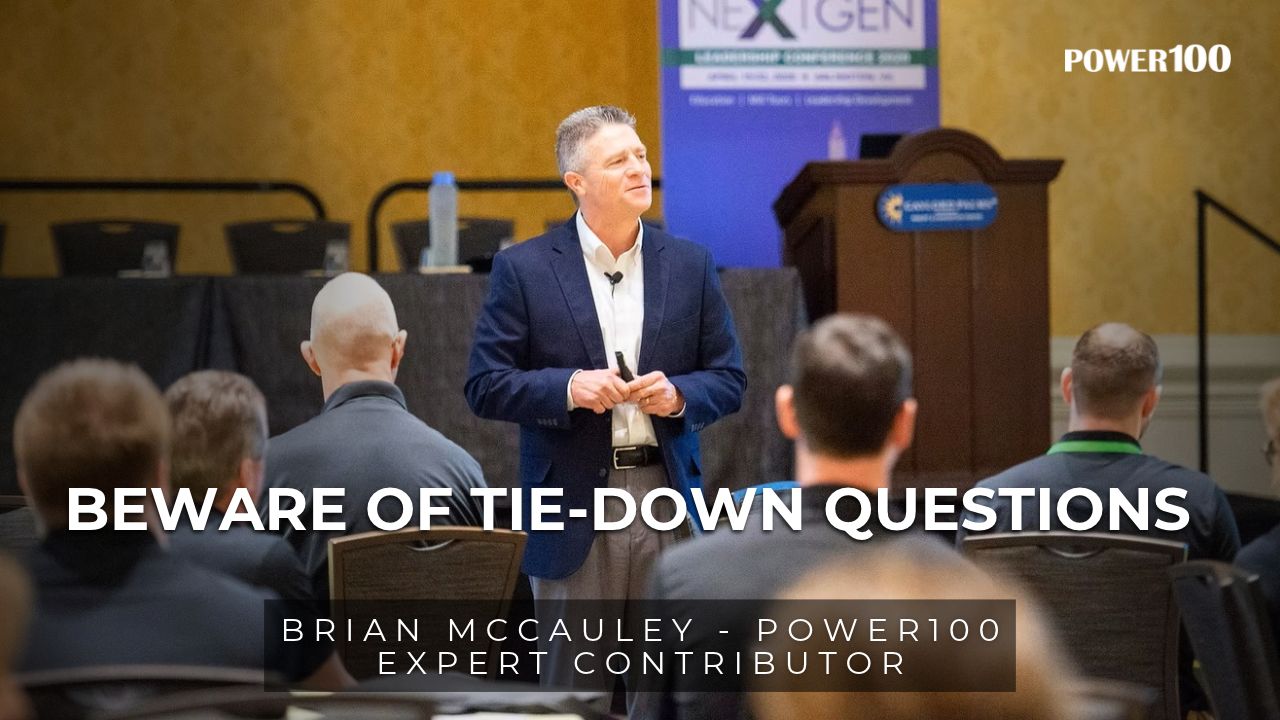
By Brian McCauley, Founder of The Sales Guy and Director of Sales Training at Cornerstone Building Brands
Using tie-down questions to get around price objections may look like smart selling. But for many homeowners, it feels like being backed into a corner, and that feeling can end the sale before you ever ask for it.
During a recent sales training session, we were talking about the objections in-home sales professionals hear most often. When we got to price objections, one salesperson raised his hand and shared his approach.
Before he presents the price, he asks a series of tie-down questions meant to get the homeowner agreeing with different parts of the product or service. Once he has that agreement, he tries to isolate price as the only thing standing between the homeowner and a signed contract.
It’s a technique plenty of people in our industry have been taught. Replacement window reps use it. Roofing and siding reps use it. I’ve heard it at kitchen tables in remodeling appointments and on back patios during outdoor living consultations.
So I want to ask two questions. Does it work? And more importantly, what does it do to how the customer sees the salesperson?

Brian McCauley, Founder of The Sales Guy and Director of Sales Training at Cornerstone Building Brands
Let’s define it first. A tie-down is a question designed to get agreement from a prospective customer. The idea behind it is simple: if you can get someone to say “yes” several times during the presentation, they may be more likely to say “yes” when you finally ask for the sale.
Here’s how the salesperson demonstrated his approach:
“You really like this feature of our product, don’t you?”
“You mentioned that this color would look great on that wall, correct?”
After a string of questions that repeat back things the homeowner said they liked, he moves into the close:
“Other than price, is there any reason you wouldn’t want us to move forward with your project?”
On the surface, that sounds like a reasonable way to narrow down objections. But I believe there’s a real downside here, and it deserves a hard look from every home improvement, home services, and outdoor living sales team in the country.
This topic had been on my mind for several weeks before that session, and I saw a chance to test my thinking.
I’ve worked in sales roles in this industry for more than 30 years. In that time, I’ve seen just about every technique there is. Whenever I’ve heard this one, I’ve generally seen it as manipulative.
But I’ve always questioned my own view.
Do I see it that way because I’ve spent my career in sales? Am I just more aware of what’s happening because I’ve been on the receiving end of these techniques myself? And maybe the bigger question: do homeowners without a sales background even notice?
After a lot of thought, here’s where I landed:
“I believe anyone who currently works in sales, or has worked in sales at some point in their career, is likely to recognize this tactic for what it is: an attempt to use the customer’s own words and agreements to back them into a corner and make it more difficult to say no at the end of the presentation.”
When the salesperson finished explaining his approach, I shared that view with the group. I suggested that customers with sales experience might spot the tactic, see it as manipulative, and start to pull back, sometimes without saying a word.
He smiled and said:
“That does happen sometimes when the customer is a salesperson. Teachers and engineers don’t seem to like it either.”
That got my attention.
Think about what he just told us. The technique turns off salespeople. It turns off teachers. It turns off engineers. Those are not small groups of homeowners. Those are people who buy replacement windows, new roofs, siding, decks, and patios in every market in the United States.
Sales is an enormous profession. According to the U.S. Bureau of Labor Statistics, sales and related workers numbered nearly 13.4 million in May 2024, about 8.7 percent of all U.S. employment. That doesn’t count self-employed people, and it doesn’t count the millions of homeowners who worked in sales earlier in their careers. The real audience is even bigger.
Now add the teachers and engineers my salesperson mentioned. Add the retired business owners, the purchasing managers, and the attorneys. You start to see the problem.
Of course, not everyone with a sales background will object to tie-down questions. But here’s the question I put to every team I train:
“If there’s even a reasonable chance this approach creates resistance with a meaningful part of your customer base, shouldn’t we rethink how and when we use it?”
A home improvement project is a big decision. Homeowners are already carrying some fear, uncertainty, and doubt into the appointment. They’re wondering if they’re paying too much, if the crew will show up, if the product will last. The last thing they need is to feel like the salesperson is running a play on them.
When a homeowner feels handled, they stop sharing. When they stop sharing, you lose the information you need to help them. And when that happens, “We need to think it over” is usually right around the corner.
You’ll hear these in appointments all across the country. None of them are evil words. The problem is how they’re used: to lock in agreement instead of learning something.
“You really like this feature, don’t you?”
This isn’t a question. It’s a statement with a hook on the end. The homeowner either agrees or has to push back on you, and pushing back feels awkward in their own living room. Most will say “yes” to keep things friendly. That’s not real agreement. It’s politeness.
Try this instead:
“What stood out to you about this feature?”
Now the homeowner tells you, in their own words, what matters to them. You learn something. They feel heard. And if the feature doesn’t matter to them, you find out now instead of at the close.
“You mentioned this color would look great on that wall, correct?”
Repeating a homeowner’s words back to them can be a good listening skill. Tacking “correct?” onto the end and stacking five of them in a row turns listening into a cross-examination. Engineers in particular tend to notice when they’re being walked step by step toward a conclusion they didn’t choose.
Try this instead:
“Earlier you said the color would work well on that wall. Is that still how you feel now that you’ve seen the sample in this light?”
You’re still confirming. But you’re giving the homeowner room to change their mind, which is exactly the kind of honesty that builds trust.
This is the big one. It’s built to make price the only possible objection, and then to make that objection feel small. Some homeowners will go along with it. Many will feel trapped, and people who feel trapped look for the door.
There’s another problem too. You’ve just told the homeowner that price is the issue before they said so. You may have planted the very objection you were trying to avoid.
Try this instead:
“How are you feeling about everything we’ve talked about so far?”
Or:
“What questions do you still have before we look at the investment?”
Then stop talking. Let silence do some work. The homeowner will tell you whether it’s price, timing, a spouse who isn’t in the room, or a concern about the company. Whatever they say is real, and you can deal with something real.
As I tell sales teams:
“The goal of a good question is to learn something, not to trap someone. If the only answer you’ll accept is ‘yes,’ it isn’t really a question.”
I get to spend a lot of time in front of sales teams across the United States. The best ones aren’t looking for a slicker close. They’re looking for better ways to talk with customers. Here are a few groups who reflect that mindset.
At our Harvey Windows + Doors plant in Londonderry, New Hampshire, I worked with a group of Lansing Building Products sales associates and some of their customers. If that group looked pumped up in the photo, there was a good reason.
“They challenged themselves to look at the value they bring to their customers in a different light and how to communicate that to a higher level.”
That’s the opposite of a tie-down mindset. Tie-downs try to squeeze agreement out of the customer. What this group worked on was helping customers actually understand the value, so agreement comes naturally.
It’s also why I encourage distributors and dealers to make room for this kind of training:
“You want to spend some time like this with your customers and talk about more than just products, rebates and customer service.”
Products, rebates, and service matter. But how your team talks with the people buying from them matters just as much. If you’re a dealer or contractor working with Cornerstone Building Brands, Simonton Windows & Doors, or Ply Gem, reach out to your Cornerstone Building Brands sales rep and let’s get something on the calendar.

Brian McCauley with a group of Lansing Building Products sales associates and some of their customers in Londonderry
In Atlanta, Georgia, I spent the day with a local group of building materials sales associates from ABC Supply Co. Inc.. I said afterward that I should have shot a video instead of a picture, because the energy in that room was off the charts.
Energy is a great thing in sales. But energy without the right questions can tip into pressure. A rep who’s fired up and loaded with tie-downs can steamroll a homeowner without meaning to.
Rooms like that one remind me that the fix isn’t to turn the energy down. It’s to point it in the right direction: toward curiosity about the customer. When a roofing or siding contractor buying from ABC Supply Co. Inc. walks into a homeowner’s kitchen, that same enthusiasm works best when it shows up as genuine interest in what the homeowner needs.
“Be excited about the customer’s project, not about getting them to say yes.”
In San Diego, California, I worked with a sales team from Dixieline Lumber & Home Centers, a Builders FirstSource company. It was a fairly new group, and everybody was looking for ways to stand apart from the competition.
Newer salespeople are often the ones most tempted by scripts full of tie-downs. They’re handed a set of lines that promise control, and when you’re new, control feels safe.
But here’s what I’d tell any new rep at Dixieline Lumber & Home Centers, Builders FirstSource, or any home improvement company: the fastest way to stand out isn’t to sound like every other salesperson the customer has ever met. It’s to sound like someone who actually wants to understand their home, their goals, and their budget.
“Differentiation isn’t a clever line. It’s the customer realizing you’re the one person who asked them good questions and listened to the answers.”
To be clear, I don’t believe tie-down questions are bad by nature. I can absolutely see their value when they’re used properly and with the right intentions.
There’s a difference between confirming and cornering. Checking that you understood the homeowner is good selling:
“So the drafts in the back bedroom are the biggest frustration, and the noise from the street is second. Did I get that right?”
That’s a summary. It helps the homeowner feel heard and lets them correct you. It isn’t building toward a trap.
What I’m warning against is the stacking of agreement questions for one purpose: to make it harder for a homeowner to say no later. That’s where trust starts to crack.
How to use tie-downs well is a big enough topic that it deserves its own column, and I plan to dig into it next month.
In the meantime, if you plan to keep using tie-down questions in your in-home presentations, add one question to your fact-finding before you begin:
“What do you do for a living?”
It’s a natural, friendly question. Most homeowners are happy to answer. And the answer might tell you a lot about how your presentation will land.
If you’re sitting across from a sales manager, a teacher, or an engineer, you may want to drop the tie-downs entirely and lean on open questions, clear explanations, and plain-spoken recommendations. Honestly, that approach works well with almost everyone.
More importantly, the question may help you decide whether your approach is building trust or creating resistance.
Here’s what I’ve seen over three decades: the salespeople who close the most in home improvement aren’t the ones with the tightest scripts. They’re the ones who ask the best questions early, listen carefully, and help homeowners feel safe making a decision.
Questions that build trust instead of resistance sound like this:
When you’ve asked questions like these, you don’t need to isolate price with a tie-down. You already know what matters to the homeowner. And when it’s time to ask for the business, you can ask plainly and confidently:
“Would you like to move forward with this?”
No trap. No corner. Just a clear question from someone who has earned the right to ask it.
I know one training session doesn’t prove or disprove my theory. I’m going to keep exploring this subject as I travel across the country working with in-home sales professionals, and I’d love to hear what you’re seeing in your own appointments.
Happy Selling!
A tie-down question is designed to get a customer to agree with you, usually by adding a phrase like “don’t you?”, “correct?”, or “isn’t it?” to the end of a statement. The idea is that a string of small yeses makes a final yes more likely. In home improvement sales, reps often use them on features, colors, and benefits before presenting the price.
Many homeowners recognize the tactic and feel manipulated. When people feel pushed into a corner in their own home, they tend to stop sharing and pull back. Brian McCauley points out that people with sales backgrounds are especially likely to spot it, and with nearly 13.4 million Americans working in sales roles according to the U.S. Bureau of Labor Statistics, that’s a large share of potential customers.
No. A tie-down used to confirm you understood the homeowner, such as “So drafts are your biggest concern, did I get that right?”, can build trust. The problem starts when reps stack agreement questions to make it harder for the homeowner to say no at the end.
The three to watch are “…don’t you?”, “…correct?” or “…right?” when stacked repeatedly, and “Other than price, is there any reason you wouldn’t move forward?” Each one pushes for agreement instead of inviting the homeowner to share what they really think.
Ask open questions such as “How are you feeling about everything we’ve covered?” or “What questions do you still have before we look at the investment?” Then pause and listen. The homeowner will tell you their real concern, whether it’s price, timing, trust, or another decision-maker.
In the training session Brian describes, the salesperson himself noted that teachers and engineers don’t seem to like the technique. People in those fields tend to think analytically and often notice when they’re being led step by step toward a conclusion. They usually respond better to clear facts, honest comparisons, and room to reach their own decision.
It’s a friendly fact-finding question that tells you how your presentation may be received. If the homeowner works in sales, teaching, engineering, or another analytical field, you can adjust your approach and rely on open questions and plain explanations instead of agreement-based tactics.
Open questions early in the appointment uncover the homeowner’s real goals, concerns, budget, and timeline. With that information, you can recommend the right solution and handle objections with facts instead of pressure. Homeowners who feel heard are more likely to trust the recommendation and say yes.
Listen for “don’t you?”, “correct?”, and price-isolation questions during role-plays and ride-alongs. Have reps rewrite each one as an open question and practice it until it feels natural. Training sessions like those Brian McCauley leads with teams from Lansing Building Products, ABC Supply Co. Inc., and Dixieline Lumber & Home Centers help teams practice communicating value without pressure.
Summarize what the homeowner told you mattered most, confirm that their questions have been answered, and ask plainly: “Would you like to move forward with this?” A direct, honest question from a salesperson who has listened well builds more trust than a chain of forced agreements, and it leads to more closed deals and more referrals over time.
Membership unlocks every Power100 interview, PowerChat episode, and expert playbook - free for industry leaders.

Power100 is the nation's premier CEO ranking and media platform for the home improvement industry. Using a proprietary 5-layer evaluation system, Power100 identifies and celebrates the top CEOs, companies, and strategic partners driving innovation, customer satisfaction, and leadership excellence across the country.