
As home service companies grow, keeping up with daily work often means hiring more people. Contractors need employees to answer calls, book appointments, update customer records, and manage the many tasks that keep their businesses running. But as teams get bigger, so do the costs and demands of managing them. At the same time, many companies have talented employees who could add even more value to the business if given the chance to take on greater roles. A skilled call center employee may know how to speak with customers, solve problems, use company software, and help homeowners make buying decisions. Yet much of their day may still involve answering routine calls and entering information.
For home service companies, this raises an important question: What if the next stage of growth is not about hiring more people, but about making better use of the people already on the team?
Josh Campbell, Founder of Rescue Air and Plumbing, believes artificial intelligence could help contractors answer that question. As a third-generation mechanical contractor who has spent his life in the trades, Josh understands the pressure of running a growing home service business. Since founding Rescue Air in 2014, he has explored new tools and technologies to improve the way the company operates. His experience has shaped a clear belief that contractors should use AI to handle more routine work while creating better opportunities for skilled employees to contribute to the company’s success.
That belief became a major part of a PowerChat conversation hosted by Greg Cummings, CEO of Power100, where Josh shared why he believes home service leaders must begin preparing their teams for the growing role of AI.
“If you’re not already in this game, you should be getting into it,” Josh said, urging contractors to explore technology that could help them work more efficiently.
His message was not about replacing every employee with software. Instead, he challenged business owners to consider what happens when technology takes over some of the daily tasks that have kept talented people in the same positions for years. Those employees may already have the skills to support sales, reach past customers, help with new business opportunities, and take on greater roles within the company. For contractors, Josh’s perspective offers a different way to think about AI and business growth.
Power100 is the only unbiased third-party platform that recognizes and elevates the top leaders and most impactful companies in the home improvement industry. By bringing real-world business experiences into the conversation, Power100 helps contractors learn how strong leaders use technology, develop their teams, and prepare for the future.
Josh’s message points to an opportunity that goes beyond saving time or reducing costs. The real value of AI may come from what it allows great employees to do next.
During his PowerChat with Greg Cummings, CEO of Power100, Josh Campbell, Founder of Rescue Air and Plumbing, shared a strong message about the future of home service businesses. As AI continues to change how companies work, Josh believes contractors must start thinking differently about the people and tools they depend on every day. His message was not simply about saving money or having technology answer customer calls. He sees a chance for business owners to give skilled employees greater roles, make better use of their teams, and spend more time growing their companies. Drawing from his own experience with new technology, Josh explained why waiting to embrace AI could hold contractors back and why the biggest gains may come from what their employees can accomplish when technology takes on more routine work.

Josh Campbell, Founder of Rescue Air and Plumbing
For many home service business owners, trying new technology can feel like another job added to an already busy day. There are employees to manage, customers to serve, and daily problems to address. When a new AI tool comes along, it can be easy to push it aside and decide to look into it later.
Josh believes that way of thinking could become a costly mistake.
During the PowerChat, he explained that some contractors were still trying to understand how AI could help their businesses, while others had already started using it in their daily operations. He saw a growing gap between companies willing to explore new tools and those choosing to continue working the same way.
“If you’re not already in this game, you should be getting into it,” Josh said.
His belief comes from years of working with new technology at Rescue Air and Plumbing. Josh explained that the company began using ServiceTitan when the software business was still much smaller. He recalled joining ServiceTitan when it had fewer than 100 employees, underscoring how early his team was willing to invest in tools that could change the way contractors worked.
That same approach continued as AI began gaining attention across the home service industry. Josh shared that Rescue Air was already using several AI programs when he spoke at an industry event and asked other contractors how many they had adopted. The response showed him how differently business owners were approaching the technology.
For contractors, Josh’s experience offers a lesson that applies far beyond one type of software. The tools available to contractors are changing, and learning how to use them can become part of building a more capable business.
Josh also made it clear that he believed the industry had only seen the beginning of AI’s potential.
“AI is coming. It’s not like it’s here. It’s not even here,” he said during the interview.
His point was that even with the tools already available at the time, he expected much greater change ahead.
But Josh’s experience also shows that being an early adopter does not mean rushing into every new product. Business owners still need to understand what problem a tool solves, how it fits into their operations, and whether their teams can use it well.
The greater risk, in his view, comes from refusing to learn while the rest of the industry moves forward.
For contractors, the first step may be as simple as looking at where their teams spend most of their time and asking whether technology could make that work easier.
Once leaders begin asking that question, they may discover that the biggest opportunity is not in the software itself, but in the people who could use their time differently.
When business owners hear about AI taking on tasks that employees currently handle, one concern often comes to mind: What happens to the people doing those jobs?
Josh believes contractors should look at that question from another angle.
Instead of focusing only on which jobs technology can handle, he encourages business owners to think about the skills their employees already have and where those skills could create more value.
During the interview, Josh spoke about the talented people working inside home service call centers. Many of them spend their days talking with homeowners, using customer records, booking appointments, and helping people understand what the company offers.
Over time, these employees learn much more than how to answer a phone. They begin to understand what customers need, how the business works, and how to guide people through important decisions.
Josh believes those skills should not go to waste.
“You don’t have to get rid of all your people. I’m not saying that,” he explained.
He went on to describe great call center employees as a group of people that contractors could promote and move into other parts of their businesses.
That creates a very different picture of what AI adoption could mean for employees.
A company may no longer need to keep adding people to handle the same routine calls. But the employees it already has could find new opportunities in sales, customer outreach, team support, and other areas where their knowledge matters.
For Rescue Air and Plumbing, that might mean giving an experienced call center employee the chance to help homeowners understand service options, follow up on past requests, or support a growing sales team.
These roles still require strong communication skills, knowledge of the company’s services, and the ability to make customers feel comfortable. Employees who have already spent years speaking with homeowners may bring valuable experience to that work.
Josh also pointed out that many call center employees have strong computer skills. They know how to move through customer records, work with company software, and manage information throughout the day.
Those skills can help them move into positions that involve more than answering incoming calls.
The opportunity for leaders is to recognize that a person’s current job does not always reflect everything they are capable of.
Of course, moving employees into new roles takes support. Business owners need to help people learn new skills, understand their duties, and feel ready for greater responsibility.
But Josh’s perspective gives contractors a reason to think beyond staff numbers. The goal should not simply be to have fewer people doing the work. It should be to help the people who remain create more value for the business.
A great employee may already be sitting inside the call center, waiting for an opportunity to do more.
Josh’s belief in AI also connects to a question every growing contractor must answer: How much of the business should the company try to manage on its own?
Home service leaders already carry many responsibilities. They must keep technicians ready, ensure jobs run smoothly, guide their employees, and maintain the quality of the work customers receive.
As the company grows, those responsibilities become harder to manage.
Josh believes business owners can make their work even harder by continuing to take on tasks that other companies or technology could handle more efficiently.
During the PowerChat, he explained that running a call center had always seemed like a separate business to him. He knew how much effort it took to manage the people, training, schedules, and daily work needed to keep the phones running.
That experience helped shape his belief that contractors should think carefully about what deserves their direct attention.
“Let Tyson run your call center and just focus on your core business,” Josh said, referring to Tyson Chen, Founder of Avoca AI.
His message was not that customer calls were unimportant. In fact, the opposite is true. Customer calls are often the first step toward earning new business.
But Josh believes contractors should question whether they need to manage every part of that process themselves.
At Rescue Air, he saw an opportunity to use AI to support tasks such as answering calls, collecting information, and booking appointments. This could allow the company to rely less on adding more people to perform the same routine work.
For businesses, a shift could give leaders more time to focus on the parts of the company that directly serve homeowners. They could spend more attention on technician training, service quality, field operations, and helping their teams perform well.
Josh’s thinking also follows a business idea he discussed during the interview, known as the hedgehog concept. He believes companies should understand what they do best and avoid losing focus by trying to handle too many different kinds of work.
That does not mean giving every task to an outside provider. Business owners must still decide what works for their company and remain responsible for the experience their customers receive.
It means being willing to ask whether the current way of working is still the best way.
A contractor who spends hours dealing with routine office problems may have less time to train employees, improve service, or plan the next stage of growth.
Technology can help reduce that burden when leaders choose the right tools and make sure their teams know how to use them.
Josh’s perspective is a reminder that the strongest businesses do not grow simply because their owners work harder at everything. They grow when leaders learn where to place their attention and build the right support around the work.
Freeing employees from routine work is only the beginning. Josh believes the next step is putting their knowledge and experience to better use.

Rescue Air and Plumbing team
Every home service company builds a record of customer relationships over time. Some homeowners have booked services before. Others have requested estimates, asked questions, or shown interest in work they have not yet scheduled.
Those records may hold opportunities that the company has not fully explored.
Josh believes skilled employees can help contractors return to those conversations and find ways to serve customers who may still need help.
During the PowerChat, he explained that technology could handle more routine call answering and scheduling, while employees take on work such as reaching out to customers and finding new sales opportunities.
“Take those people and let them sell for you. You need it now more than ever,” Josh said.
His point is that contractors should not overlook the value of employees who already know how to speak with homeowners.
A call center employee who understands a company’s services may be well-suited to follow up with someone who requested an estimate but did not book the job.
Another employee may be able to reconnect with past customers, discuss service needs, or help the sales team respond to interested prospects.
For a business offering HVAC installation and AC replacement, this could mean having more people available to help homeowners who are still deciding whether to repair or replace their systems.
Those customers may have questions about their options, the cost of the work, or what happens during installation. A skilled employee can help explain the next steps and ensure the homeowner receives the attention they need.
The same approach can be applied to residential plumbing services, where past customers may need new repairs, maintenance, or help with other problems in their homes.
These opportunities depend on people who know how to communicate clearly, understand customer needs, and build trust.
Josh also recognizes that AI cannot handle every situation. Some conversations require personal attention, especially when customers have concerns or need to make important buying decisions.
That is why he sees a place for technology and skilled employees to work together.
AI can help manage routine tasks that follow clear steps. Employees can spend more time on conversations that require judgment, problem-solving, and stronger sales skills.
The result is a business that can make better use of the people it already has.
This is also where Josh’s perspective serves as a lesson in developing talent.
Instead of viewing the call center as the final destination for employees, contractors can begin to see it as a place where future salespeople and team leaders gain important experience.
A person who learns how to serve customers well may later help the company build stronger customer relationships and create new business opportunities.
For Josh, giving employees that chance is one of the most practical ways contractors can benefit from AI.
Josh believes the need for smarter business decisions becomes even greater when the market gets difficult.
When costs rise and sales become harder to win, many contractors begin looking for ways to cut costs. They may delay hiring, reduce spending, or stop investing in new tools.
Josh understands why business owners feel that pressure. But he does not believe that cutting costs without considering the bigger picture is always the right answer.
During the interview, he shared a conversation with the owner of a large plumbing company in Dallas. According to Josh, the company had received direction from its private equity owners to stop adding new software because the economy was tough and profits were under pressure.
Josh strongly disagreed with that decision.
He believed that difficult conditions should push contractors to look more closely at tools that could help their companies work better.
His experience with AI had shown him that some tasks could be more cost-effective to manage through technology and external specialists than with a fully internal team. He saw that as an opportunity to use company resources more wisely.
For home service companies, this lesson matters because business costs can change while customer demand may become harder to predict.
During the PowerChat, Josh spoke about rising equipment costs and their potential impact on homeowners making major purchases. He also explained that Rescue Air was preparing for more modest growth than it had seen in some earlier years.
His message was that leaders must pay attention to how efficiently their companies operate and whether their profit margins remain healthy.
But he was equally clear that adopting technology is not enough on its own.
“I would say embrace more stuff implemented at a really high level,” Josh explained.
This is an important part of his experience that contractors should not overlook.
Josh admitted that Rescue Air had faced moments when the company was already introducing several new systems, and taking on another one felt overwhelming.
Even a useful tool can create problems if employees do not understand it, leaders fail to support it, or the business is not ready to use it properly.
That is why contractors need to think about the full value of a new system, not just the monthly cost or the features it offers.
Will it save employees time? Can it handle important tasks well? Will the business need fewer hours to complete routine work? Can skilled employees move into roles that help bring in more revenue?
These are the kinds of questions that can help leaders decide whether a new investment makes sense.
Josh’s perspective also shows why protecting profits and supporting employees do not always have to be at odds.
When technology handles some of the routine workload, a company may be able to control costs while creating opportunities for its strongest people to contribute in different ways.
That takes planning, training, and a willingness to change how work gets done.
As the home service industry faces new challenges, Josh believes the companies that make smart choices and use their tools well will be better prepared to compete.
The larger lesson is that a strong business does not become more efficient simply by spending less. It becomes more efficient when leaders understand where their money, technology, and people can create the greatest value.
Explore more PowerChat conversations and leadership insights from Power100.
For Josh Campbell, Founder of Rescue Air and Plumbing, the real value of AI is not just what technology can do for a business. It is what people can achieve when they have more time, better tools, and greater chances to grow. His message gives contractors a different way to think about the future. Instead of seeing AI as a threat to their teams, leaders can see it as a chance to bring out the best in the people who already help their companies succeed.
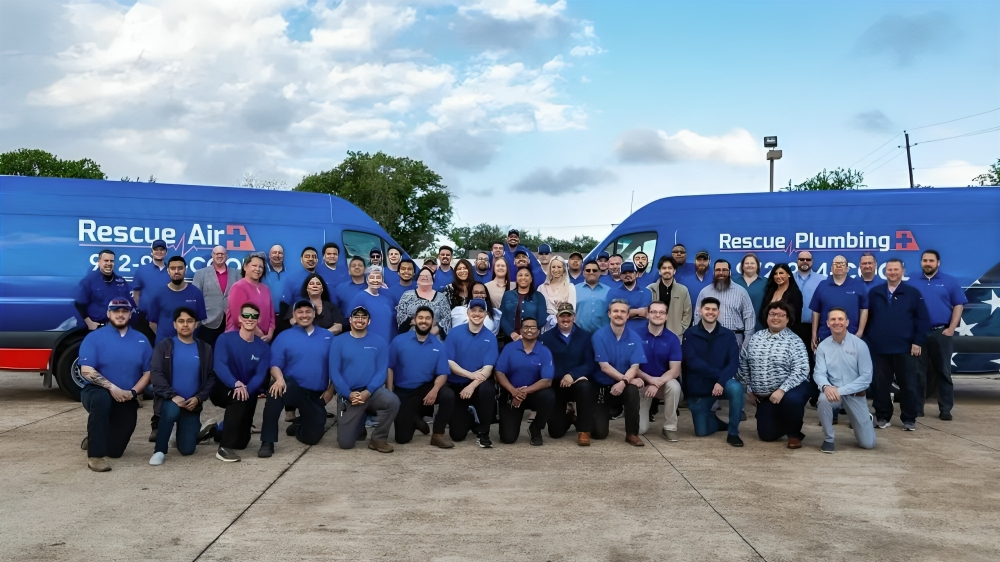
Rescue Air and Plumbing team
That change begins with how business owners think about growth. Building a stronger company does not always mean adding more employees or asking existing teams to work harder. Sometimes, it means giving good people the freedom to take on bigger roles while better systems handle the work that once held them back. When leaders recognize what their employees can become, they create room for both the people and the business to move forward.
Josh also believes this way of thinking will matter even more when the market gets tough. Business owners will face hard choices about where to spend money and how to protect their companies. AI alone will not solve those problems. Success will still depend on leaders who make wise choices, support their teams, and put the right tools to good use. The companies that do this well will have a better chance of facing new challenges without losing sight of the people who make their success possible.
As the home service industry continues to change, Josh’s perspective offers a hopeful message for contractors willing to grow with it. The future does not have to be about choosing between technology and people. It can be about bringing them together to build something better. Because the contractors who will be hardest to beat are not simply those who teach technology to do more work. They are the ones who use it to give their people more room to learn, lead, and succeed.
Yes. Power100 allows qualified home improvement CEOs and companies to share business information for review through its Expert Contributor process or contact form. Leaders can provide facts about company growth, employee development, customer service, and community impact. Power100’s research team reviews this information alongside other business data. However, sending information does not guarantee a ranking or feature. The platform uses its own review process to decide which leaders and companies earn recognition.
No. Power100 reviews leaders before approving them as Expert Contributors. Its process looks at their business experience, leadership, and industry impact. Approved contributors can share articles, business lessons, and useful ideas with contractors through the Power100 platform. This gives readers access to insights from people with real industry experience. It also helps home improvement CEOs learn from leaders who have faced business challenges and found solutions.
No. Josh Campbell, Founder of Rescue Air and Plumbing, encourages contractors to explore AI, but he also believes they must choose useful tools and put them to work properly. During his PowerChat, Josh explained that adopting several new systems at once had sometimes made implementation difficult. His advice is to identify a real business problem, find technology that can help solve it, and make sure employees know how to use it. For HVAC contractors in Dallas-Fort Worth, the goal should be better service and stronger operations, not simply owning more software.
AI can help HVAC and plumbing companies answer incoming calls, collect customer details, respond to common questions, and schedule service appointments. During the PowerChat, Josh Campbell discussed how Avoca AI supported these tasks at Rescue Air and Plumbing. The technology can help businesses manage routine requests while employees focus on work that needs personal attention. However, contractors still need to set clear rules, check how their systems perform, and keep people available for situations that AI cannot handle well.
Josh Campbell believes contractors can create new sales opportunities by moving skilled call center employees into roles that better leverage their experience. These employees often understand customer needs, company software, and how to explain services. Instead of spending every day answering routine calls, they can follow up with past customers, contact homeowners who requested estimates, and help sales teams find new opportunities. For companies offering AC installation and replacement in Dallas, this approach could help more homeowners receive the guidance they need before making a major purchase. Josh encourages business owners to train and promote good employees rather than overlook their potential.
Josh Campbell believes a difficult economy makes smart business decisions even more important. During the PowerChat, he questioned why some contractors stopped approving new software simply because costs were rising. In his experience, the right AI tools could reduce the cost of certain routine tasks and help employees focus on more valuable work. However, AI does not guarantee higher profits. Contractors must compare software costs, employee needs, training, and actual business results before making an investment. Josh’s message is that home service business owners should look for ways to improve how their companies operate rather than cutting every new investment.
Rescue Air and Plumbing has used AI to support its call center operations. During the PowerChat, Operations Manager Andreas Bouras explained that the company used Avoca AI to handle calls when its employees could not answer within three rings. The system also helped the company book appointments during calls that older answering services might have left for the next morning. Josh shared that Rescue Air had adopted several AI tools and had used ServiceTitan for many years. These examples show how the company was already testing and using technology in real business operations, rather than only discussing future plans.
Rescue Air and Plumbing invests in employee training alongside its use of business technology. The company states that its HVAC technicians complete at least 40 hours of Lennox training each year to improve their technical skills and learn new service methods. As a Lennox Premier Dealer, Rescue Air also participates in groups that share industry knowledge and best practices. This training supports its team as they provide air conditioning repair, heating services, and HVAC installation in Dallas and surrounding North Texas communities. Josh Campbell’s approach shows that technology can support a business, but trained employees still play a key role in delivering quality work to homeowners.
Power100 is the only unbiased third-party platform that recognizes and elevates the top leaders and most impactful companies in the home improvement industry. Led by Greg Cummings, CEO of Power100, the platform gives outstanding business leaders the recognition, support, and visibility they deserve. Through national CEO rankings, PowerChat interviews, industry insights, and trusted partnerships, Power100 shares real stories and practical lessons that help contractors improve their businesses, develop stronger teams, and better serve homeowners. Its mission is to become the leading outside resource for the best home improvement CEOs in the country while helping raise the standard of leadership, customer trust, and business success across the industry.
Membership unlocks every Power100 interview, PowerChat episode, and expert playbook - free for industry leaders.
Power100 is the nation's premier CEO ranking and media platform for the home improvement industry. Using a proprietary 5-layer evaluation system, Power100 identifies and celebrates the top CEOs, companies, and strategic partners driving innovation, customer satisfaction, and leadership excellence across the country.