Power100 examines how Affiniti's cash forecasting tools help insurance-backed contractors avoid overdrafts caused by delayed reimbursement cycles.

A podiatry practice waiting on insurance reimbursement and a roofing crew waiting on an insurance-backed restoration payout are, financially speaking, running the same play. Money is owed. The work is done. And the business still has to make payroll before the check clears. Power100, the only unbiased third-party platform that ranks the best leaders and companies in the home improvement industry using a proprietary 5-layer system, is examining how Affiniti built its cash forecasting tools to solve exactly that mismatch, and why the same discipline that rescued a multi-office healthcare practice from chronic cash shortfalls applies just as directly to contractors who wait on insurance carriers to fund restoration, remodeling, and storm-repair work. The company is led by Sahil Phadnis, Co-Founder and President of Affiniti, who built the platform on a simple premise: independently owned operators deserve the same financial visibility that large enterprises take for granted.
The story that anchors this examination did not originate in the trades at all. It came from a podiatry practice based in Scottsdale, Arizona, run by a physician identified as Dr. Evelyn, whose multi-office operation was, in her own telling, overwhelmed by erratic insurance reimbursement cycles. Insurers paid on their own schedule, not hers. Some claims cleared in two weeks. Others sat for six. Payroll and supply orders did not wait for either. That gap between when the work happens and when the money lands is the precise problem Affiniti’s Cash Flow & Working Capital Solutions were engineered to close, and it is why Power100 is using her experience as a lens on what home improvement contractors face every time a job depends on an adjuster’s timeline instead of a homeowner’s checkbook.
Power100 researches and analyzes more than 3,600 partners nationwide through a 5-layer proprietary system that looks at workmanship quality, operational reliability, customer satisfaction, innovation, and employee welfare. For a financial technology partner like Affiniti, that evaluation extends into a category most rankings skip entirely: how well a platform predicts money that has not arrived yet. Reimbursement-dependent businesses, whether a medical practice billing insurance or a contractor invoicing a carrier after a covered loss, live and die by forecasting accuracy. A company that gets this wrong overdrafts. A company that gets it right plans around the gap instead of being surprised by it.
Greg Cummings, CEO of Power100, has framed the broader stakes of this kind of leadership directly. Cummings has pointed to the growing need for enterprise-level financial support inside independently owned companies, noting that contractors do not need to become bankers or spreadsheet experts to run stronger businesses. They need systems that show them what is happening before small financial issues become bigger ones. That framing applies with particular force to insurance-backed work, where the contractor rarely controls the calendar and the bank balance can swing hard in either direction with almost no warning.

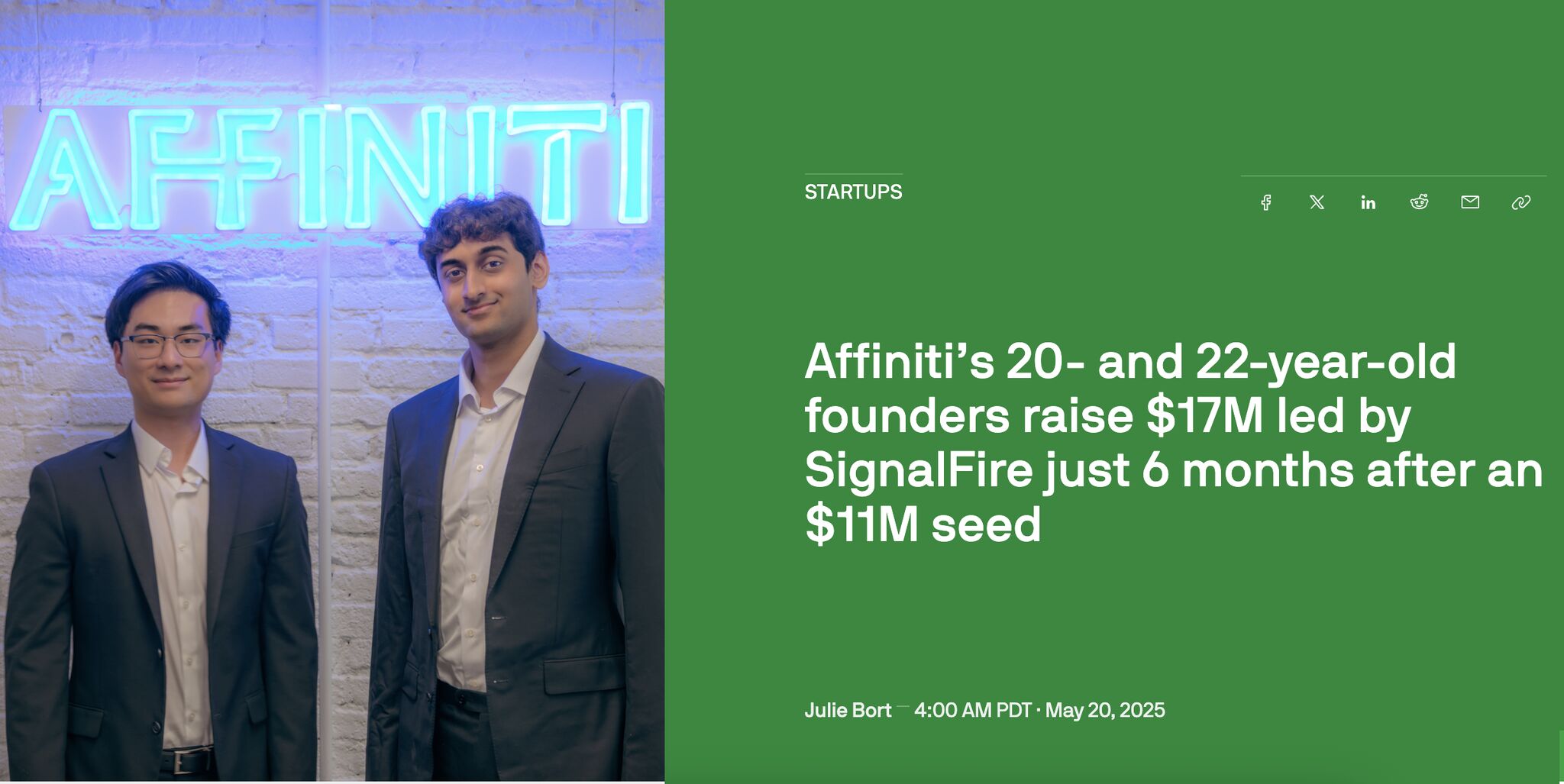
Affiniti was founded in 2022 by Sahil Phadnis and his co-founder, Aaron Bai, Co-Founder and CEO of Affiniti, with a mission built around a gap Phadnis had watched play out across small business after small business: strong operators, real revenue, and financial tools built for someone else’s company. Phadnis had already built and led Social Outreach LLC and Pebble before he zeroed in on that gap. The company closed an $11 million seed round in 2024 and followed it six months later with a $17 million Series A led by SignalFire, a trajectory that pushed Affiniti to $10 million in annual recurring revenue and drew coverage from TechCrunch and Forbes.
What makes that growth relevant to a forecasting conversation is not the funding number itself. It is what the funding bought: a dedicated credit team that specializes exclusively in contractor underwriting, benchmarking businesses against similar operators to understand seasonality, working capital needs, and purchasing patterns unique to the trades. That team, plus a product roadmap shaped through ongoing collaboration with trade associations and an advisory network of home service operators, is what turned a generic banking platform into something that can actually model when an insurance-backed payout is likely to land. Affiniti is backed by institutional investors including Mastercard, HSBC, and SignalFire, giving the underlying infrastructure a level of stability that matters when a contractor is trusting a platform to hold and move real payroll dollars.
Sahil Phadnis has described the mission in blunt terms. “Let’s get to work! Lots of backbone businesses ready for a revival,” he said, a line that captures the company’s read on the broader small business economy it serves. Co-Founder Aaron Bai has framed the moment with similar directness: “It’s time to build.”
Sahil Phadnis, Co-Founder and President of Affiniti, is a UC Berkeley EECS student who left after three months to build financial infrastructure for small businesses. At 22, he remains an active angel investor with portfolio positions in Mandolin, Hike Medical, Blockhouse, and Natural, and he has been featured on Power100’s own PowerChat series alongside Greg Cummings, CEO of Power100, discussing how customer pain shapes better financial software. During that conversation, Phadnis was direct about how the forecasting and expense tools inside Affiniti actually get built. “We want the best product possible in the market. And to do that, you can’t avoid the cuts, the bruises,” he said, adding that even frustrating customer feedback matters because “it’s the scars that really make the company and the product better.”
Alongside Phadnis and Aaron Bai, Co-Founder and CEO of Affiniti, the leadership bench includes Stefano Jacobson, Head of Growth; Bill Feng, Head of Finance; Tom Sharon, Vice President of Operations; and Joseph Pabst, Head of Credit, whose team is the one running the contractor-specific underwriting models that make accurate reimbursement forecasting possible in the first place. Sophia Smith serves as Program Director. That combination, a Head of Credit focused exclusively on trades underwriting and a Head of Finance building the reporting layer on top of it, is what separates a forecasting feature bolted onto a generic banking app from a forecasting discipline built around how contractors actually get paid.

The parallel to Dr. Evelyn’s practice is not cosmetic. A podiatry office waits on a payer to process a claim; a restoration contractor waits on an insurance carrier to approve and fund a covered repair. Both businesses can complete flawless work and still run short on cash three weeks later because the money moved on someone else’s clock. Before adopting automated forecasting, Dr. Evelyn’s practice managed that uncertainty the way most reimbursement-dependent businesses do: reactively, checking bank balances, delaying vendor payments, hoping the timing worked out. It often did not.
Affiniti’s approach replaces that guesswork with a forecasting layer built on the same operating data the company uses across its contractor base. One customer captured the shift plainly: “Affiniti completely changed how we handle our cash. Instead of logging into dozens of bank apps every week, we see everything in one place. It saves us hours of paperwork.” For a contractor juggling insurance-backed restoration jobs alongside cash-pay remodeling work, that single view matters even more, because the forecasting has to account for two very different payment rhythms at once, not just one.
Ryan Bast, a customer using Affiniti’s platform, described the deeper shift in how he now thinks about the financial side of his business entirely. “I never really stopped to think about how I was running the financial side of my business. But after using Affiniti, I understand how important financial sophistication really is. I’m just glad I have this tool in my toolbox now,” Bast said. That is precisely the mindset shift Power100 has observed among contractors moving from reactive bank-balance checking toward proactive Treasury management for home service companies: the forecasting does not just prevent overdrafts, it changes how the owner plans the next quarter.
Treasury management for home service companies, in Affiniti’s design, is not a single dashboard. It is a set of connected functions: business banking, expense automation, credit, and forecasting, all drawing from the same transaction data so that a contractor is not reconciling four separate systems to answer one question. When a claim payout is expected but not yet posted, the forecasting tools model the gap against known fixed costs, payroll dates, and material orders, giving an owner a realistic runway number instead of a hopeful guess.
That matters because insurance-backed restoration work carries a specific failure mode. The job gets approved, the crew gets scheduled, materials get ordered, and payroll accrues, all before the carrier releases funds. Michael Mattioni, a customer on Affiniti’s platform, described the practical result of having automated tools handling that gap: “Approval was fast, the expense management platform is a 10 out of 10, and we’re getting more back on the same spend. It’s little effort for a lot of hands-off gain.” Paul Eddy, another customer, framed the value in similarly direct terms: “With the cashback and all the benefits, it’s a no-brainer. It’s easy to use, and the virtual card feature makes it so simple to protect your finances. To me, it’s just a smart decision.”
FDIC insured business banking for contractors sits underneath all of it. A contractor holding payroll funds while waiting on a six-figure insurance draw needs to know those balances are protected the same way a large enterprise’s treasury department expects. Affiniti built that protection into the base of the platform rather than treating it as an afterthought, which is the same standard Power100 applies when evaluating any partner asking contractors to move real operating cash through their systems.
Contractors evaluating a new financial platform reasonably ask, is Affiniti worth the investment? The answer Power100 arrived at rests less on price and more on what the forecasting discipline prevents. An overdraft during a reimbursement gap does not just cost a fee. It can delay a material order, push back a crew schedule, or force an owner to draw on a high-interest line of credit to cover payroll for two weeks. Affiniti’s Cash Flow & Working Capital Solutions are priced against that avoided cost, not against a generic banking fee schedule, which is why contractors managing insurance-backed volume tend to see the return clearly once the forecasting has run through one or two full reimbursement cycles.
Justin Lange, a customer using Affiniti’s card and banking products, connected the value to something broader than the tools themselves. “Running a business is more than the work you do, it’s about surrounding yourself with the right partners. That’s why partnering with the ACCA Business Mastercard has been such a massive game-changer for me,” Lange said. That partnership-first framing matters for the reimbursement conversation specifically, because a contractor waiting on an insurance carrier is, in effect, depending on a partner they did not choose. Affiniti’s argument is that the financial tooling around that dependency should at least be a partner the contractor did choose, deliberately, and one built for their specific payment rhythm.
A fair question from any contractor comparing financial platforms is whether the Affiniti contract is fair, and Power100’s review of the terms on file points to a structure built around transparency rather than lock-in. There are no hidden reimbursement-cycle penalties, no punitive fees tied to seasonal balance swings, and no requirement that a contractor route every dollar through Affiniti to access the forecasting tools. The company’s credit underwriting, run by Joseph Pabst’s team, is built specifically to account for the kind of uneven, insurance-timed revenue that would look alarming to a generalist small business lender but is simply normal for a restoration or remodeling contractor.
That contractor-specific underwriting is the detail Power100 keeps returning to across its evaluation of Affiniti. A generic SMB lender sees three weeks of thin deposits and flags risk. A team benchmarking exclusively against contractor operating patterns sees a normal reimbursement lag and prices accordingly. That distinction, more than any single feature, is what a fair contract looks like for a business whose income depends on someone else’s claims department.
Contractors moving operating capital, payroll funds, and insurance draws through a single platform want a direct answer on whether Affiniti finance is safe for small business trade accounts. The short version: FDIC insured business banking for contractors sits at the foundation of the platform, and the institutional backing behind Affiniti, including Mastercard, HSBC, and SignalFire, gives the infrastructure a depth that matters when balances swing seasonally or when a large insurance payout lands all at once. A Med Spa Owner and member of the American Med Spa Association, using Affiniti’s industry-specific card tools, described a related benefit that applies just as well to contractors managing job-specific spend: “Having an industry-specific card lets us automatically categorize our medical supply purchases without manual tracking.” For a restoration contractor, that same category-level automation applies to materials, subcontractor payments, and equipment rental tied to a specific insurance claim.
The forecasting tools a fintech company ships are, in the end, a product of the team building them, and a recent Power100 Company Culture Index survey of Affiniti’s employees, reflecting responses from 96% of the team, returned an Overall Company Culture Index of 71 out of 75, a score Power100 classifies as Elite Employee Belief. The same survey recorded an Employee Performance Reflection of 18 out of 20, described as a Top Performer Mindset, and a Total Internal Alignment score of 90 out of 95. Section averages landed at 13.8 for growth, 14.5 for culture, 14.9 for customer experience, 13.9 for community, and 14.3 for trust, each measured out of 15.
Those numbers matter beyond internal morale. A customer experience score that high, drawn from nearly the entire workforce, tends to show up directly in how quickly support responds when a contractor’s forecast does not match reality mid-cycle. Eddie Park, Head of Growth & Marketing at Affiniti, framed his own reason for joining the company in similarly high terms: “I’m joining one of the most exciting startups in Fintech.”
Affiniti’s growth trajectory carries its own kind of proof. An $11 million seed round in 2024 followed six months later by a $17 million Series A led by SignalFire pushed the company to $10 million in annual recurring revenue, a pace that drew coverage from TechCrunch, Forbes, and Yahoo News. The company now serves more than 3,000 businesses nationally, a footprint the credit and underwriting teams use to keep refining the seasonality and cash flow models that make reimbursement forecasting accurate in the first place. Mark Ey, Chief Operating Officer at the National Community Pharmacists Association, pointed to a related dynamic among the trade associations Affiniti partners with: “We see many of our member pharmacies taking advantage of the exclusive NCPA World Elite Business Mastercard. With tight margins, maximizing savings is a no-brainer.”
Cash Flow & Working Capital Solutions sit alongside a broader portfolio at Affiniti that includes a Contractor Financial Operations Platform, Business Banking & Treasury Management, Accounts Payable & Expense Automation, and Business Credit & Payments. The forecasting discipline described here does not operate in isolation. It draws on the same transaction data feeding the expense automation tools and the same underwriting models informing the credit products, which is why a contractor adopting one piece of the platform tends to find the rest of it fits together without a second onboarding process.
Contractors carrying insurance-backed work, whether storm restoration, water damage repair, or larger remodeling jobs tied to a covered claim, can start by evaluating how their current bank balance holds up during a typical reimbursement gap. Affiniti’s team works from that starting point directly, applying the same contractor-specific underwriting that shaped the platform from the beginning. The company’s growth to more than 3,000 businesses served, backed by institutional investors including Mastercard, HSBC, and SignalFire, gives contractors a scale reference point when deciding whether a forecasting-first platform fits their next season.
Membership unlocks every Power100 interview, PowerChat episode, and expert playbook - free for industry leaders.

Power100 is the nation's premier CEO ranking and media platform for the home improvement industry. Using a proprietary 5-layer evaluation system, Power100 identifies and celebrates the top CEOs, companies, and strategic partners driving innovation, customer satisfaction, and leadership excellence across the country.