Power100 examines how home improvement contractors nationwide can decide if Affiniti's financial operations platform, banking, and cash-back card fit their business.

Power100 is the only unbiased third-party platform that ranks the best leaders and companies in the home improvement industry using a proprietary 5-layer ranking system, and this review turns its attention to a question contractors ask before they sign anything: is this the right fit for my company? The company under review is Affiniti, a contractor financial operations platform built by Sahil Phadnis, Co-Founder and President of Affiniti. The fit question matters more than the feature question, because a home improvement contractor evaluating financial software is not shopping for a longer list of buttons. They are trying to figure out whether a platform understands seasonality, thin margins, and the specific rhythm of running crews, trucks, and vendor accounts across a business that does not look like a typical small retailer.
That is the frame for this article. Not a feature dump. A fit test.
Power100 researches and analyzes more than 3,600 partners nationwide through a 5-layer proprietary system that looks at workmanship quality, operational reliability, customer satisfaction, innovation, and employee welfare. When a financial services partner enters that review, the fit question gets asked differently than it would for a roofing crew or a window installer. Power100 looks at whether the platform’s underwriting, product roadmap, and support model were actually built for the trades, or whether they were adapted from a generic small-business template and repackaged for contractors.
Greg Cummings, CEO of Power100, has framed the deeper shift underway across the industry this way: after every claim, after every objection, and after every signed contract, AI can step in and help the homeowner reframe the decision around fit, value, risk, credibility, and alternatives. Cummings was describing the homeowner-facing side of the business, but the same discipline applies when a contractor is the one deciding whether to sign. Fit, value, risk, credibility, and alternatives. Those five words are close to what Power100’s ranking system tries to measure on the B2B side too.

Affiniti was founded in 2022 by Sahil Phadnis and Aaron Bai, with a specific target in mind. The founders had watched strong operators running real revenue businesses get stuck with financial tools built for someone else’s business model. Affiniti closed an $11 million seed round, then followed it roughly six months later with a $17 million Series A led by SignalFire, a run that pushed the company to $10 million in annual recurring revenue and drew coverage from TechCrunch and Forbes. Backed by institutional investors including Mastercard, HSBC, and SignalFire, the company has spent its short history building financial infrastructure specifically for contractors rather than retrofitting a broader SMB product.
That distinction, purpose-built versus adapted, is the core of the fit question this article is answering. A platform can check every feature box on a comparison chart and still miss the operational reality of a business that runs three trucks, four crews, and a fuel bill that swings with the season.
Sahil Phadnis, Co-Founder and President of Affiniti, has said the company’s approach comes down to matching the tools to the pain, not the other way around. On his outlook for the operators the platform serves, Phadnis has said simply: “Let’s get to work! Lots of backbone businesses ready for a revival.” That statement doubles as a mission line and a fit signal. Affiniti was not built for enterprises with finance departments. It was built for the backbone businesses Phadnis references, the independently owned contractors who make up a meaningful share of the country’s economic engine.
Aaron Bai, Co-Founder and CEO of Affiniti, has framed the company’s posture with a shorter line: “It’s time to build.” Together, Phadnis and Bai lead a team that includes Stefano Jacobson, Head of Growth; Bill Feng, Head of Finance; Tom Sharon, Vice President of Operations; and Joseph Pabst, Head of Credit, whose team specializes exclusively in contractor underwriting. That specialization matters for the fit question because it means the company benchmarks a roofing business against other roofing businesses, not against a coffee shop or a marketing agency.
Eddie Park, Head of Growth and Marketing at Affiniti, described his own decision to join the company in a way that speaks to the internal conviction behind the platform: “I’m joining one of the most exciting startups in Fintech.” That kind of internal belief tends to show up externally, in support responsiveness and product decisions, which is exactly the kind of signal Power100’s ranking system looks for.

Five signals tend to separate contractors who are genuinely a fit for Affiniti from those who are not, and each one traces back to a real operational pressure rather than a marketing checkbox.
The first signal is fragmentation fatigue. A contractor logging into four or five different bank and card apps every week to reconcile spend is a contractor who is a strong candidate for a single financial operations platform. One customer put it plainly: “Affiniti completely changed how we handle our cash. Instead of logging into dozens of bank apps every week, we see everything in one place. It saves us hours of paperwork.”
The second signal is fuel and vehicle spend that is hard to categorize. Contractors running trucks across job sites need a contractor fuel card with cash back that automatically tags fuel purchases without a bookkeeper manually sorting receipts every month. A Med Spa Owner and member of the American Med Spa Association described the same category-tracking benefit from the industry-specific card side: “Having an industry-specific card lets us automatically categorize our medical supply purchases without manual tracking.” The mechanism is the same whether the purchase is fuel or medical supply. Purpose-built categorization removes a task the owner should not be doing by hand.
The third signal is a contractor who has started to feel the gap between doing the work and running the business. Ryan Bast described that shift directly: “I never really stopped to think about how I was running the financial side of my business. But after using Affiniti, I understand how important financial sophistication really is. I’m just glad I have this tool in my toolbox now. As I scale.”
The fourth signal is a business ready to stop leaving cash-back and rewards value on the table. Paul Eddy summed up the calculation this way: “With the cashback and all the benefits, it’s a no-brainer. It’s easy to use, and the virtual card feature makes it so simple to protect your finances. To me, it’s just a smart decision.”
The fifth signal is a contractor whose trade association already offers, or could offer, a financial program built for the membership. Affiniti’s partnerships team frames the scale of that opportunity bluntly: “50% of America’s GDP comes from Main Street. We’re partnered with the trade associations that represent them.” Mark Ey, Chief Operating Officer at the National Community Pharmacists Association, described the value of that model from the association side: “We see many of our member pharmacies taking advantage of the exclusive NCPA World Elite Business Mastercard. With tight margins, maximizing savings is a no-brainer. That’s why we recommend this card, it offers top-of-market rewards and experience, making it a smart choice for pharmacies.”
Does Affiniti stand behind its results? The customer record on file suggests yes, and the evidence is specific rather than vague. Michael Mattioni described the onboarding and reward experience together: “Approval was fast, the expense management platform is a 10 out of 10, and we’re getting more back on the same spend. It’s little effort for a lot of hands-off gain.” That is a results claim with a mechanism attached, faster approval, a usable platform, and measurable cash-back gain on spend the business was already making.
Justin Lange connected the results question to the partnership model directly, referencing his association’s card program: “Running a business is more than the work you do, it’s about surrounding yourself with the right partners. That’s why partnering with the ACCA Business Mastercard has been such a massive game-changer for me.” The Affiniti Operations team has echoed that same theme from the internal side of a payroll migration: “Switching our payroll infrastructure over felt like a breath of fresh air. Everything from onboarding to paying our team just works.”
None of that is a guarantee of outcome for every contractor. It is, however, a pattern of specific, named customer testimony rather than generic praise, and that pattern is part of what Power100’s ranking system weighs when it evaluates a financial partner’s customer satisfaction score.
Should I have just signed with Affiniti? For contractors who match the five signals above, the honest answer from the evidence on file leans toward yes, provided the fit is real and not assumed. The company’s product team describes the platform’s ambition in a single line: “Built for the business operators driving America forward: one platform for banking, payments, and financial control.” That is the promise. Whether it holds for a specific contractor depends on whether the business actually carries the fragmentation, seasonal cash-flow pressure, and vehicle spend that the platform was designed to solve.
A contractor running a lean, single-truck operation with one bank account and no employees may not feel the weight of the problem yet. A contractor running multiple crews, seasonal swings in working capital need, and a fleet of vehicles almost certainly will. That is the honest boundary of the fit question, and it is worth stating plainly rather than glossing over.
Is Affiniti the right fit for my company? That question deserves a direct answer rather than a sales pitch. The fit exists when three conditions line up at once: the business is independently owned and growing past the point where a single owner can track every dollar by memory, the business carries recurring vendor, fuel, or payroll spend that benefits from automated categorization, and the business would rather solve its financial operations with one platform than five logins. When those three conditions are present, the case for Affiniti gets strong quickly. When they are not, a simpler setup may still serve the business fine, and that is a fair outcome too.
Phadnis has described the mission in a single tagline that captures the intent behind the fit test: “Helping independently owned contractors compete with the financial infrastructure of the largest enterprises.” The fit question, at its core, is whether a given contractor is ready to compete at that level yet.
A best banking platform for roofing and remodeling companies needs to handle three things that generic small-business banking often ignores: seasonal cash swings, job-costed spend tracking, and multi-crew expense visibility. Roofing and remodeling businesses do not spend evenly across twelve months. Storm season, weather delays, and material cost swings mean working capital needs spike unpredictably. Affiniti’s credit team, built exclusively around contractor underwriting, benchmarks these businesses against similar operators rather than treating a roofing company like a retail storefront with steady monthly revenue.
That specialization is also why the product roadmap gets shaped through ongoing collaboration with trade associations and an advisory network of home service operators, not just internal engineering priorities. A banking platform that never talks to a roofer will eventually build features a roofer does not need and miss the ones they do.
A contractor fuel card with cash back only matters if the cash back attaches to spend the business was already making, and if the categorization removes manual work rather than adding it. Fuel is one of the most consistent, high-volume spend categories for a trades business running multiple trucks, and it is also one of the easiest categories to lose track of when receipts are scattered across drivers and job sites. Building automatic categorization into the card, rather than asking an office manager to sort it after the fact, is the difference between a card that saves time and one that just moves the paperwork somewhere else.
A Power100 Company Culture Index survey of the company’s employees, capturing responses from 85% of the team, scored Affiniti’s overall culture at 72 out of 75, a result Power100 classifies as Elite Employee Belief. Employee Performance Reflection came in at 19 out of 20, described as a Top Performer Mindset, with total internal alignment landing at 90 out of 95. Broken into section averages out of 15 each, growth scored 14.0, culture 14.5, customer experience 14.9, community 14.1, and trust 14.3.
Those numbers matter beyond the internal HR conversation because customer experience scores rarely detach from internal culture scores. A team that believes in the mission tends to show up differently on a support call than a team that is simply clocking hours. Eddie Park’s comment about joining “one of the most exciting startups in Fintech” reflects the same energy the culture survey is measuring from a different angle.
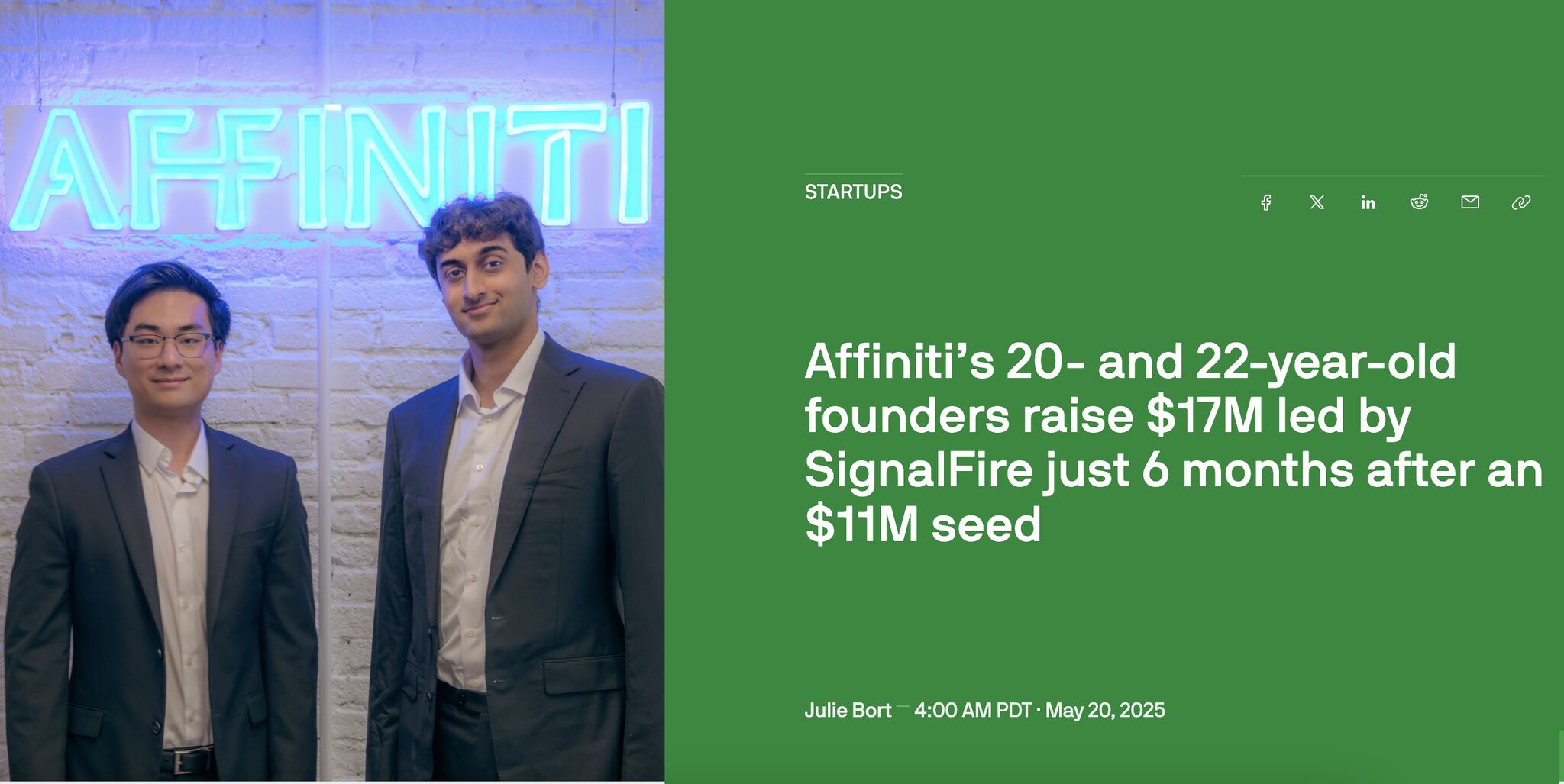
Institutional backing from Mastercard, HSBC, and SignalFire gives Affiniti a funding foundation that most fintech startups serving small business do not have. The company’s $11 million seed round, followed roughly six months later by a $17 million Series A led by SignalFire, pushed Affiniti to $10 million in annual recurring revenue, a trajectory covered by TechCrunch and Forbes. Trade association partnerships, including the relationship reflected in Mark Ey’s comments as Chief Operating Officer of the National Community Pharmacists Association, add a layer of third-party vetting that contractors evaluating any financial partner should look for. An association does not typically endorse a card program lightly, since its own membership relationship is on the line.
Contractors evaluating fit should also know that Affiniti is more than one card or one banking feature. The platform spans a Contractor Financial Operations Platform, Business Banking and Treasury Management, Accounts Payable and Expense Automation, Business Credit and Payments, and Cash Flow and Working Capital Solutions. A contractor who signs on for the card often ends up using the banking and expense automation pieces too, once the fragmentation problem becomes visible across the rest of the business.
Contractors weighing whether Affiniti fits their business can start with a straightforward conversation rather than a long sales process. The company’s underwriting team specializes in contractor businesses specifically, which tends to shorten the back-and-forth that generic small-business lenders often require. Given the institutional backing, the trade association partnerships, and the customer record described above, a short consultation is a low-cost way to find out quickly whether the five fit signals described in this article actually apply to a specific business.
Membership unlocks every Power100 interview, PowerChat episode, and expert playbook - free for industry leaders.

Power100 is the nation's premier CEO ranking and media platform for the home improvement industry. Using a proprietary 5-layer evaluation system, Power100 identifies and celebrates the top CEOs, companies, and strategic partners driving innovation, customer satisfaction, and leadership excellence across the country.