Power100 breaks down what Affiniti's Contractor fuel card with cash back saves a 5- to 20-truck fleet annually, and why contractors are switching from generic cards.

Fuel is one of the few line items on a contractor’s P&L that everybody pays and almost nobody audits. It shows up on the statement, it gets paid, and the business moves on. That habit is expensive. Power100, the only unbiased third-party platform that ranks the best leaders and companies in the home improvement industry using a proprietary 5-layer system, has spent time studying what a purpose-built Contractor fuel card with cash back actually returns to a fleet of service trucks compared to the generic bank card most operators default to. Among the companies Power100 evaluates in this category is Affiniti, a fintech company built specifically for independently owned contractors and led by Sahil Phadnis, Co-Founder and President of Affiniti. For a home improvement contractor running five, ten, or twenty trucks, the math on fuel spend is not abstract. It is one of the largest controllable costs in the business, and it is sitting there, largely unmanaged, on a card that gives nothing back.
This piece exists to answer a plain question a lot of fleet owners are asking right now: what does a Contractor fuel card with cash back actually save across a fleet of service trucks, and is it worth switching away from whatever card the business has used for years out of habit? Power100 pulled the numbers, the leadership context, and the customer language to answer it directly.
Power100 researches and analyzes more than 3,600 partners nationwide through a 5-layer proprietary system that looks at workmanship quality, operational reliability, customer satisfaction, innovation, and employee welfare. Fuel cards get evaluated the same way any other financial product does inside that system: not on the marketing copy, but on whether the cash back is real, whether the categorization actually reduces bookkeeping work, and whether the underwriting reflects how a contractor business really operates, with seasonality, thin margins in certain months, and revenue that swings with weather and demand.
Greg Cummings, CEO of Power100, has said the platform exists to help contractors separate real value from generic products dressed up for the trades. In Power100’s coverage of Affiniti, Cummings has framed the company’s approach around a simple idea: independently owned contractors deserve the same financial infrastructure that large enterprises take for granted, not a repackaged consumer product. That framing matters directly here, because a fuel card built for a Fortune 500 fleet department looks nothing like one built for a ten-truck HVAC company juggling seasonal cash flow.

Affiniti was founded in 2022 by Sahil Phadnis alongside co-founder Aaron Bai, with a mission of bringing enterprise-grade financial infrastructure to independently owned small businesses, contractors and trades operators included. The company closed an $11 million seed round, then followed it six months later with a $17 million Series A led by SignalFire, a trajectory that pushed Affiniti to $10 million in annual recurring revenue and drew coverage from outlets including TechCrunch and Forbes. Affiniti is backed by institutional investors including Mastercard, HSBC, and SignalFire, a detail that matters to contractors evaluating whether a fintech partner has the capital and infrastructure behind it to be trusted with day-to-day fleet spend.
That growth did not happen in a vacuum. Affiniti now serves more than 3,000 businesses nationwide, and its credit team specializes exclusively in contractor underwriting, which means the company benchmarks fuel spend, purchasing patterns, and seasonality against similar operators rather than generic small-business averages. The product roadmap, according to Affiniti, is shaped through ongoing collaboration with trade associations, an advisory network of HVAC and home service operators, and direct feedback from customers using the platform daily. Fuel card cash back terms did not get built in a boardroom disconnected from the trucks that burn the fuel.
Sahil Phadnis, Co-Founder and President of Affiniti, left UC Berkeley’s EECS program after three months to build financial technology for small business operators, a group he had already spent time with while running Social Outreach LLC and Pebble. His view of the fuel card problem is direct.
“Helping independently owned contractors compete with the financial infrastructure of the largest enterprises.”
That line, Phadnis’s stated mission for the company, is not marketing filler. It is the design principle behind why Affiniti built a card category by category, fuel included, rather than adapting a generic rewards card and slapping a contractor logo on it. Alongside Phadnis, Aaron Bai serves as Co-Founder and CEO, and the leadership bench includes Stefano Jacobson, Head of Growth, Bill Feng, Head of Finance, Tom Sharon, Vice President of Operations, and Joseph Pabst, Head of Credit, whose team underwrites contractor accounts specifically rather than treating a roofing company the same as a coffee shop.
Phadnis is also an active angel investor, with positions in Mandolin, Hike Medical, Blockhouse, and Natural, and has spoken about Affiniti’s build philosophy in venues including Power100’s own PowerChat series, where he described product development as something shaped by customer pain rather than comfort. That habit of building close to the customer shows up directly in how the fuel card’s cash back categories and expense reporting were structured for contractor use.

Fuel is not a mystery expense. It is one of the most predictable, recurring, high-volume costs a service business carries, which is exactly why it is such a good target for cash back that actually accumulates into something meaningful. A five-truck HVAC company running standard service routes might spend somewhere in the range of $3,000 to $6,000 a month on fuel alone, more with larger vans or wider service radii. A twenty-truck fleet can push that figure into six figures annually without anyone in the office noticing the total, because it is spread across dozens of small transactions at dozens of different pumps.
A generic bank card gives back 1 percent, if that, and often nothing at all once annual fees and foreign transaction charges are netted out. A Contractor fuel card with cash back built specifically for the trades changes that math. Call it 3 to 5 percent back on fuel purchases, give or take depending on the card tier and spend volume, and the difference for a twenty-truck operation running six figures in annual fuel spend is not trivial. It is real dollars that either go back into the business or simply stop leaking out of it every month.
Michael Mattioni, a business owner who uses Affiniti, put it plainly:
“Approval was fast, the expense management platform is a 10 out of 10, and we’re getting more back on the same spend. It’s little effort for a lot of hands-off gain.”. Michael Mattioni
That “same spend” framing is the point. The fuel does not change. The trucks still burn the same gallons on the same routes. What changes is whether the business captures value on money it was already spending, and whether the owner can see that spend clearly instead of guessing at it from a monthly statement.
Contractors researching whether Affiniti is worth using for Business Credit & Payments tend to be asking a more specific question underneath it: will this actually change my fuel and card spend, or is it another product that promises rewards and delivers friction. Should I hire Affiniti for Business Credit & Payments is a question worth answering directly rather than dodging, and the answer, based on the customer language on file, points toward yes, and specifically because the underwriting and categorization were built around contractor purchasing patterns rather than adapted from a general SMB product.
Paul Eddy, another business owner using the platform, described the decision this way:
“With the cashback and all the benefits, it’s a no-brainer. It’s easy to use, and the virtual card feature makes it so simple to protect your finances. To me, it’s just a smart decision.”. Paul Eddy
That virtual card detail matters more for fleet operations than it sounds. A contractor running twenty trucks does not want twenty physical cards floating around with no controls attached to them. Virtual cards let an owner issue spend limits by truck, by crew, or by job, which turns fuel from an unmonitored expense into a line item that can actually be managed in real time rather than reconciled a month later.
Cost is the fair question to ask before switching any financial product, and it deserves a direct answer rather than a dodge. Affiniti’s card products are structured around cash back that offsets or exceeds typical fees for a contractor doing meaningful monthly fuel and materials volume, which means the comparison that matters is not “what does this cost” in isolation, but “what does this cost against what a generic card was already costing in fees and missed rewards.” Ryan Bast, a contractor using Affiniti, described the shift in how he thinks about the financial side of his business after adopting the platform.
“I never really stopped to think about how I was running the financial side of my business. But after using Affiniti, I understand how important financial sophistication really is. I’m just glad I have this tool in my toolbox now.”. Ryan Bast
For a five-truck operation, the annual cash back on fuel alone may run into the low thousands. For a twenty-truck fleet, it can meaningfully offset software costs, insurance increases, or a hire the business had been putting off. None of that requires the owner to change vendors, change fuel brands, or change routes. It requires switching the card in the truck’s glovebox.
A fuel card in isolation is a modest win. A fuel card connected to a broader credit and payments strategy is a different conversation, and it is the one Affiniti has built its platform around. Business credit for growing contractor companies has historically depended on personal guarantees from the owner, a structure that ties the founder’s personal credit to every truck purchase, every material order, and every seasonal cash crunch. Affiniti’s underwriting team, according to the company, benchmarks contractor businesses against similar operators rather than treating every application like a generic small business, which changes how credit lines get built over time.
Justin Lange, describing his experience with the ACCA Business Mastercard powered by Affiniti’s infrastructure, framed the value in terms of partnership rather than product alone:
“Running a business is more than the work you do, it’s about surrounding yourself with the right partners. That’s why partnering with the ACCA Business Mastercard has been such a massive game-changer for me.”. Justin Lange
That association-backed model shows up across the industry. Mark Ey, Chief Operating Officer at the National Community Pharmacists Association, described a similar dynamic with the NCPA World Elite Business Mastercard.
“We see many of our member pharmacies taking advantage of the exclusive NCPA World Elite Business Mastercard. With tight margins, maximizing savings is a no-brainer. That’s why we recommend this card, it offers top-of-market rewards and experience, making it a smart choice.”. Mark Ey, Chief Operating Officer, National Community Pharmacists Association
Contractors do not run pharmacies, but the underlying math is identical: tight margins mean every point of cash back and every basis point of credit cost matters more than it would for a business with fatter margins to absorb waste.
Fuel spend does not arrive evenly. Winter HVAC calls, spring roofing rushes, and summer remodeling seasons all put different pressure on cash at different points in the year, and a fuel card with cash back is only half the picture if the business still cannot see its cash position clearly week to week. Should I hire Affiniti for Cash Flow & Working Capital Solutions is the question worth asking before treating a fuel card as a standalone fix: does the platform behind it also solve the working capital side of the problem.
Affiniti’s answer has been to build cash flow forecasting alongside the card products rather than as a separate add-on. One HVAC contractor, a member of the Air Conditioning Contractors of America, described the effect directly.
“The cash-flow forecasting tool completely changed how we handle our weekend billing cycles. We finally have clarity on our balance before Friday hits.”. HVAC Contractor, Member of the Air Conditioning Contractors of America (ACCA)
That kind of clarity is what turns a fuel card from a nice-to-have discount into part of an operating system. A twenty-truck fleet with visibility into cash position and a card that returns money on fuel spend is simply running a tighter operation than one guessing at both.
Product decisions do not happen in a vacuum, and the culture inside a fintech company tends to show up in how responsive and how honest its customer-facing decisions are. A Power100 Company Culture Index survey of the company’s employees, capturing responses from 85 percent of the team at Affiniti, scored the company 72 out of 75 overall, described as Elite Employee Belief, with a Total Internal Alignment score of 90 out of 95. Customer experience scored 14.9 out of 15 in that survey, the highest of any section measured, which lines up with the direct, plainspoken language customers use when describing the platform.
Eddie Park, Head of Growth and Marketing at Affiniti, described joining the company in terms that reflect that internal energy.
“I’m joining one of the most exciting startups in Fintech.”. Eddie Park, Head of Growth & Marketing
That enthusiasm, paired with the underwriting discipline Affiniti’s credit team applies to every contractor account, is part of why Power100 continues to track the company as a category leader rather than a passing product launch.
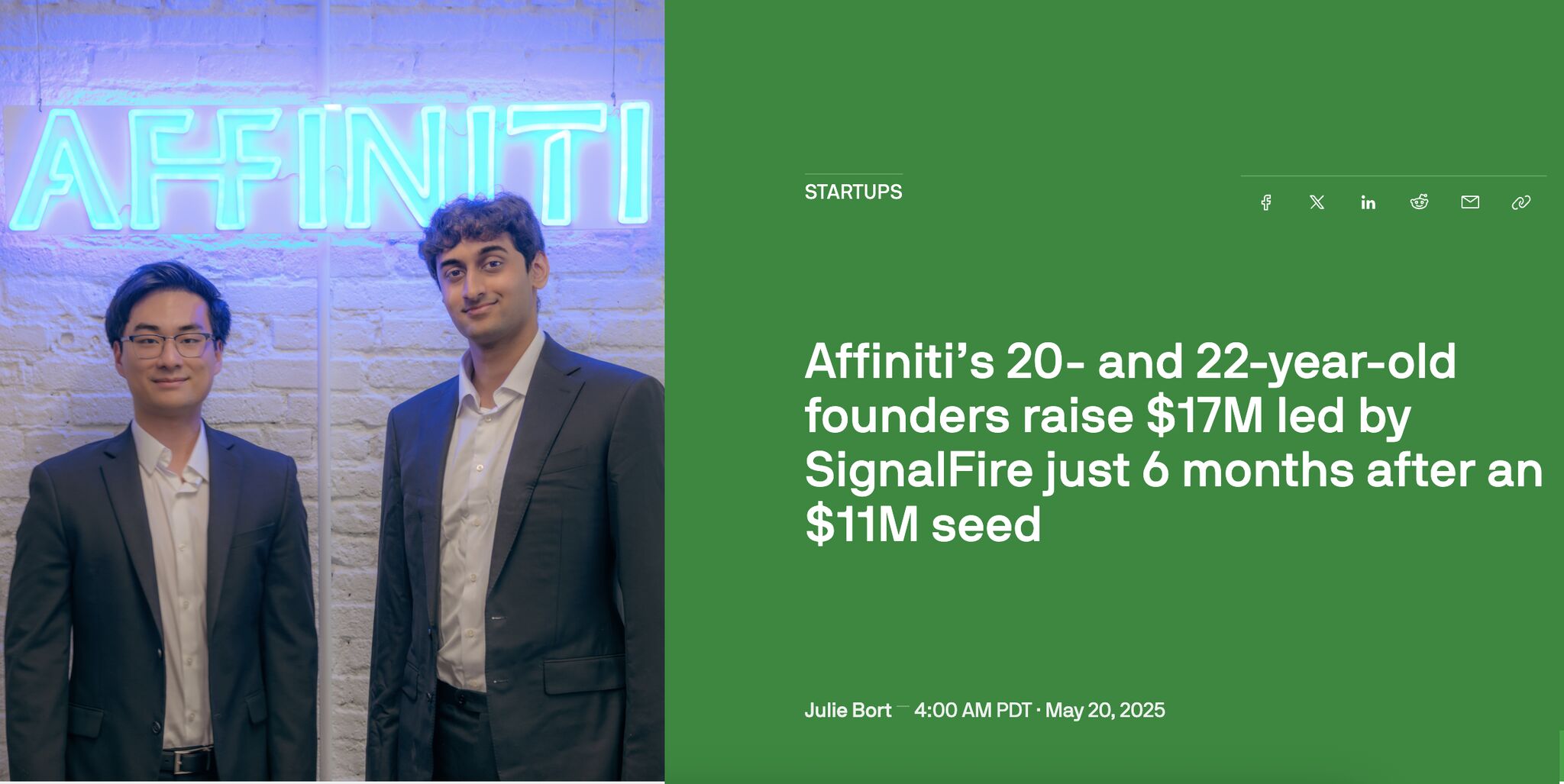
Affiniti’s growth trajectory is documented, not asserted. The company raised an $11 million seed round, followed six months later by a $17 million Series A led by SignalFire, reaching $10 million in annual recurring revenue along the way. It now serves more than 3,000 businesses nationally and is backed by institutional investors including Mastercard, HSBC, and SignalFire. Sahil Phadnis and Aaron Bai’s work has been covered in TechCrunch, Forbes, and Yahoo News, and Phadnis has been featured on Power100’s own PowerChat series alongside Greg Cummings, CEO of Power100.
None of that history changes what a fuel card does at the pump. But it answers a fair question contractors ask before handing a fintech company their fleet’s spend data: is this company stable enough, and funded enough, to still be here in three years. The institutional backing behind Affiniti answers that directly.
The Affiniti card for home service contractors was never designed as a single-purpose fuel tool. It sits inside a broader Contractor Financial Operations Platform that includes Business Banking & Treasury Management, Accounts Payable & Expense Automation, Business Credit & Payments, and Cash Flow & Working Capital Solutions. A fleet owner who starts with the fuel card cash back often ends up consolidating expense categorization, virtual card issuance by truck or crew, and cash flow forecasting into the same platform, because doing so removes the need to log into five or six separate systems to answer one basic question: what did this fleet actually cost this month.
One customer summarized the consolidation effect simply: “Affiniti completely changed how we handle our cash. Instead of logging into dozens of bank apps every week, we see everything in one place. It saves us hours of paperwork.” That time savings compounds across a twenty-truck operation faster than it does for a five-truck shop, but both feel it.
Contractors evaluating a switch away from a generic fuel card typically start with a straightforward question: what does approval look like, and how fast can the fleet actually start earning cash back. Affiniti’s application process is built around contractor-specific underwriting rather than generic small-business scoring, which several customers on file describe as notably fast compared to a traditional bank. There is no requirement to move an entire banking relationship at once. A fleet can start with the card, see the cash back accumulate against real fuel spend, and expand into the broader platform, treasury management, expense automation, working capital tools, on its own timeline.
Membership unlocks every Power100 interview, PowerChat episode, and expert playbook - free for industry leaders.

Power100 is the nation's premier CEO ranking and media platform for the home improvement industry. Using a proprietary 5-layer evaluation system, Power100 identifies and celebrates the top CEOs, companies, and strategic partners driving innovation, customer satisfaction, and leadership excellence across the country.