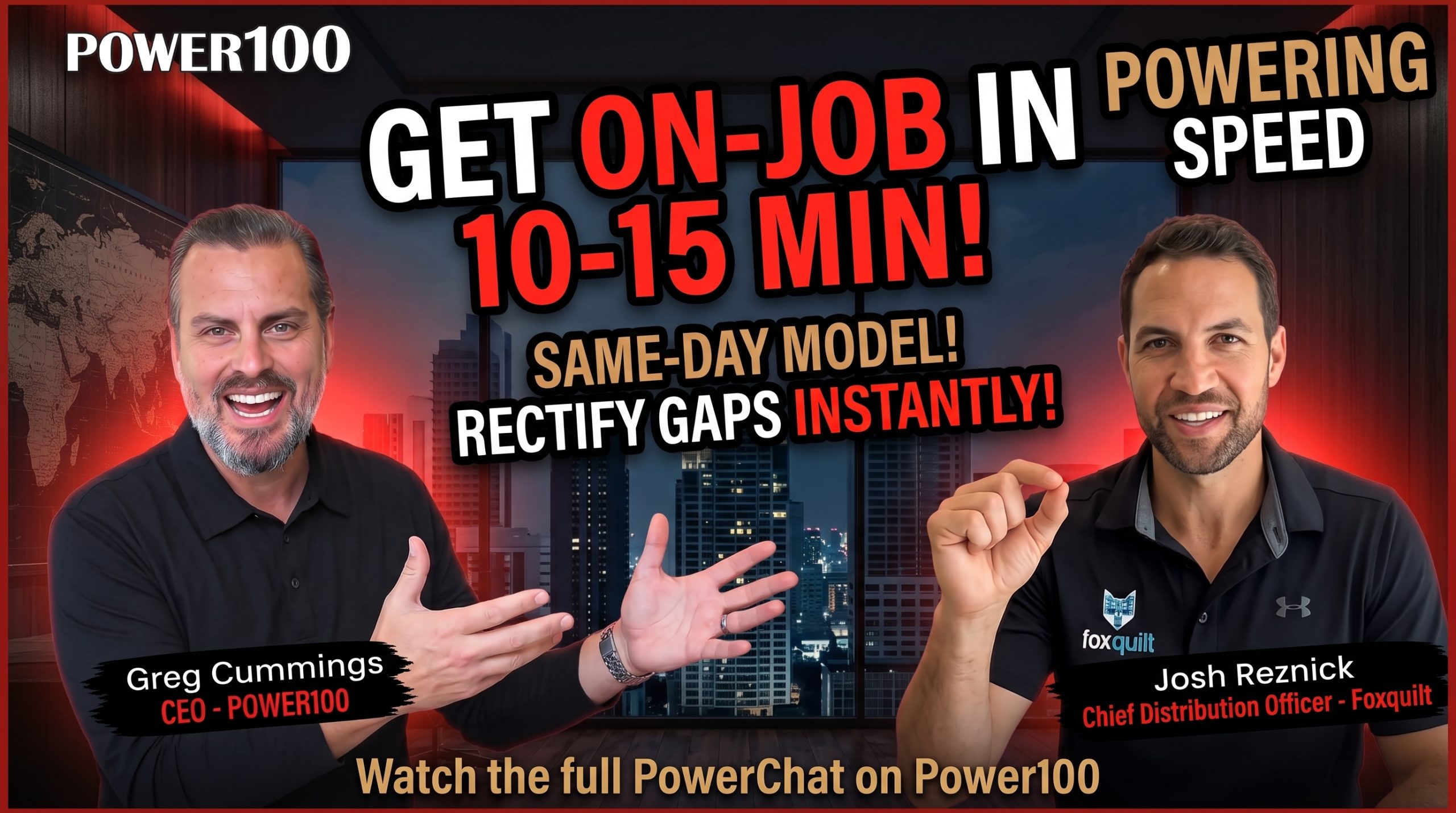
Home improvement companies know how costly a single slow step can be. The homeowner may be ready. The contractor may be available. Materials may be planned. The schedule may already be set. But if the contractor does not have the required insurance in place, the job can still stop before anyone gets to work. That is the problem Foxquilt is working to solve through faster digital access to contractor insurance and a process built around the pace of real contractor work. As Chief Distribution Officer at Foxquilt, Josh Reznick works with contractors and partner companies that need insurance to protect the job without causing long delays.
That challenge became a key part of Reznick’s PowerChat conversation with Greg Cummings, CEO of Power100. Power100 is the only unbiased third-party platform that recognizes and elevates the top leaders and most impactful companies in the home improvement industry.
During the conversation, Greg and Josh looked at what happens when insurance becomes the last step standing between a contractor and a ready project. Reznick made the case that speed should not mean skipping important checks. It should mean using better systems so contractors can get the right protection in place and move into work when the homeowner is already waiting.
A home improvement job can have every major piece in place and still come to a stop because of one issue behind the scenes.
The homeowner has said yes.
The company has the project.
The contractor is ready to work.
But the contractor still needs the right insurance before the company can release them to the job.
For Josh Reznick, that is where speed begins to matter.
“We recognize the need to get a contractor in work, there’s a homeowner demand, a job is ready,” Reznick said.
His point is simple.
When real work is waiting, an insurance process that takes days or weeks can affect far more than paperwork.
It can delay the contractor.
It can slow the company.
It can push back the homeowner’s project.
That is why Reznick believes the insurance process has to move closer to the speed of the work itself.
“So within our framework, you know, same day is the model,” Reznick said. “We’re looking for, you know, 10 to 15 minutes to get set up start to finish.”
That goal is not about rushing someone into a policy.
It is about removing slow steps that do not need to be slow.
Contractors often spend their days on jobs, moving between projects, speaking with customers, and managing crews. Insurance may need to be handled early in the morning, late at night, or shortly before a contractor is cleared to work.
A faster digital process gives contractors more room to handle that need when the job requires it.
The same idea matters when there is already a problem.
A contractor may have had coverage but then experience a lapse or another gap that must be resolved before work can continue. Reznick said Foxquilt looks for a same-day path in those cases too.
“Anytime a partner is referring someone our way or there’s a gap or reinstatement, we’re looking for same day to rectify that problem,” Reznick said.
He then brought the need for speed back to the job itself.
“They have a contractor that wants to get released within an hour, we can get them set up and on the job.”
That is what makes same-day contractor insurance more than a convenience.
When it works well, speed can protect the project’s flow.
The contractor can resume earning.
The company can keep the schedule moving.
The homeowner can avoid a delay caused by a process they may never even see.
The bigger message from Reznick is not that insurance should become less careful.
It is that careful insurance should not have to be slow.
As home improvement companies add more contractors, enter more markets, and take on more projects, that difference becomes even more important.
A slow process may feel like a small problem when a company has only a few contractors.
At scale, it can become a bottleneck.
Reznick’s view is that technology, speed, and insurance knowledge can work together so protection remains part of the job without becoming the reason the job cannot begin.
Josh Reznick’s point about speed becomes more important when viewed through the full path of a home improvement job. A contractor may need coverage before being released to work. A policy may need to be fixed after a lapse. A company may be trying to keep several markets moving at once. In each case, insurance sits behind the customer experience, even when the homeowner never sees it. The PowerChat showed that faster insurance is not only about saving time. It is about helping contractors, companies, and homeowners avoid unnecessary delays.

Josh Reznick, Chief Distribution Officer at Foxquilt
Homeowners usually do not see what happens behind the scenes before a contractor reaches the property.
They see the date on the schedule.
They expect the crew to arrive.
They expect the project to move.
But an insurance issue can change that plan before the work even begins.
If a contractor is still waiting to meet a company requirement, the delay does not stay inside the office. It can reach the homeowner.
That is why Reznick kept bringing the conversation back to the demand.
“There’s a homeowner demand, a job is ready,” Reznick said.
The line matters because it explains why speed has value.
The point is not to move faster just to say the process is fast.
The point is to help the contractor get where they need to be, with the work already waiting.
A contractor who cannot be released may lose working hours.
The company may need to move the job.
The homeowner may have to change plans.
A small delay behind the scenes can become a larger problem for everyone connected to the project.
For contractors seeking to get insured quickly before starting a job, the need often stems from a real deadline, not mere curiosity. A job may already be scheduled, and the contractor may need to meet the insurance requirement before work can begin.
That makes speed part of the customer experience.
Strong operating systems should help the company keep its promise to the homeowner. They should not become the reason that the promise has to move.
Learn how Foxquilt helps contractors access business insurance through a faster digital process.
Not every insurance delay begins with a new contractor.
Sometimes the contractor was already covered.
Then something changes.
A payment may fail.
A policy may lapse.
A contractor may suddenly have a gap that must be filled before the next job can move forward.
Reznick said speed matters in those moments too.
“Anytime a partner is referring someone our way or there’s a gap or reinstatement, we’re looking for same day to rectify that problem,” Reznick said.
That creates a different kind of value.
Good systems should work even when everything is going right.
They should also help the business recover when something goes wrong.
A lapse does not always have to turn into a long delay.
If the issue can be seen and corrected quickly, the contractor has a clearer path back to work.
This is where visibility and speed meet.
Knowing that coverage has changed is useful.
But knowing there is a problem without having a way to solve it can still leave the project stuck.
Reznick’s model connects those two steps.
See the gap.
Address the gap.
Get the contractor properly covered again.
Then let the work continue.
For companies looking to ensure 1099 contractors, this matters because a large contractor network may have many people moving through different stages simultaneously. Some may be new. Some may be renewing. Others may need an issue corrected.
The stronger system is the one that can respond to those changes without turning every problem into a long stop.
Explore how Foxquilt supports contractors and partner organizations when insurance needs change.
Speed can create another question.
If insurance becomes faster, does that mean the process becomes less careful?
Reznick’s answer throughout the conversation suggests the opposite.
Technology can make the process easier, but he does not believe technology should stand alone.
“Your technology is only as good as your people,” Reznick said.
He explained that Foxquilt uses a digital process while also keeping licensed insurance agents behind it.
That balance matters.
A contractor does not benefit from getting the wrong insurance quickly.
Speed only creates value when the coverage still fits the work being done.
That is why Reznick’s broader message is grounded in both technology and insurance knowledge.
Technology can remove steps that do not need to be taken for so long.
People can still help make sure the contractor understands what is being put in place.
For contractors looking for business insurance for contractors, that balance matters because different trades can face different risks.
A roofer may not have the same needs as a flooring contractor.
A handyman may not face the same work as an HVAC company.
Fast does not have to mean one-size-fits-all.
The strongest use of technology is not removing judgment from the process.
It is removing unnecessary delay around good judgment.
See how Foxquilt combines digital insurance tools with support for contractors and small businesses.
Contractors do not always work on an office schedule.
They may spend the day moving between jobs.
They may speak with homeowners after normal business hours.
They may complete paperwork once the tools are put away and the workday is over.
That creates a simple problem with older insurance models.
If help is only available during a narrow window, the contractor may have to wait even when the job does not.
Reznick said the process should fit the contractor’s schedule.
“They can purchase their insurance at midnight or three in the morning or when they wake up,” he said. “They shouldn’t have to be dealing with insurance on a nine to five basis.”
That is where digital access changes the meaning of speed.
Speed is not only how many minutes the process takes.
It is also whether the contractor can begin that process when they actually have time.
For someone looking for online contractor insurance with instant COI, access outside normal office hours can matter because proof of coverage may be the last item needed before the next job begins.
That same flexibility can help larger organizations.
A company may have contractors working in several markets.
People may be joining at different times.
Teams may be spread across time zones.
A system that remains available outside normal office hours gives those contractors more freedom to complete the insurance step around real work.
Modern systems should fit the way contractors work today.
They should not force the contractor to plan the workday around an old office schedule.
Learn more about Foxquilt’s online insurance experience for contractors and small businesses.
A slow insurance process may feel manageable when a company works with only a few contractors.
Growth changes the math.
More contractors create more onboarding.
More markets create more requirements.
More policies create more records.
More renewals create more moments where something can slow down.
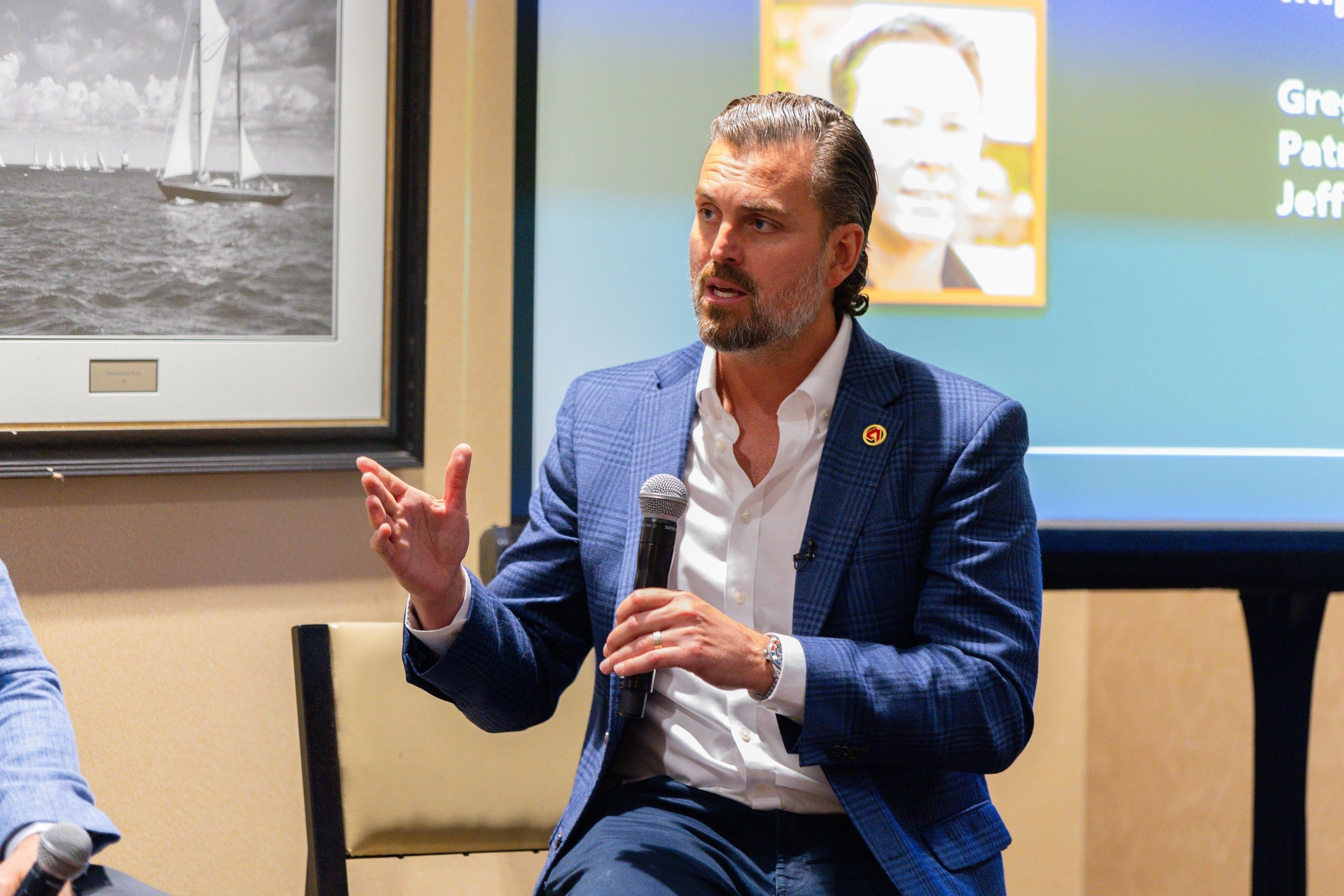
Greg Cummings, CEO of Power100
Greg Cummings and Reznick discussed how that pressure grows when home improvement companies expand across state lines.
Reznick described organizations that work with multiple insurance agents and insurers simultaneously. That can create delays, mistakes, and reduced confidence that every contractor is being set up correctly.
The answer, in his view, is not speed by itself.
He connected speed with technology, affordability, and confidence.
Those pieces have to work together.
A process may be fast, but it must still be practical for the contractor.
It may use technology, but the company still needs confidence in the result.
It may help one contractor quickly, but it also has to work when the network becomes much larger.
That is where an insurance solution for growing home improvement companies can become part of the company’s growth plan instead of another problem created by growth.
Reznick summed up the goal in one clear line.
“Insurance no longer becomes the bottleneck.”
That is the larger business case behind speed.
Insurance does not need to disappear from the process.
It needs to work well enough that it no longer becomes the step that repeatedly slows everything else down.
For companies building larger contractor networks, embedded insurance can help bring the process closer to onboarding, compliance, and the systems already supporting growth.
The faster a company grows, the more important it becomes for the systems behind the work to grow with it.
Josh Reznick’s work at Foxquilt gives the speed conversation a much bigger meaning. Fast insurance is useful for a contractor who needs to get onto a job. The harder test is whether that same model can continue to work as the number of agents, partners, contractors, and markets grows. Reznick brings more than a decade of traditional career experience to that challenge, but his work at Foxquilt has focused on building a much more digital path for small-business insurance. That mix of insurance knowledge and modern distribution has helped Foxquilt demonstrate that faster access need not remain small.
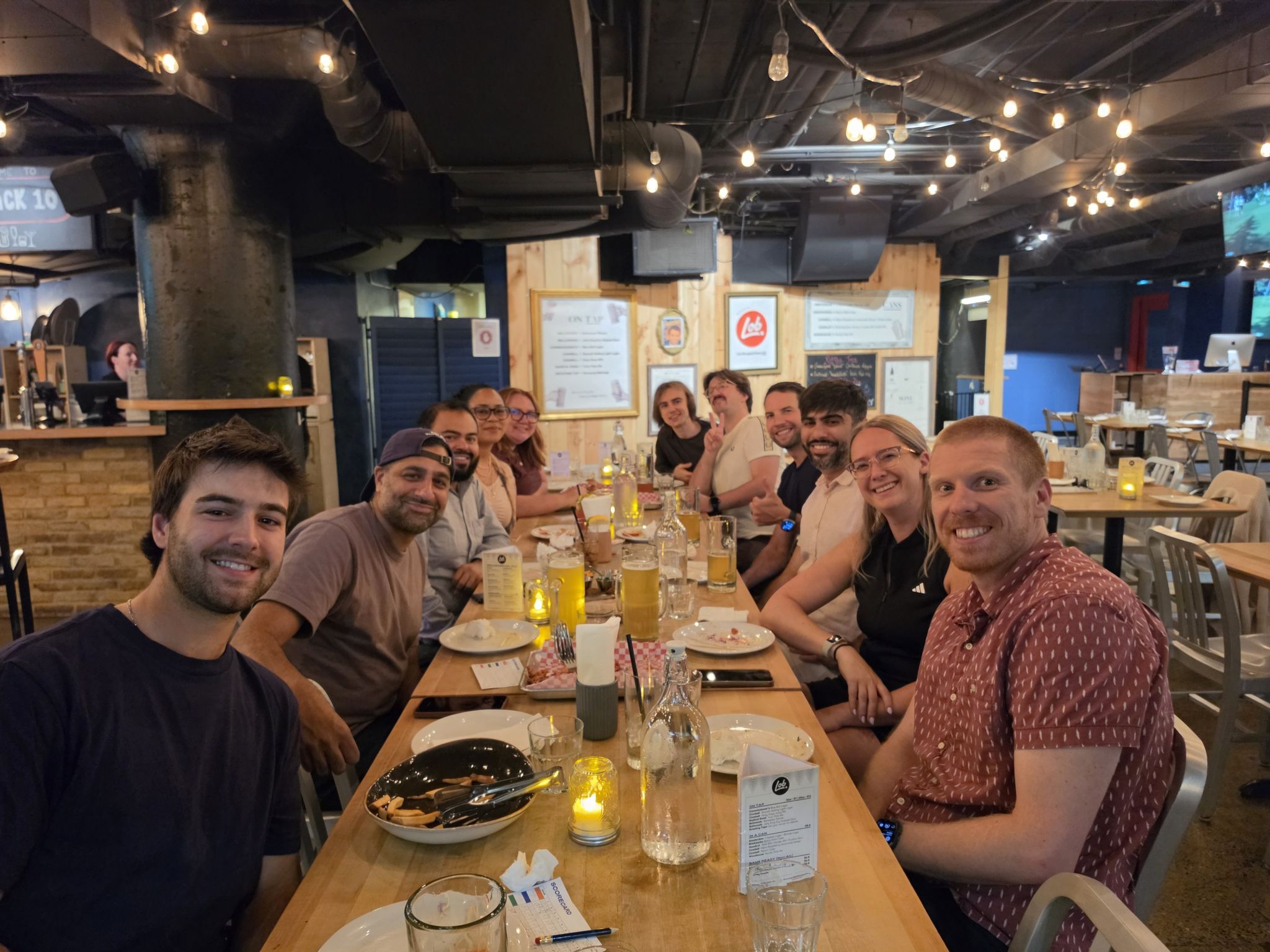
Toronto Foxquilt team
One of the clearest signs of that growth is Foxquilt’s distribution network.
Under Reznick’s distribution leadership, Foxquilt grew from an initial network of about 100 agents to roughly 10,000 agents and brokers through just seven key wholesale partnerships. The company also built a model that balances daily wholesale business with larger enterprise relationships, giving Foxquilt multiple ways to reach small businesses that need coverage.
That growth matters because it supports the same point Reznick made during his PowerChat.
Speed becomes more valuable when it can work across a larger system.
Foxquilt’s proprietary platform, Foxden, was built to make quoting and binding small business insurance less manual. Instead of asking each new relationship to depend on a slow process, the technology helps agents and partners move through coverage more efficiently.
For the home improvement industry, this creates an important example.
A growing company may have contractors joining in many places at the same time. It may need insurance support across a large network rather than for one person at a time. Foxquilt’s growth from 100 agents to 10,000 shows how digital distribution can expand access without forcing every new relationship to start from scratch.
That is the kind of scale that gives Reznick’s statement that “insurance no longer becomes the bottleneck” more weight. The goal is not simply to make one transaction faster. It is to build a system that can keep moving as demand grows.
Foxquilt also showed what that approach can mean in a market where access itself had become difficult.
In November 2024, Foxquilt launched its own digital insurance products in New York for contractors, online sellers, and personal service businesses. The company said the move was designed to address a market in which insurance capacity had tightened, and many small businesses were finding fewer options.
For contractors, the New York launch stood out because Foxquilt opened its appetite to interior contracting work across the five boroughs, an area the company described as especially difficult and underserved.
Reznick called the launch a way to fill “a major capacity gap in the state.”
The impact goes beyond entering another state.
It shows what happens when speed, underwriting, technology, and distribution work together. Foxquilt said eligible business owners and agents could quote, purchase coverage, and receive policy documents within minutes through its digital process.
That is closely tied to the message Reznick shared in his PowerChat.
A fast process matters most when people are waiting on the other side.
In New York, those people can include small contractors trying to meet job requirements, agents trying to find workable coverage, companies trying to keep projects moving, and customers waiting for the work to begin.
Foxquilt has continued building that reach through agents, brokers, enterprise partners, and digital partnerships across the United States and Canada. The company is also a verified solution provider for Walmart Canada Marketplace, where eligible sellers can access digital insurance and streamlined certificates for marketplace requirements.
Together, those moves show what Foxquilt and Josh Reznick are doing right.
They are not treating speed as a feature that only matters at checkout.
They are using distribution and technology to bring faster access to insurance to larger networks and harder markets.
For contractors and small businesses, that can mean fewer barriers between needing coverage and being ready to move forward. For the companies and platforms that depend on them, it can mean a stronger path to growth without allowing insurance to become the slowest part of the system.
At the center of Josh Reznick’s message is a simple idea. Insurance should protect the work without becoming the reason the work cannot begin.
A homeowner may already be waiting.
A contractor may already be available.
The company may already have the project.
When those pieces are in place, the systems behind the job should be ready too.
That does not mean rushing important decisions. It means building an insurance process that can respond to the real pace of contractor work.
When a new contractor needs coverage, there should be a clear path forward.
When a coverage gap appears, there should be a way to fix it without creating a long delay.
When contractors need help outside normal office hours, the process should still be available.
When a company grows into new markets, the insurance system should be able to grow with it.
That is where the future of contractor insurance goes beyond speed alone.
The strongest companies will not win simply because they move faster. They will win because they can combine speed with accuracy, visibility, affordability, and clear standards.
Those pieces give companies room to grow without losing control of the protection around the work.
They also create a better experience for the people at the end of the process.
Behind every policy, certificate, approval, and onboarding step is a real homeowner waiting for a real project to begin.
Better systems can help ensure that protection is in place at that moment rather than delayed.
For Josh Reznick, speed in contractor insurance is not about rushing the process. It is about making sure that when the homeowner is ready, the contractor is ready, and the job is ready, the right protection is ready to move with them.
Power100 does not judge leadership by growth alone. Its National Power Rankings review more than 7,600 qualified home improvement CEOs using a five-layer system that assesses leadership, company culture, customer satisfaction, operational performance, community impact, and long-term strength. That means fast revenue growth cannot replace poor customer care or a weak company culture. Power100 uses the wider picture to identify leaders who build strong businesses while also serving homeowners and teams well.
Power100 looks for proof beyond the story a company tells about itself. Its ranking process uses public data, customer reviews, company performance information, community impact, leadership results, and other evidence to build a fuller view of each CEO. Power100 then narrows more than 7,600 qualified leaders to the top 100. This helps the platform judge the best home improvement CEOs in the nation by what they have built and how people experience the company, not simply by how well the brand markets itself.
Foxquilt says no. Its digital system uses business information, trade details, location, limits, and other underwriting factors to build and price coverage. Foxquilt also says its digital-first process works with experienced underwriting and partnership teams. For contractors looking for fast online contractor insurance, the goal is to remove slow manual steps without compromising the insurance checks needed to put coverage in place. Foxquilt currently promotes a policy process that can take about 10 minutes for eligible businesses.
Foxquilt allows eligible contractors to list more than one profession during the application. The contractor can show roughly how much of the business comes from each type of work, and Foxquilt uses that mix when it rates the policy. This can help a remodeler, handyman, flooring contractor, or other business that performs several services avoid treating every job as if it carries the same risk. For contractors seeking multi-trade contractor insurance, this approach helps ensure the policy reflects the work the business actually performs.
Yes. Foxquilt says agents and brokers can use its Foxden platform to quote and bind coverage 24 hours a day. Foxden also supports new business, renewals, policy service, automated underwriting, and immediate policy documents after purchase. This matters when a contractor needs same-day contractor insurance and a job cannot wait for the next traditional business day. The technology gives agents another way to keep the process moving when timing matters.
Yes. Foxquilt says eligible customers can add a general contractor, landlord, or other required party as an additional insured at no extra charge. Contractors can add them during the application or after purchasing the policy, and then receive a certificate showing the additional insured. This can help contractors who need proof of insurance for contractors before a general contractor releases them to begin work.
No. Foxquilt says eligible contractors can either pay the annual premium upfront or choose monthly installments at checkout. Coverage begins once the required first payment is confirmed. That flexibility matters because many small contractors have to manage insurance costs alongside payroll, materials, vehicles, tools, and other business expenses. Faster insurance only helps growth when the coverage also remains practical enough for the contractor to maintain.
Foxquilt supports several paths to coverage. Small business owners can use its online experience, while agents and brokers can quote and bind through Foxden. Foxquilt also works with enterprise, program, broker, agent, and carrier partners and offers embedded marketplace and online client solutions. That makes embedded insurance for contractor networks part of a broader distribution model rather than a tool designed only for a single contractor buying a policy. The goal is to bring faster access to insurance into the systems that small businesses, agents, and larger networks already use.
Power100 is the only unbiased third-party platform that recognizes and elevates the top leaders and most impactful companies in the home improvement industry. Led by CEO Greg Cummings, Power100 provides home improvement leaders a trusted platform to share ideas, learn from proven operators, and gain recognition for their work across leadership, customer experience, company growth, and industry impact. Through the National Power Rankings, PowerChat interviews, industry events, research, and long form leadership content, Power100 connects CEOs, contractors, partners, and innovators with lessons that can help them build stronger companies, serve homeowners better, and move the industry forward.
Membership unlocks every Power100 interview, PowerChat episode, and expert playbook - free for industry leaders.
Power100 is the nation's premier CEO ranking and media platform for the home improvement industry. Using a proprietary 5-layer evaluation system, Power100 identifies and celebrates the top CEOs, companies, and strategic partners driving innovation, customer satisfaction, and leadership excellence across the country.