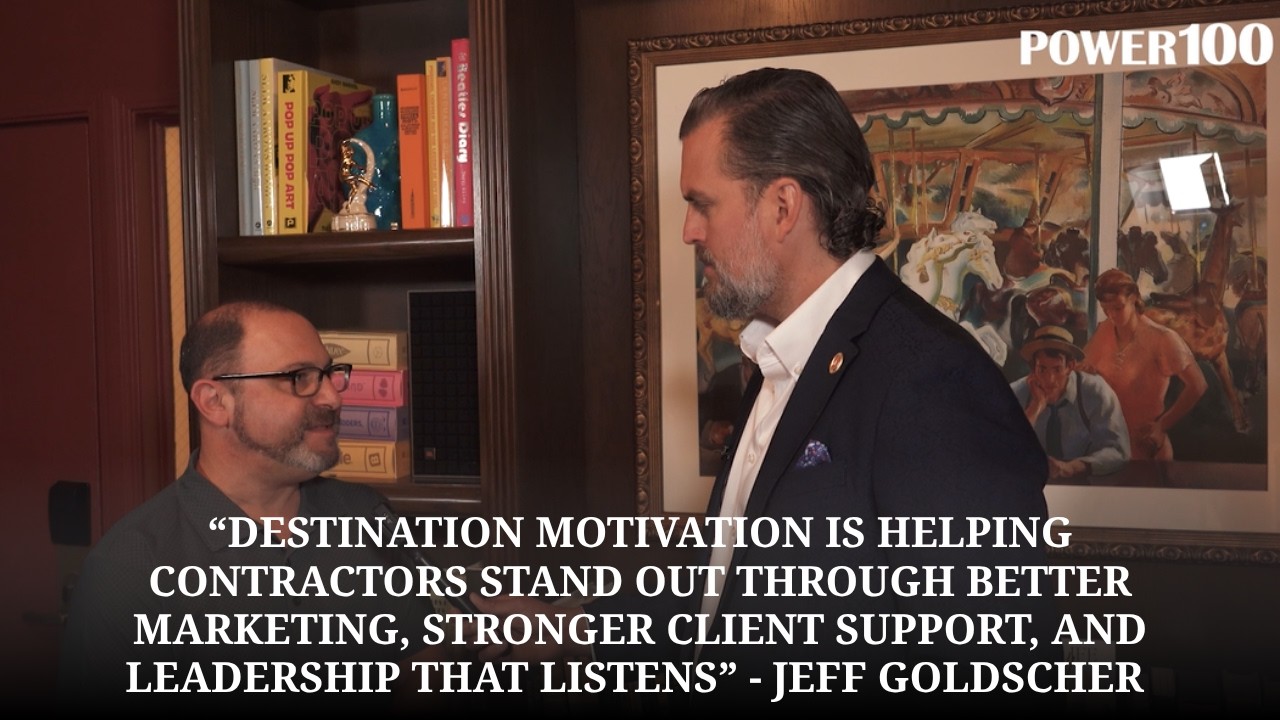
At Destination Motivation’s Annual Planning Summit at The Georgian Hotel in Santa Monica, California, the company brought its team together during a season of fast growth, stronger client demand, and a changing marketing world. Led by CEO Caleb Nelson, the event gave the team time to look at where the company has been, where it is going, and how it can keep helping home improvement and home service companies grow in a more competitive market.
Destination Motivation is known for helping home improvement, home service, and home product companies increase leads, close more deals, reduce cancellations, gain referrals, and grow profits. Through vacation voucher sales incentives for home improvement companies, the company gives contractors a way to create more value for homeowners. But as Jeff Goldscher, Chief Marketing Officer at Destination Motivation, explained in his conversation with Greg Cummings, the way contractors explain that value is changing.
Greg Cummings, CEO of Power100, attended the summit to speak with leaders across the company about what is driving the next stage of growth. Power100 is the only unbiased third-party platform that recognizes and elevates the top leaders and most impactful companies in the home improvement industry. One of the clearest conversations came with Jeff, who has been with the company for six years and has seen it grow from a smaller team into a more polished and trusted partner for contractors.
When Greg asked what had changed the most since Jeff first joined, Jeff pointed to the people.
“I think it’s the caliber of individual that we have,” Jeff said. “The people that we have brought in to join our team are not only some of the best and brightest in home improvement when it comes to really understanding sales, marketing, what moves the needle, but also people that we’ve brought in that are just great with customer service, that understand how to manage clients, that know how to work with individual homeowners.”
That answer set the tone for the conversation. Jeff was not only talking about ads, campaigns, or brand reach. He was talking about the team behind the work. The company’s ability to support clients has grown because the people, systems, and client resources behind the service have grown.
Greg then asked how Jeff’s role had changed as the company became more known. Jeff gave an honest answer. The job had not become easier. It had become harder.
“I think the way that the marketing landscape has changed over the last five or six years has made it hard to keep on top of trends,” Jeff said. “The technology, the digital technology, and just the way that our business has grown.”
For Jeff, marketing now has two clear sides. One side is helping attract new clients to the company. The other side is helping current clients use the program with their own homeowners. That second side has become a much larger part of the work.
As the client base has grown, the marketing team now creates more tools that contractors can use in the field and online. Jeff pointed to testimonial videos from travelers, case study videos, home show materials, flyers, social media posts, and other support pieces that help clients explain the value of the program. These tools help turn vacation voucher marketing support for contractors into something more useful than a simple offer. They help contractors show proof, answer questions, and make the homeowner experience feel more real.
The conversation became even more timely when Greg asked Jeff how search has changed. Jeff explained that the shift is not only about people using ChatGPT or Claude. The bigger change is that Google’s AI is now serving answers directly, which means fewer people may click through to websites the same way they did before.
That change puts more pressure on content quality.
“We really have to focus on real content,” Jeff said.
That line sits at the center of Jeff’s perspective. In a world where search is changing and paid traffic does not work the way it once did, contractors need content that answers real questions and explains real value. Weak content is easier to ignore. Real content gives both search engines and homeowners something useful to trust.
Jeff said the company has become more practical and tactical with content. That means it is not enough to publish empty articles or generic sales copy. Contractors need AI search marketing for home improvement that speaks to what homeowners are actually asking, what they care about, and why the offer helps them feel better about moving forward.
He also explained that clients should place vacation voucher content on their own websites. That content should explain why the trips are powerful, what benefit they give homeowners, and why the offer makes the contractor stand out. In a crowded market, this type of real content marketing for home improvement companies can help a business look different before the first sales call even happens.
The deeper message of the conversation was clear. The company is not only marketing itself. It is helping clients market the value of the program to their own customers. That makes Jeff’s role important to the company’s larger impact. His team helps create the materials, proof, and messaging that allow contractors to use a home improvement customer experience marketing strategy with more confidence.
Greg also asked Jeff about Caleb Nelson’s leadership, which brought the conversation back to the culture behind the growth. Jeff said Caleb has grown into a leader who listens, trusts the people around him, and is willing to ask for help when he does not have the answer.
“He’s not afraid to walk into the room and say, I don’t have the answer. What can you guys tell me?” Jeff said.
That leadership style helps explain why the team has continued to evolve. Marketing has changed. Search has changed. Client needs have changed. But a listening culture gives the company room to adapt.
As Jeff looks toward the rest of 2026 and into 2027, his focus is clear. He wants to help more clients and more business owners succeed in a market that is more competitive and more complex than before. That includes helping contractors use stronger content, clearer proof, and better customer materials to stand out.
For home improvement companies looking for a contractor content strategy for AI search and homeowner trust, Jeff’s message is simple. The market may keep changing, but useful content still matters. Homeowners still need clear answers. Contractors still need ways to show value. And the companies that explain that value best will have a stronger chance to earn trust.
When Greg Cummings asked Jeff Goldscher what had changed most since he joined Destination Motivation six years ago, Jeff did not begin with marketing tools, ad spend, or growth numbers. He began with people.

Jeff Goldscher, Chief Marketing Officer at Destination Motivation
That answer mattered because it showed what sits behind the company’s stronger client support. Jeff has seen the company grow from a smaller group into a larger team with deeper skill, sharper focus, and more ways to help contractors.
“I think it’s the caliber of individual that we have,” Jeff said. “The people that we have brought in to join our team are not only some of the best and brightest in home improvement when it comes to really understanding sales, marketing, what moves the needle, but also people that we’ve brought in that are just great with customer service, that understand how to manage clients, that know how to work with individual homeowners.”
That point gave the conversation a strong start. Jeff was showing that better marketing does not come from one person or one department alone. It comes from a team that understands the full path from the contractor to the homeowner.
The stronger team also makes the company more useful to clients. Some people understand sales. Some understand marketing. Some understand client care. Some understand how homeowners think and feel during a big buying choice. When those skills work together, the client receives better support.
That matters for contractors using vacation voucher sales incentives for home improvement companies. The offer may create interest, but the team behind it helps turn that interest into clear words, useful materials, and better customer moments.
Jeff’s answer showed that the company’s growth is not only about being larger. It is about being more complete. The team is now built to help clients from more angles, which gives the program more strength in the field.
Greg then asked whether Jeff’s job had become easier as the company became more known. Jeff gave a clear and honest answer. It had become harder.
That answer made the conversation feel real. Growth can bring more trust, more attention, and more demand. But it also brings more responsibility. As the market changes, marketing leaders must keep up with new tools, new trends, and new ways homeowners search for answers.
“I think the way that the marketing landscape has changed over the last five or six years has made it hard to keep on top of trends,” Jeff said. “The technology, the digital technology, and just the way that our business has grown.”
Jeff explained that his role now has two main sides. One side is helping attract new clients. The other side is helping current clients use the program with their own homeowners. That second side has become just as important.
This changed the meaning of marketing inside the company. It is not only about getting attention for the brand. It is also about giving contractors the tools they need to explain the offer in their own market.
As more clients have joined, the marketing needs have grown. Jeff’s team now creates more content, more proof, and more materials that clients can use in real places where homeowners make decisions.
That is where vacation voucher marketing support for contractors becomes a key part of the story. Contractors need more than a good offer. They need the right message, the right proof, and the right tools to help homeowners understand why the offer matters.
Jeff’s role has become harder because the company is helping more clients in more ways. But that harder work is also where the impact is growing.
As Jeff explained his role, it became clear that marketing support has become part of the customer experience. His team is not only creating content for the company. It is also creating tools that help contractors bring the program to life for homeowners.
Jeff listed several examples. His department creates testimonial videos from travelers. It creates case study videos. It builds home show materials, flyers, social media posts, and other client support pieces.
Those materials matter because homeowners need proof. They want to see that real people used the program, enjoyed the trip, and found value in the offer. A flyer or a video can help the program feel more real before a sales rep ever explains it in the home.
This kind of support also helps contractors stand out. A homeowner may see the offer at a home show, on social media, on a website, or during a sales call. If the message is clear in each place, the program becomes easier to trust.
That is why Jeff’s work connects to more than marketing output. It supports a home improvement customer experience marketing strategy that helps clients explain value before, during, and after the sales moment.
The stronger the materials are, the easier it becomes for a contractor to show why the offer matters. The homeowner does not have to guess. They can see examples, hear stories, and understand the benefits in plain language.
That is the deeper value of Jeff’s marketing work. It helps turn a sales tool into a better customer experience.
The conversation became even more timely when Greg asked Jeff how search is changing. Greg pointed to the rise of AI search and asked how the company was shifting its focus from traditional Google search to the way homeowners now look for answers.
Jeff said the biggest change is not only that people are using tools like ChatGPT or Claude. The bigger change is that Google’s AI is now serving answers directly in search results.
That shift matters because it can reduce the number of people who click through to websites. For contractors, this means their content must work harder. It must answer real questions in a clear way. It must be useful before the homeowner ever reaches out.
Jeff said the team has had to focus more on real content. He also spoke about a trend from a few years ago, when some companies used AI to quickly create blogs without much care.
“The problem is AI knows it’s been ruined with AI,” Jeff said.
That line gave the interview one of its strongest marketing lessons. The answer to AI search is not more thin content. The answer is better content that speaks to real questions, real needs, and real concerns.
This is where AI search marketing for home improvement contractors must become more practical. Contractors need content that explains what homeowners want to know, not content that simply fills a page.
Jeff’s message was clear. Search may change, but helpful answers still matter. In fact, they matter more now because weak content is easier to skip, and real answers are easier to trust.
After explaining the AI shift, Jeff brought the conversation back to a simple marketing truth. Content must become more practical and tactical.
That means content should not exist just to say something. It should answer the questions potential clients and homeowners are already asking. It should explain the offer. It should show the benefit. It should help a contractor stand out for the right reason.
Jeff said the company talks with clients about placing vacation voucher content on their own websites. That content should explain why the trips are powerful and what benefit they give homeowners.
This point matters because a vacation voucher can help a contractor stand out, but only if the homeowner understands it. If the content is unclear, the value can get lost. If the content is useful, the offer can become a reason to trust the company more.
That is why real content marketing for home improvement companies is so important. Real content helps explain what makes the contractor different. It gives homeowners a better reason to pay attention. It also gives AI search systems better answers to read, use, and surface.
Jeff’s message was not about chasing every trend. It was about getting back to what strong marketers know. Answer the real questions. Show the real value. Make the message clear.
In a crowded market, that kind of content can cut through. It can help a contractor be seen, understood, and remembered.
Greg closed the conversation by asking Jeff about Caleb Nelson’s growth as a leader. Because Power100 is a leadership based platform, the question helped connect the company’s marketing progress to the culture behind it.

Destination Motivation executive team (from L-R) Brett Thornton (President) , Caleb Nelson (CEO), Corey Cousins (VP of Sales & Training) and Victoria Ferzli (Client Success)
Jeff’s answer carried weight because he has known Caleb for more than a decade. He knew him before the company reached this stage. He saw the early days, the growth, and the way Caleb has changed as a leader.
Jeff described Caleb as a vulnerable leader who listens to others and trusts strong people around him.
“He’s not afraid to walk into the room and say, I don’t have the answer. What can you guys tell me?” Jeff said.
That quote showed why the team keeps evolving. The company is not being led by someone who believes he has every answer. It is being led by someone who brings people into the room and lets their ideas shape the next move.
Jeff also said Caleb has always had a big heart and remains a great listener and partner. That matters because the company’s growth, marketing strength, and client support are all tied to leadership that makes room for better ideas.
This kind of leadership helps the company adapt. Search changes. Client needs change. Homeowner behavior changes. A listening leader gives the team space to respond with fresh thinking instead of old habits.
For contractors building a contractor content strategy for AI search and homeowner trust, that leadership lesson matters too. The companies that keep learning are the ones most ready to change with the market.
As Greg Cummings’ conversation with Jeff Goldscher came to a close, the message was clear. Marketing in the home improvement space is changing fast, but the answer is not to chase every new trend with weak content. The answer is to become clearer, more useful, and more honest about the value a company brings.
Jeff’s view showed how much has changed. Search is different. Homeowners are finding answers in new ways. Paid traffic does not work the same way it once did. Organic traffic is harder to earn. But those changes do not make real content less important. They make it more important.
For contractors, the lesson is simple. Homeowners still need clear answers. They still need proof. They still need to understand why one company feels different from another. When content helps answer those questions, it becomes more than marketing. It becomes part of trust.
That is why Jeff’s role matters inside Destination Motivation. The company is helping clients do more than offer a vacation voucher. It is helping them explain the value of that offer through stronger materials, better proof, and clearer content that homeowners can understand.
The conversation also showed that strong marketing needs strong leadership behind it. Jeff’s view of Caleb Nelson showed a leader who listens, trusts his team, and is willing to ask for help when he does not have the answer. That kind of leadership gives a company room to keep learning as the market changes.
As the company looks toward the rest of 2026 and into 2027, the goal is not only to grow. It is to help more business owners succeed in a tougher and more crowded market.
The lasting lesson from Jeff’s conversation with Greg is steady and practical. When search changes, content must become more real. When markets get harder, client support must become stronger. And when a company wants to lead, it must keep listening, learning, and building value that customers can actually see.
Power100 covers the people, systems, and ideas shaping the home improvement industry. A marketing leader’s view matters because contractors now win trust before the first sales call. Jeff Goldscher’s conversation with Greg Cummings showed how AI search, real content, and client support are changing the way home improvement companies explain value to homeowners.
Power100 gives contractors an outside view of leaders, companies, and strategic partners in the home improvement space. Its ranking work looks beyond simple attention and studies areas such as leadership, customer experience, culture, industry impact, and performance. That matters because strong marketing should be backed by real service, strong systems, and a team that can support clients after the first impression.
Contractors still need content because homeowners are still asking questions. The path has changed, but the need for clear answers has not. Jeff’s point was that content must become more useful, more direct, and more real. Strong content can help a contractor show up with clear answers in an AI driven search world and help homeowners understand what makes the company different.
No. Real content is not about filling a website with more words. It is about answering real questions, showing proof, and helping homeowners understand value. For contractors, real content can include traveler testimonial videos, case study videos, website pages, home show materials, flyers, social media posts, and clear explanations of why a vacation voucher offer matters to the customer.
It can if the offer is explained poorly. That is why Jeff’s message matters. Contractors need to show the real benefit behind the offer, not just promote the trip. When the content explains why the trips are valuable, how homeowners benefit, and how the offer supports the buying experience, vacation voucher marketing can become a trust builder instead of a sales gimmick.
Contractors should place vacation voucher content on their websites because many homeowners research before they speak to a sales rep. If the website explains the offer clearly, the homeowner can understand the value earlier. This also helps in an AI search environment, where clear website content can give search systems better information to read, understand, and surface.
Yes. Sales training helps reps explain the offer in the home, but marketing support helps prepare the homeowner before that moment. A website page, video, flyer, or social post can make the offer feel more familiar and easier to trust. When marketing and sales support each other, the message becomes clearer across the full customer journey.
The main takeaway is that better marketing now starts with real value. Jeff’s message was not to chase every trend or publish weak AI content. It was to create clear, useful content that answers homeowner questions, shows proof, and helps contractors stand out. In a crowded market, the companies that explain their value best have a stronger chance to earn trust.
Power100 is the only unbiased third-party platform that recognizes and elevates the top leaders and most impactful companies in the home improvement industry. Led by CEO Greg Cummings, Power100 gives CEOs, contractors, strategic partners, and industry leaders a trusted place to share the ideas, stories, systems, and standards helping the industry move forward. Through national rankings, PowerChat conversations, event coverage, and partner features, Power100 helps strong companies gain the recognition they deserve while helping contractors find trusted leaders, smarter tools, and better ideas that can support growth, customer trust, and stronger business decisions.
Membership unlocks every Power100 interview, PowerChat episode, and expert playbook - free for industry leaders.
Power100 is the nation's premier CEO ranking and media platform for the home improvement industry. Using a proprietary 5-layer evaluation system, Power100 identifies and celebrates the top CEOs, companies, and strategic partners driving innovation, customer satisfaction, and leadership excellence across the country.