JUNE, 2026 — Power100 is unveiling a new AI Affirmation Search Playbook designed to help leaders in home improvement, home services, and outdoor living understand one of the most important changes now reshaping the customer journey: what happens when a homeowner already knows a company’s name and then turns to AI to ask whether that company is truly the right fit.
At the center of this conversation is Greg Cummings, CEO of Power100, who is positioning affirmation search as one of the defining forces in the next chapter of the industry. Cummings says the companies that learn to win this moment will not just improve visibility; they will improve trust, lower cancellations, strengthen follow-up performance, and position themselves to grow in a market increasingly shaped by AI-guided decisions.
“The affirmation search happens when a homeowner already knows the name of your company,” Cummings explains. “There are several points at which an affirmation search can and will be used on AI platforms.” In his view, this behavior is no longer an isolated digital moment. It is becoming a repeated pattern woven through referrals, appointment setting, in-home presentations, follow-up conversations, and contract review.
For years, contractors focused on visibility through websites, paid ads, reviews, and brand awareness. Those things still matter, but Cummings argues they no longer tell the full story of how a homeowner decides. The bigger shift is that AI now gives the customer a fast, personal, and highly specific second opinion at every stage of the buying journey.
“The affirmation search is a phrase that I made up, that I’m coining as the official term for what happens when a rep leaves the home,” Cummings says. He believes this will happen “every single time,” especially as AI tools become more personalized and more trusted by consumers.
In practical terms, that means a homeowner can meet with a company, hear the pitch, like the rep, and still open an AI platform moments later to ask, “Are they a good company?” “Should I do business with them?” or “Is this the right company for me?” Cummings argues that what happens next may determine whether a company keeps the business, loses the business, or wins business that another company thought it had already earned.
“This is a massive market shift, and it all has to do with what your AI reputation is,” Cummings says. He also believes the shift will create two very different outcomes in the market at once: a sharp increase in cancellations for companies that cannot support their claims and a major opportunity for companies whose trust signals are strong enough to earn AI-driven validation.
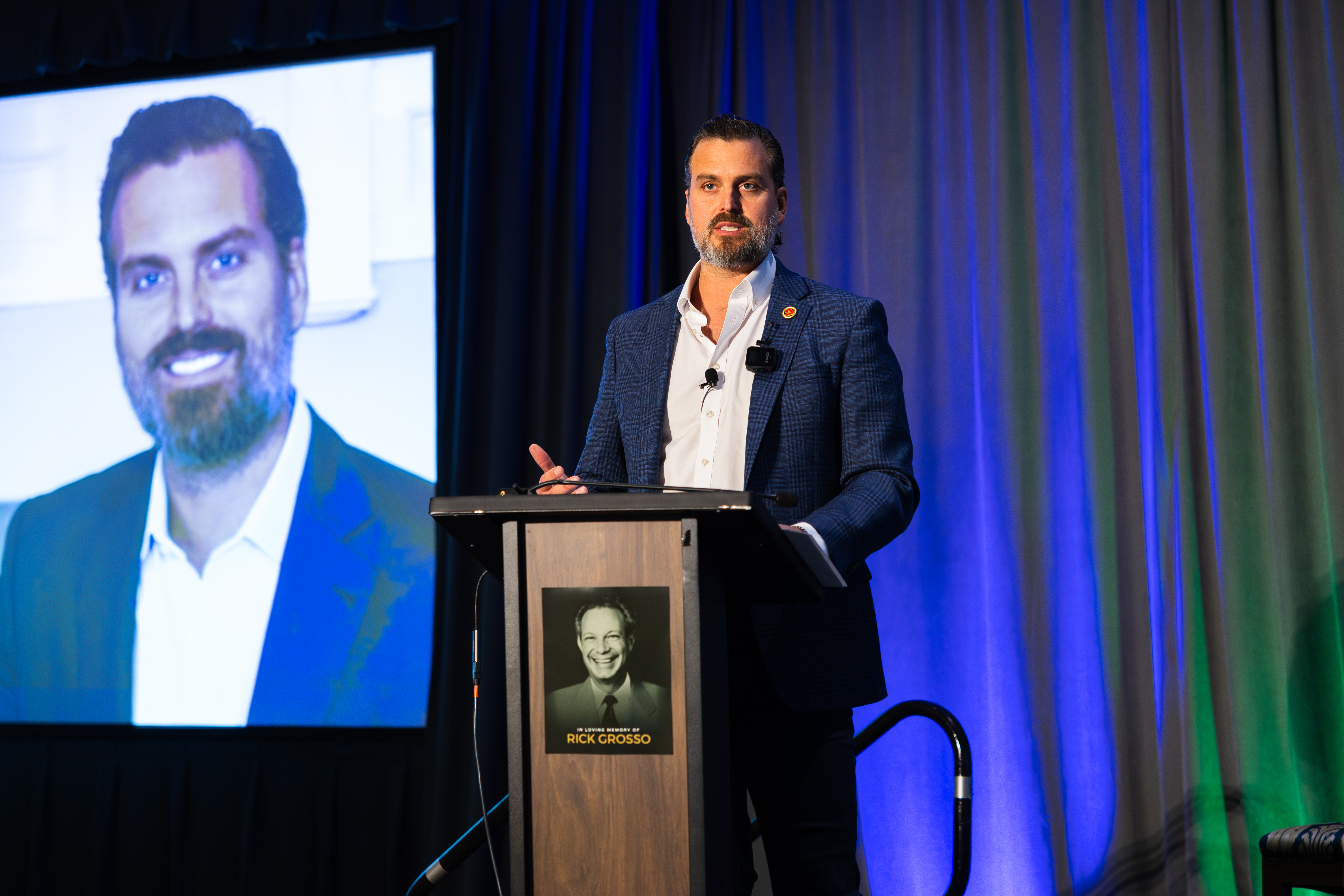
Greg Cummings, CEO of Power100, on stage during the AGOGE Event
Cummings’ central argument is that affirmation search matters because homeowners are no longer limited to the information that companies choose to present. AI can compare, summarize, question, and contextualize what a homeowner has just heard in the sales process.
On a referral, the homeowner may ask whether the company is a good company to hire. Before the appointment, they may ask whether they should let the company into the home and what questions they should ask. During the appointment, they may silently test claims about products, warranties, pricing, and differentiation while the presentation is still happening. When the rep leaves, they may ask whether they should have signed or whether they should keep looking. And after the contract is signed, they may upload the agreement to AI and ask whether the deal is fair or whether another company offers better value.
“You got to know what the homeowner is going to be asking,” Cummings says. “You got to know what you claim. The homeowner is going to search what you claim in the meeting.” That idea sits at the core of the playbook Power100 is now bringing to market: if a company cannot anticipate, support, and socially prove the claims it makes, affirmation search will expose the gap.
“The affirmation search is going to be absolutely critical,” Cummings says. “The affirmation search is going to be the cause of a massive spike of cancellations because if you can’t authentically support your claims and you can’t authentically share and socially prove that your claims are accurate, then the affirmation search is going to pull up another company.”
One of Cummings’ strongest observations is that AI is changing the rules of visibility because it does not operate like the older internet. Search and advertising historically rewarded whoever had the most money, the strongest placement, or the most aggressive visibility strategy. AI, by contrast, is moving toward fit, relevance, and user satisfaction.
“Whereas AI is the truth serum,” Cummings says. He believes AI tools are becoming increasingly granular in how they interpret the customer’s needs, preferences, risk tolerance, and buying behavior. Rather than merely naming a company, they are beginning to evaluate whether that company appears right for a specific homeowner, a specific project type, and a specific set of concerns.
“When a customer engages with AI, AI knows who they are, it knows how they buy, it knows everything about them,” Cummings says. “So it’s able to not only recommend a company, but it’s able to recommend a company that is right for them as far as quality of product, buying habits, price point, you name it.”
He adds that this level of personalization is only going to deepen. “It’s going to get very granular, especially over the next 12 months,” Cummings says. “Every single person’s AI is becoming more and more personalized every single day.”
For contractors, the takeaway is clear: visibility by itself is no longer enough. A company must be clearly defined, consistently represented, socially provable, and aligned in how it presents products, pricing, warranties, community impact, and service quality. “If you are not defining who you are, who you serve, your products, transparency in pricing, transparency in warranties, transparency in community, then AI is not going to recommend you,” Cummings says.
Cummings is particularly focused on what happens after the in-home presentation, and especially after the contract is signed. In his view, many companies still behave as though a sale is secure once paperwork is complete, even though the modern homeowner has a powerful new validation tool in hand.
“And if you close a deal, you still have that three-day right of rescission, and closing a deal without an AI reputation will be the modern version of suicide,” Cummings says. He uses strong language intentionally because he believes many companies are underestimating how quickly AI can reshape the homeowner’s perception of the deal after the rep is gone.
As Cummings describes it, the homeowner can upload the contract into AI and ask a series of direct questions: Does the pricing look fair? Is the company as advertised? Is there a loophole in the warranty? Is there another company nearby that appears to offer a stronger value? In that moment, the decision is no longer held only inside the emotional momentum of the sales appointment. It is being tested by a machine built to minimize the user’s sense of risk.
That is why Cummings believes affirmation leads will become increasingly important. Companies with strong AI reputations may benefit from homeowners who revisit their choices after another appointment and begin searching for better-fit alternatives. “Those leads are going to be critical,” Cummings says. “Those affirmation leads.”
Through the AI Affirmation Search Playbook, Power100 is positioning itself as both a guide and a filter for the market. Cummings says the goal is not merely to help companies get more attention, but to help the right companies become more visible, more understandable, and more affirmable in an AI-driven environment.
“We are here to support the best companies to make sure they are seen and heard authentically,” Cummings says. “Not the companies that are not good that want to make themselves appear good. That’s not what we’re here to do.”
That is where Power100’s broader mission connects directly to affirmation search. Cummings says Power100 evaluates companies on an annual and ongoing basis so that homeowners can have a more trustworthy way to identify companies that are likely to do the job the way it was promised, intended, and expected. The platform is built to support independently owned and operated businesses in home improvement, home services, and outdoor living that care about customers, employees, products, service, and community impact.
“So, all companies that attend will be evaluated to make sure that the weapons that we are going to give them are going to the right hands,” Cummings says. He says those standards matter because the companies Power100 wants to support are the ones “that will serve the American people to the best ability possible with the best products, the best service, the best warranties.”
Cummings also ties this directly to culture and community. He says the right companies are not simply good at sales; they are also “bettering the communities with community service, outreach, and effort.” In his view, AI will increasingly reward businesses whose internal culture and external behavior create aligned proof.
Cummings argues that Power100 is uniquely positioned for this moment because it has already built a third-party framework around ranking, evaluating, and identifying the best companies across the markets it serves. “We are the only 100% third-party unbiased platform out there,” Cummings says. He adds that Power100 has “currently evaluated over 640,000+ contractors, residential contractors” and “ranked the top 300 now, 100 in home improvement, 100 in home services, and 100 in outdoor living for homeowners across America.”
For Cummings, that work gives Power100 a different role than a traditional lead source, agency, or media brand. It is meant to help homeowners find the right contractor for them while helping strong companies communicate value in a way that stands up to scrutiny.
“When we work with top-ranked companies, Power100 will authentically share and tell and support the homeowner in their decision-making process by authentically pairing the top-ranked companies with the homeowner that they should be paired with,” Cummings says. “We are not pressing or promoting a business. We are helping them authentically get the information from the companies that have been consistently doing the right thing over an extended period of time and are truly the best fit for the homeowner, both short-term and long-term.”
That idea of short-term and long-term fit is part of what Cummings calls “extended value.” In other words, the right contractor is not just the one who closes the deal. It is the one who creates the right outcome over time.

Greg Cummings, CEO of Power100, on stage during The Pinnacle Event
Cummings frames affirmation search as a business issue, but also as a homeowner protection issue. He points to the enormous amount of money flowing through residential contracting each year and the massive cost of projects that have to be redone.
“Because in this industry, it is over a trillion dollars a year of U.S. spending,” Cummings says. “And roughly 50% or $500 billion of it every single year is rework, meaning a customer, an American homeowner, is having to pay twice for the same project because the contractor overpromised and underdelivered, did it incorrectly, messed up, or didn’t complete the project.”
That is a striking claim, but it helps explain why Cummings believes affirmation search is so consequential. Homeowners often like the salesperson and trust the conversation, yet still lack a truly reliable way to validate whether the company will deliver what was promised. AI changes that by making additional scrutiny fast and accessible.
“That is why we created Power100 to clearly identify the best companies that will finish the job the way it is expected, the way it is intended, the way it is explained when the salesperson is in your home and then when the company and the job is complete, your expectation is met,” Cummings says.
As part of the AI Affirmation Search Playbook rollout, Power100 is also preparing education and event programming to help contractors understand what is changing and what to do next. Cummings has already described a private seminar around AI findability and a webinar focused on affirmation search, both intended to help the best companies prepare for the shift.
“If you want to hear more on this, reach out to us directly, as we are going to be having a private seminar around AI findability,” Cummings says. He describes it as an offering for independently owned and operated, privately held companies in home improvement, home services, and outdoor living.
He has also said that Power100 “will be doing a webinar at the end of the summer” and encourages professionals to “join the inner circle in order to have an invitation sent to you.” Together, those initiatives signal that Power100 is not treating affirmation search as a one-off content concept, but as a category-defining shift that requires training, clarity, positioning, and accountability.
More than anything, Cummings wants contractors to understand that the market has entered a new accountability era. Sales claims, reputation signals, and post-sale trust are now being tested at a speed and depth the industry has not seen before.
“The affirmation search is going to drive business in ways we’ve never seen,” Cummings says. “We’re super excited to be at the forefront of it, and our research and our due diligence has allowed us to step into it as the industry-leading expert.”
He also believes the shift is good for the market overall. “This is going to change the industry, and the landscape is changing for the better, because AI is the truth serum,” Cummings says. “AI will show great companies.”
For contractors that are transparent, disciplined, community-minded, and genuinely committed to doing the right thing, the message from Power100 is ultimately encouraging. If the business can support its claims, clarify its value, and align its reputation with the reality of how it operates, affirmation search may become one of the strongest growth opportunities in the modern market.
As Cummings puts it, “We appreciate everybody for doing right. We are excited about the future and, as always, power up.”
The AI Affirmation Search Playbook is Power100’s framework for helping leaders in home improvement, home services, and outdoor living understand how homeowners use AI to validate companies before, during, and after the sales process. It is built around Greg Cummings’ concept of affirmation search, which describes what happens when a homeowner already knows a company’s name and then uses AI to decide whether that company is truly the right fit.
Affirmation search is the term Greg Cummings coined for the AI-driven validation process that happens when a homeowner already knows a contractor’s name and asks whether that company should be trusted, hired, or chosen. It can happen on a referral, before the appointment, during the appointment, after the rep leaves, and after a contract is signed.
Cummings believes affirmation search is important because it gives homeowners a fast and increasingly personalized second opinion at the exact moments when trust, hesitation, and regret are most active. He argues that this will directly affect close rates, cancellations, follow-up performance, and long-term market share over the next 24 months.
According to Cummings, AI changes the sales process by continuing the decision conversation after the pitch is over and by testing company claims in real time. Homeowners can now ask AI whether products are truly different, whether warranties are stronger, whether pricing is fair, and whether another company appears to offer better value.
Cummings says contractors that ignore affirmation search risk higher cancellations, weaker follow-up performance, and more lost opportunities after the homeowner re-evaluates the decision through AI. He specifically warns that companies without a strong AI reputation may find that signed contracts are no longer as secure as they once seemed.
Power100 is providing education, positioning insight, third-party trust signals, evaluation, and a standards-based path for contractors that want to become more visible and more affirmable in an AI-driven market. The company is also preparing seminar and webinar opportunities to help leaders understand what changes to make now.
Greg Cummings says Power100 evaluates who it helps because the goal is not to make weak operators look stronger than they are. The goal is to support companies that already use strong products, deliver strong service, honor warranties, care about employees, and improve their communities.
Cummings uses the phrase “AI is the truth serum” to explain that AI is moving beyond simple visibility and toward fit, scrutiny, and verification. In his view, AI will increasingly surface whether a company’s claims, positioning, pricing, and reputation actually hold up when examined from the homeowner’s perspective.
Contractors can contact Power100 directly to learn more about the AI Affirmation Search Playbook and related private seminar opportunities. They can also join the Inner Circle to receive notification about the webinar that Greg Cummings said Power100 plans to hold at the end of the summer.
Membership unlocks every Power100 interview, PowerChat episode, and expert playbook - free for industry leaders.

Power100 is the nation's premier CEO ranking and media platform for the home improvement industry. Using a proprietary 5-layer evaluation system, Power100 identifies and celebrates the top CEOs, companies, and strategic partners driving innovation, customer satisfaction, and leadership excellence across the country.