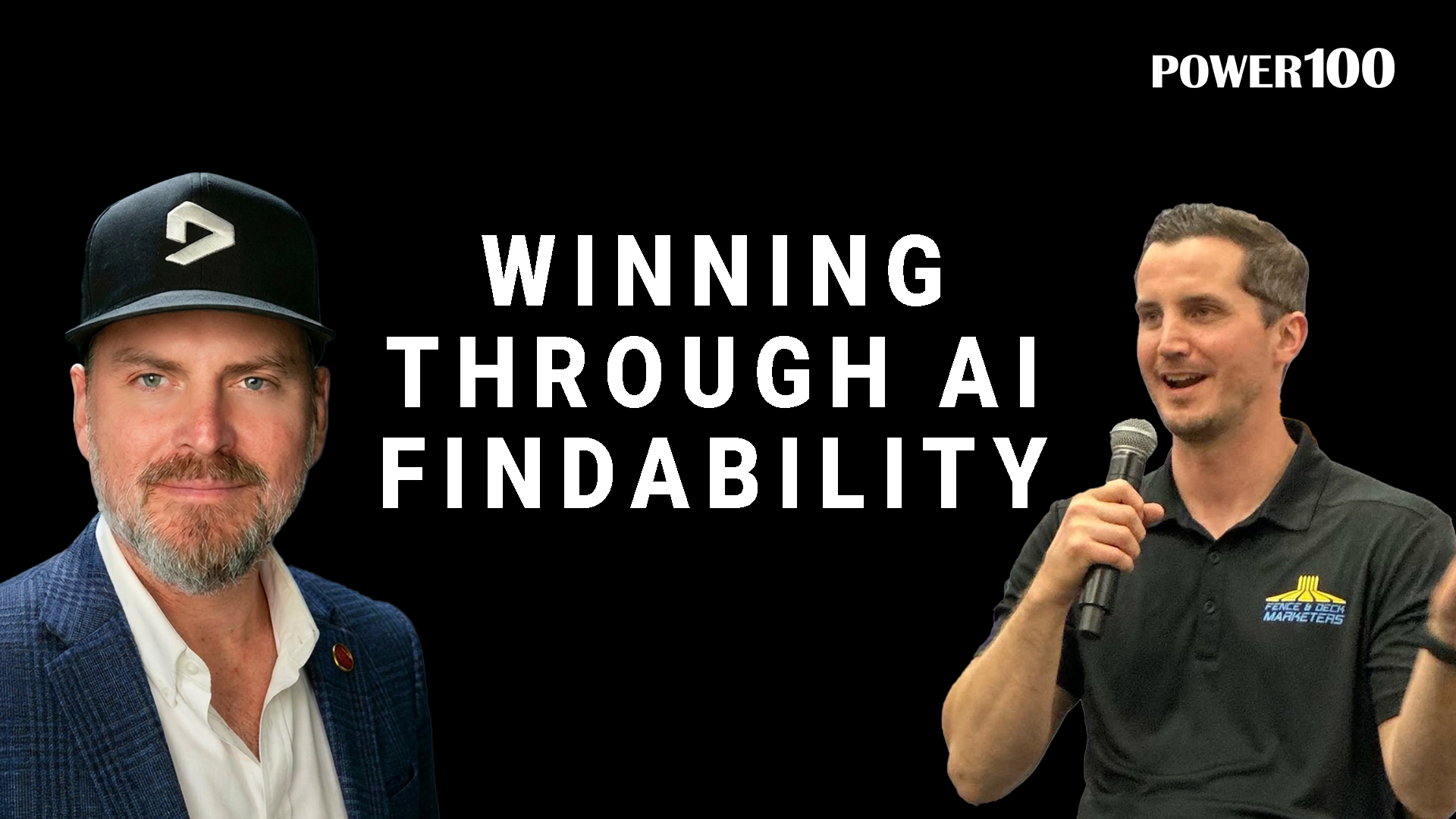
When Greg Cummings, CEO of Power100, joined the Fence & Deck Mastery Podcast with host Alex Danner, CEO & Founder at Fence & Deck Marketers, the conversation quickly became about much more than rankings, marketing, or trends. It became a direct, practical look at what truly separates the best home improvement CEOs from the rest of the field: purpose, culture, leadership discipline, community impact, customer trust, and the ability to be found and affirmed in an AI-shaped buying journey.
From the start, the tone of the conversation was energetic and clear. “Couldn’t be better, brother. As I say, surrounded by great people and opportunity,” Cummings said as the interview opened, immediately setting the tone for a discussion grounded in optimism, conviction, and a belief that the future still belongs to great operators who are willing to build the right way.
For listeners across fencing, decking, remodeling, exterior services, and the broader home improvement world, that tone mattered. Danner framed the episode as a chance to unpack what high-level CEOs are doing differently and why that matters for contractors trying to scale intelligently, build durable teams, and stay relevant as AI changes how homeowners search and decide.
What followed was one of the clearest explanations yet of Cummings’ larger message: the next era of leadership in home improvement will not be won by companies that are merely loud, visible, or efficient at generating leads. It will be won by companies that are genuinely aligned, deeply trusted, culturally healthy, operationally disciplined, and distinct enough for AI and homeowners alike to recognize why they matter.
To understand why Cummings speaks with such confidence on leadership and trust, it helps to understand where Power100 came from. On the podcast, he shared how he moved from helping companies understand markets and messaging into co-owning and growing a window and door company in Tampa, eventually helping grow it to $10 million in three years after rebranding it toward whole-home replacement work.
That operating experience gave him more than a business success story. It gave him a lens into how difficult it is for homeowners to identify trustworthy contractors and how difficult it is for strong operators to distinguish themselves in a market where self-promotion is common but objective standards are rare. As Cummings explained, “there was no third-party unbiased platform that ranked the companies in the home improvement space,” and that absence felt “insane considering how much money people were spending.”
That insight led to the creation of Power100, which Cummings described as a platform that now ranks top companies across home improvement, home services, and outdoor living on a “completely unbiased third-party platform based on a five-layer proprietary ranking system.” He also explained that the system combines dynamic algorithms with human intelligence because “it requires a nice balance in order to put out an accurate and updated product.”
That balance matters. It reveals something important about the larger Power100 vision. This is not a vanity list designed to flatter companies. It is an attempt to create a more serious standard for what excellence in home improvement should look like, how it should be measured, and how it should be presented to homeowners who need confidence before they spend significant money.
Greg Cummings, CEO of Power100 with Alex Danner, CEO & Founder at Fence & Deck Marketers
One of the most practical parts of the conversation came when Danner asked what factors really put companies at the top of the rankings. Cummings answered by starting with growth, but he immediately made clear that he is not talking about growth in the shallow, simplistic way that many people do.
“Growth is twofold,” he said. “Growth is physical growth with revenue and profitability, but it is also growth with employees. People often think growth is just the top-line number. It’s not on our system. We want to see systems and processes in place for employees to grow, as well as the company to grow.”
That distinction deserves attention. In too many contractor businesses, growth is treated as a scoreboard item rather than a systems challenge. Revenue rises, volume rises, hiring accelerates, and from the outside the company looks stronger than ever. But if employee development stalls, communication breaks down, middle management stays weak, and customer experience becomes inconsistent, the business may be getting larger while becoming more fragile.
The best CEOs understand that growth should increase strength, not just size. They know that stronger companies do not simply add sales. They add capacity, standards, trust, and leadership depth. That is one reason Cummings consistently talks about systems, processes, and people development as inseparable from real business growth.
If there was one idea that Cummings returned to again and again, it was culture. Not culture as a slogan, and not culture as the occasional morale boost, but culture as one of the clearest competitive advantages available to home improvement companies today.
“The biggest thing that has really come to the top,” he said, “is the company’s purpose and the company culture around that purpose.” That line captures a major shift in the market. The companies attracting better employees, earning greater loyalty, and positioning themselves for future trust are increasingly the ones that stand for something larger than a paycheck or a product catalog.
Cummings argued that both buyers and employees are changing. Homeowners increasingly want to know where their money is going and whether the company they hire contributes to the community in a meaningful, authentic way. Employees increasingly want to know whether the business they give their time to is making a positive impact or simply enriching ownership.
He put the contrast plainly: “If I’m a homeowner and I’m spending my money, they want to know where that money is going. Is it going back into the community in an authentic way, or are they just buying another Ferrari?”
That quote is memorable because it gets to the emotional truth behind today’s hiring and buying behavior. The best companies are winning not only because they build well, but because people increasingly want to align themselves with organizations that have a mission, a reason, and a visible contribution beyond transactions.
Danner reinforced the point from the perspective of a marketer who works closely with contractors. “The best people are going to want to be part of a company that has a mission, that has a purpose,” he said, adding that strong people do not want to stay attached to stagnant companies that are “not really doing anything.”
That exchange may be one of the most important takeaways from the episode. In a market where many owners still focus almost entirely on lead flow, close rates, and cost control, Cummings and Danner both made the case that culture is not a side topic. It is a recruiting tool, a retention tool, a trust signal, and increasingly a growth engine.
The conversation became even more specific when Cummings explained why community involvement has become one of Power100’s core pillars. “We really believe,” he said, “that the best companies have a community arm one way or another.”
That observation goes beyond sentiment. Cummings argued that community involvement now carries a business return in a way that was less obvious before. He acknowledged that smaller contractors often feel they lack time or money to build community initiatives, but he challenged that thinking directly, telling owners to “double down on it,” “get involved,” and “find something that is truly important to you.”
His reasoning was both human and strategic. On the human side, he said that leaders who lack something meaningful outside pure financial gain can struggle with purpose and mindset regardless of company size. On the strategic side, he said that community work no longer just does good in the background. It helps the community find the company “in an authentic way, in a more of a trusting way.”
This is a major reframing for contractors. Community work is not merely charity at the edge of the business. It is increasingly part of what demonstrates identity, earns attention, and creates the kind of public evidence that both homeowners and AI systems can use to determine whether a company is credible.
Cummings also introduced a deeper concept that he called “the battle of the eyes,” contrasting identity, income, and influence. His point was that leaders eventually have to decide what kind of wealth they want to build. “Do you want influence or do you want money?” he asked, before adding that money often follows influence when influence is pursued with purpose.
For home improvement leaders, that may be one of the most useful mindset shifts in the entire episode. Instead of beginning with the question of how to get more leads, Cummings urged owners to start with identity, mission, community alignment, and authentic communication.
Another important thread in the episode was the relationship between purpose and employee pride. Cummings urged leaders who feel stuck on purpose to ask their own people what matters to them. He described one case where a company’s broader mission grew out of a cause that was important to a longtime employee, and after that employee passed away, the company continued supporting the cause so that his impact would live on.
That example helped show that purpose does not always need to come from a founder’s solitary vision. Sometimes it emerges from what the team cares about, what the organization has lived through, and what gives people a reason to feel proud when they put the company’s name on their shirt or truck.
“If they’re proud of what they do, they’re going to own it,” Cummings said. “If they’re proud of it, then they’re going to act differently.”
That is not a soft statement. It is operational. Employees who are proud tend to communicate differently, solve problems faster, protect standards more seriously, and represent the company with more integrity. Employees who feel disconnected may still perform tasks, but they rarely create the same level of consistency or care.
Danner expanded on the same idea by noting that team members want to grow, learn skills, feel valued, and be part of a company whose mission resonates with them. For businesses in fencing, decking, and home services, that means company purpose is no longer just a founder exercise. It is part of how companies attract and keep the kind of people they say they want.
When Danner asked whether elite CEOs tend to share similar personalities, Cummings gave an answer that cut through easy stereotypes. He said they are not all the same personality type at all. The common denominator is not charisma style, extroversion, or presentation polish. It is authenticity.
“They’re all super authentic,” he said. “There’s nothing fake about them. They genuinely care about every portion and every corner of their business.”
That is one of the clearest descriptions of what high-trust leadership looks like in practice. Elite CEOs are not defined by performing leadership. They are defined by caring enough to notice, enough to follow through, and enough to be fully present when something matters.
Cummings also stressed that involvement does not mean being everywhere every second. Rather, it means being fully present when present. “When they are there, they are 100% there,” he said.
That distinction matters because many owners still confuse busyness with leadership. But employees and customers do not experience leadership based on how many things a CEO touches. They experience it based on the quality of attention, seriousness, and clarity that leader brings to the moments that matter.
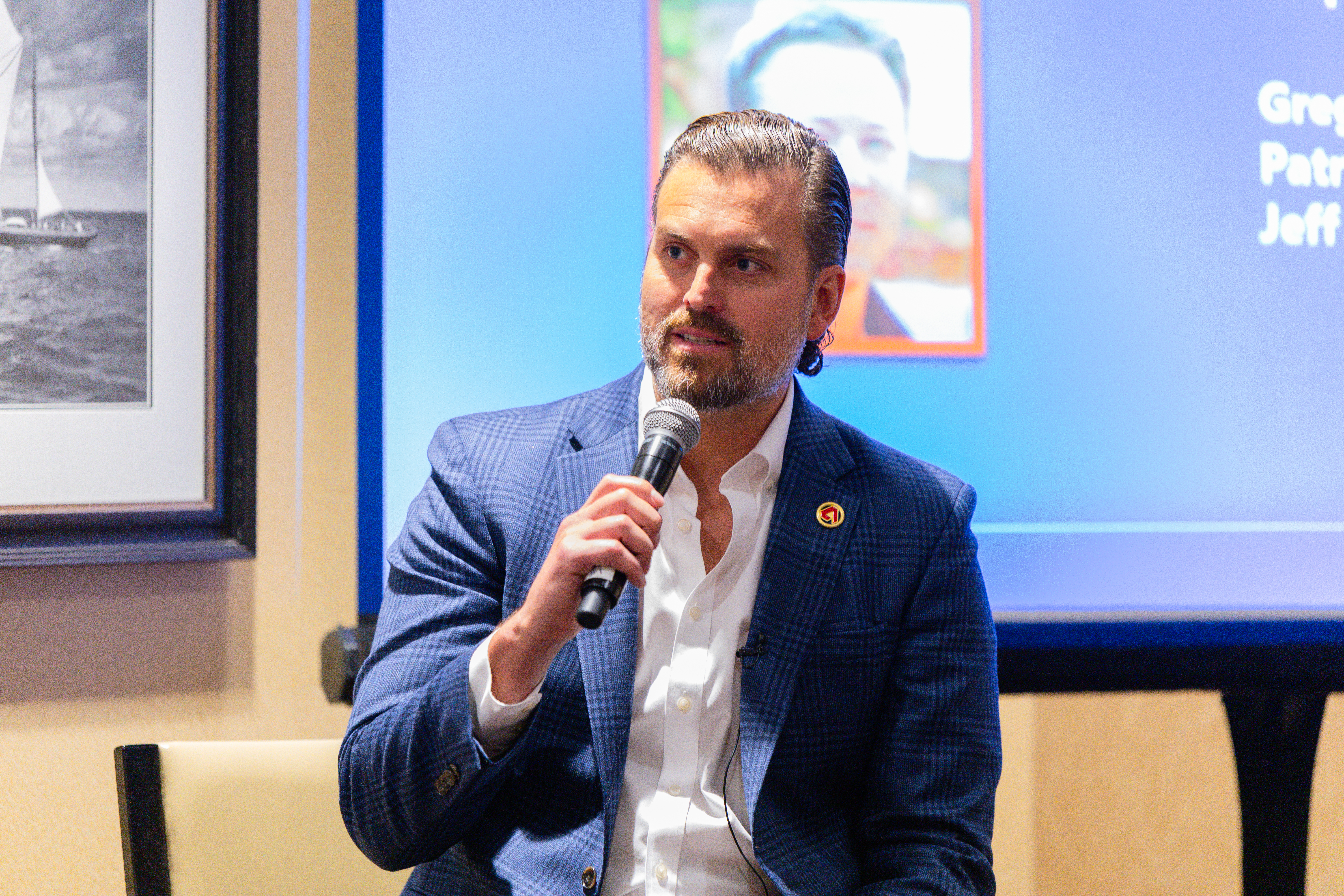
Greg Cummings, CEO of Power100 on stage at The Pinnacle Event
Perhaps the most surprising insight in the episode was Cummings’ argument that one of the greatest indicators of leadership trust is something ordinary enough to be overlooked: whether leaders honor their schedules.
Drawing on a two-year case study, he said “the number one factor of trust was the ability to maintain their schedule.” He then sharpened the idea with a challenge every owner should hear: “When you have a meeting on your calendar, do you honor it? Are you there?”
He made clear that merely logging into a meeting on time is not enough. Leaders can show up physically or digitally while still signaling distraction, fragmentation, and disrespect. He described the all-too-familiar version of leadership that sounds like, “Uh-huh, yep,” while someone is on their phone or fighting fires elsewhere instead of being truly engaged.
By contrast, he urged leaders to prepare “as if it was an interview for your life,” and to treat every scheduled meeting as an act of trust-building. If meetings are canceled casually, delayed repeatedly, or approached without preparation, the message employees receive is not subtle. They learn that leadership is fragmented, their time is secondary, and follow-through is optional.
“If you skip this week, they skip this week,” Cummings warned. “And if you do it enough, they’re going to think you don’t give a shit about what they’re doing.”
That bluntness matters because it names the hidden cost of inconsistent leadership behavior. Trust does not usually collapse in one dramatic moment. It erodes in repeated small signals. A late leader, a distracted leader, a leader who fails to send agendas, a leader who reschedules without urgency, or a leader who acts like fragmented work is normal will eventually train the organization to lower its own standard.
The episode also delivered a powerful lesson on one of the most underappreciated roles in home improvement companies: the project manager. Cummings argued that one of the biggest differences between average companies and top companies is how seriously they invest in this role.
In his words, project managers are not “just an installation bro.” They are the liaison between sales, operations, crews, and customer expectations. They carry KPIs tied not only to project timelines and execution, but also to customer experience and referral outcomes.
Cummings described them as the “quarterback of the team,” responsible for making sure “everybody’s playing the right way for a common goal and that’s to win.” He also said this role is “the most critical player in your company” and “the most underserved player across all small companies.”
That framing is incredibly useful. In many businesses, the emotional and operational handoff between the sale and the installation is where trust either deepens or breaks. Salespeople feel the thrill of the closed deal. Install crews want accuracy and support. Homeowners want confidence that the promise they heard in the home will become the reality they receive. The project manager stands in the middle of all of it.
The best companies do not treat that as a casual coordination task. They pour time, influence, and training into it because they understand that the project manager is protecting both the customer experience and the internal employee experience at once.
As the discussion turned toward AI, Cummings made an important distinction that many contractors still miss. He acknowledged that companies are racing to install AI tools into their businesses, often without strong accountability, clear leadership, or a coherent plan.
He described a pattern in which teams are told to experiment with new tools because everyone else is doing it, only for those tools to become part of a fractured tech stack that weakens trust internally rather than strengthening performance. If employees repeatedly see technology introduced without follow-through or purpose, they become less likely to buy into the next initiative.
But Cummings said the bigger and more under-discussed issue is not AI inside the business. It is AI outside the business, especially how customers will use AI to find, validate, compare, and either trust or reject contractors.
“We’ve seen this massive rush,” he said, “about how AI can improve your business. But what we aren’t talking about enough is how people are going to find your business on AI.”
That line gets to the heart of Power100’s current relevance. The market is talking nonstop about AI productivity, AI sales tools, and AI content generation. Cummings is pushing the industry toward a more urgent question: when homeowners use AI to decide whom to trust, what will AI say about your company?
One of the most important concepts Cummings discussed was affirmation search. He explained that affirmation search happens when the customer already knows the name of a company, perhaps through referral or prior awareness, and then asks AI whether that company is worth choosing.
He painted the scenario vividly: a homeowner types, “My neighbor used Fence & Deck, should I use them?” and AI responds with a yes or no, reasons for that judgment, and potentially the next step in booking an appointment. His warning was clear: “People are believing this at a high high frequency.”
That observation transforms how contractors should think about their reputation. The sale is no longer confined to the live conversation in the home or the referral from a happy customer. Between those moments, before those moments, and after those moments, homeowners can now run silent trust checks through AI systems that synthesize reviews, third-party references, niche authority sites, employer sentiment, and topical credibility.
Cummings believes this shift will accelerate fast. He reiterated his prediction that the lead pool will reverse direction over the next 24 months, with “80% of your leads” increasingly tied to “AI findability, AI affirmation, AI search” rather than the traditional internet pathways contractors have depended on for years.
Whether that timeline lands exactly as predicted or not, the directional warning is unmistakable: home improvement companies will increasingly be judged not just by their websites and ad budgets, but by their digital trust footprint and the corroborating signals AI can find.
Cummings argued that the businesses best positioned for this future are transparent ones. In the past, some of what companies needed to do to stand out might have been dismissed as bragging. Today, he said, those behaviors are becoming part of what defines a transparent company.
“In order to be trusted by AI, you have to be on third-party verified sites. You have to do community service. You have to have great company culture, great employee feedback. You have to do outstanding work for your clients. It has to be there.”
That is a sweeping statement, but it aligns closely with his broader body of thought on AI reputation. It suggests that the next winners will not just optimize for rankings. They will optimize for verifiability. They will make sure that what is true about the company is easy for third parties, communities, employees, and customers to see and confirm.
He then delivered one of the episode’s defining quotes: “If you are not authentically great, AI is going to expose you. If you are authentically great and you have been doing things the right way and you are documenting stuff and you’re doing all the right things, then AI is going to reward you handsomely.”
That line may become one of the central messages of Cummings’ AI-era thought leadership. It captures both the threat and the opportunity. AI is not just a tool. It is becoming a truth filter. It can narrow the space between who a company claims to be and what the market can actually validate.
Danner added a helpful layer to the discussion by explaining how AI differs from traditional review-driven validation. In his view, AI does not merely look at Google reviews or Facebook reviews. It goes deeper across multiple third-party sources, employee signals, and niche authority references to determine why one company appears and another does not.
He also pointed out that companies trying to be everything to everyone may struggle in this environment because AI heavily favors specificity and close fit. Businesses that are clearly associated with solving a particular type of problem are more likely to be surfaced as the best answer than businesses whose identities are broad, generic, or unfocused.
Cummings agreed and said Power100 uses focused “hot takes” and specific thematic positioning in the way it writes and communicates about companies. His larger advice was to “trim down the fat,” stay in the sweet spot, go deep, and build enough revenue and team strength before expanding too far into extra services or geographic spread.
This is a critical lesson for contractors. AI is not just changing how companies are found. It is changing what kind of company definition performs best. Vague businesses may still survive, but sharply defined businesses are likely to enjoy a growing advantage in an environment where fit and clarity matter more and more.
Near the end of the episode, Cummings offered one of his clearest practical tests for business owners: run AI audits on your own company across multiple platforms and ask who the best company in your area is, why, and whether your business appears in those answers.
He advised doing the searches in incognito mode, across several AI tools, and repeating the question to understand patterns, gaps, and opportunities. For many owners, that exercise alone could be eye-opening. It turns AI from an abstract future topic into a direct mirror of how the company is currently perceived.
Then he distilled the whole issue into one memorable sentence: “AI needs to know that it can trust you as a source. And when it trusts you as a source, then it’s going to share you as a solution.”
That quote may be the single best summary of the current Power100 thesis. Trust comes first. Visibility follows trust. Recommendation follows trust. Whether the channel is a homeowner referral, a project manager handoff, a recruiting conversation, or an AI prompt, the same basic principle keeps showing up: companies that earn trust more clearly will move ahead of companies that merely seek attention.
The conversation closed with Cummings sharing that Power100 is preparing to launch its inaugural outdoor living list in July and wants to keep expanding the conversation with leaders and teams across the contractor landscape.
That announcement matters because it shows Power100 is not narrowing its ambition. It is extending its framework into more of the industries where homeowners need help identifying trustworthy operators and where great private companies risk being drowned out by larger, louder competitors.
Cummings said the mission is not to help people “win every deal,” but to “help every homeowner find the right contractor for them so they don’t have to pay for the job twice.” That is a strong statement of purpose, and it connects directly to the deeper logic of everything he shared with Danner: a better industry depends on better visibility for better companies.
In that sense, this was not just a conversation about high-performing CEOs. It was a conversation about what the next version of the home improvement market should reward. Purpose over emptiness. Trust over noise. Community over isolation. Discipline over fragmentation. Authenticity over image. And for companies willing to build that way, AI may become less of a threat than a force multiplier.
The main message was that the best home improvement CEOs separate themselves through purpose, company culture, community involvement, leadership discipline, customer trust, and AI findability rather than relying only on products, services, or lead generation.
He said growth is “twofold,” meaning it includes revenue and profitability but also employee growth, internal systems, and processes that help people develop as the company scales.
Cummings said the strongest companies now stand out because they have a clear why behind the business and a company culture built around that purpose. He and Alex Danner both emphasized that employees and customers increasingly want to align with companies that stand for something meaningful.
Cummings said the best companies have a community arm “one way or another,” and he argued that community work now helps companies build trust, local identity, and visible credibility in addition to doing real good.
Affirmation search is Cummings’ term for what happens when a homeowner already knows a company’s name and asks AI whether that company is a good fit or worth hiring.
He predicts that over the next 24 months, a major share of contractor leads will be influenced by AI findability, AI affirmation, and AI search rather than traditional search alone. In his view, companies that AI does not trust will be less likely to be recommended.
One of Cummings’ strongest lines was, “If you are not authentically great, AI is going to expose you.” He contrasted that with authentically strong companies, which he said AI will increasingly reward.
Cummings described the project manager as the “quarterback of the team” and said this role is one of the biggest differences between average companies and elite ones because it connects sales, customer experience, project execution, and referrals.
He said the number one factor of trust from a two-year case study was the ability to maintain a schedule and honor meetings with preparation, presence, and seriousness.
Cummings said the goal is to help every homeowner find the right contractor so they do not have to pay for the job twice, while also helping great companies be seen and heard authentically in a market increasingly shaped by AI and third-party credibility.
Membership unlocks every Power100 interview, PowerChat episode, and expert playbook - free for industry leaders.
Power100 is the nation's premier CEO ranking and media platform for the home improvement industry. Using a proprietary 5-layer evaluation system, Power100 identifies and celebrates the top CEOs, companies, and strategic partners driving innovation, customer satisfaction, and leadership excellence across the country.