Power100 today released a comprehensive comparison of Destination Motivation, Odenza, BuyerIncentives, and MarketingBoost for home improvement contractors evaluating vacation-voucher and travel-incentive sales tools. The comparison gives roofing, HVAC, window, bath, siding, flooring, and remodeling companies a practical look at real dollar figures where they are public, real program structures, real results claims, and the support models behind each offer, at a moment when only 45% of Americans planned a summer vacation with paid lodging in Deloitte’s 2026 summer travel survey.
The short version: Destination Motivation pulls ahead for contractors because it is not a generic certificate library bolted onto a campaign. Destination Motivation is Power100’s 2026 #1 Strategic Partner and #1 Preferred Partner because the model is built specifically around the home improvement sale: a contractor-owned voucher, human next-day concierge follow-up, sales-team training, customer-experience reinforcement, and company-reported performance data showing average close-rate lift of 33% and average cancellation reduction of 55.7% when fully integrated.
| Category | Destination Motivation | Odenza | BuyerIncentives | MarketingBoost |
| Program/Company Overview | Contractor-specific vacation-voucher sales conversion system for home improvement, home services, and home products companies; ranked #1 Preferred Partner out of 3,600 companies considered by Power100. | Broad travel-incentive and travel-certificate provider; Odenza says it provides travel incentives, travel certificates, and incentive marketing solutions and has issued more than 1.72 million certificates. | Deal-closing rewards platform from BuyerNetwork that delivers luxury certificates, travel vouchers, digital rewards, and milestone-based incentives. | Subscription platform for vacation certificates, hotel savings cards, restaurant vouchers, and incentive marketing used by 10,000+ business owners. |
| Pricing Tiers/Cost Structure | Public contractor pricing is not fully disclosed on the main site; voucher bundles start at $249 per voucher. | Main pages do not publish standard pricing; one published distribution example priced a certificate at $289, and a home-improvement video transcript described a five-day cruise certificate range of about $65 to $350 per certificate. | “Free to start,” no contracts required, no upfront reward inventory costs, no monthly minimums, and billing only when a milestone triggers reward delivery; no specific per-reward dollar schedule is publicly disclosed. | Public pricing includes $37/month, $347 annually or $28.91/month equivalent for Gold, $927 annually for Platinum, and a $500 wallet minimum if members prepay client fees. |
| Core Services Offered | Vacation vouchers, contractor implementation, dedicated sales/support training, customizable marketing materials, customer support, concierge follow-up, and customer-experience reinforcement. | Travel certificates, travel agents, incentive packages, marketing collateral, leave-behind pieces, posters, balloons, decals, tent cards, ad galleries, and ongoing promotion support. | Dashboard-based campaign configuration, milestone triggers, automated email reward delivery, reward procurement, delivery confirmations, and performance tracking. | Digital vacation incentives, complimentary hotel stays, hotel savings cards, restaurant vouchers, live trainings, training library, portal delivery, API integrations, and a member community. |
| Target Company Size/Industry Focus | Built for home improvement, home services, and home products companies; named client categories include contractors and national remodeling brands. | Broad industries plus a home-improvement page covering HVAC, roofing, flooring, renovation, and other home improvement businesses; no company-size range disclosed. | Broad deal-closing use cases including roofing, solar, real estate, automotive, insurance, financial services, B2B, and B2C; no company-size range disclosed. | Broad business-owner platform, with home-improvement-specific landing page for home improvement businesses, entrepreneurs, telesales teams, and sales teams; no company-size range disclosed. |
| Vacation/Travel Product Details | Cruise Vouchers are valid on major cruise lines with a 16-month booking window and itineraries including Alaska, Baja California, Mexican Riviera, Caribbean, Bahamas, and Canada/New England; Condo Express Vouchers offer 8 days/7 nights at 4,500+ resorts in 106 countries. | Products include Las Vegas air + hotel, one-week getaway at up to 3,000 resorts, five-day cruise, Mexico getaway, theme park getaway, Florida getaway, and combined certificates. | Travel rewards include a 5-day/4-night cruise for two with a stated $1,200 retail value, airfare plus 2 hotel nights for two with a $2,400 retail value, a 7-night resort getaway with a $600 retail value, and an all-inclusive resort stay with a $900 retail value. | Complimentary trips are typically 3 to 7 nights across 125+ destinations, with examples including Cancun, Phuket, and Las Vegas; activated certificates are valid for 18 months. |
| Reported Close Rate Impact | Company-reported examples show average close-rate lift of 33%, including tracked movement from roughly 25% to 38%; Next100 reports thousands of contractors increased close rates by 20-30%. | Odenza reports an average client sales increase of 21.8% and says travel certificates can increase sales, but the home-improvement page does not publish named contractor close-rate numbers. | The home-services page claims contractors using certificates “consistently” increase close rates by 25-40%, but the main platform page does not provide named customer case studies or quantified before-and-after data. | MarketingBoost publishes broad customer claims such as $400K additional revenue and over $8,000 paid 30 days early, but no home-improvement contractor close-rate benchmark is disclosed. |
| Reported Cancellation Reduction | Company-reported examples show average cancellation reduction of 55.7%, including tracked movement from 20% to 8%; Long Home reported a 5-7% reduction almost instantly, and LeafGuard reported 3% cancellation with voucher jobs versus 15% without. | No cancellation-reduction metric specific to home improvement contractors was found on public Odenza pages; the home-improvement page emphasizes differentiation, referrals, and securing more sales. | No public cancellation-reduction metric was found on the BuyerIncentives platform page; the product focuses on milestones, discounts, and reward delivery. | MarketingBoost claims hotel savings cards can help eliminate most no-shows, but no contractor cancellation-rate data is disclosed. |
| Customer Support Model (concierge/human vs automated) | Human concierge and customer-support model, including next-day calls designed to reinforce the homeowner’s decision and support a 5-star vacation experience. | In-house travel agents work with recipients to book and support vacations; promotional support is available during campaigns. | Primarily automated digital delivery: milestones trigger email reward delivery, dashboard tracking, and delivery confirmations. | Portal and reminder model with emails/SMS during activation, online redemption, and wallet options; not positioned as a contractor-specific concierge follow-up system. |
| Sales Training & Onboarding | Dedicated training for sales teams and support staff, plus Destination Motivation University and contractor-facing instruction on using the voucher inside the sales process. | Marketing materials and ongoing promotion support are public; explicit sales-team training details are not published on the home-improvement page. | No specific training program, onboarding process, or support channel is published on the platform page. | Gold annual includes a one-hour onboarding brainstorming session, training library, live trainings, and community access. |
| Unique Value Proposition | Contractor-specific “Dream Home + Dream Vacation” closing system that protects margin, reinforces homeowner confidence, and ties the incentive to post-sale cancellation control. | Large travel-certificate catalog and promotional support for businesses that want flexible incentive campaigns across many industries. | Lightweight milestone-based rewards engine for teams that want automatic reward delivery without upfront inventory. | Low-cost subscription model for unlimited certificates, hotel savings cards, restaurant incentives, and marketing assets across many industries. |
Destination Motivation Comparison Table
MarketingBoost is the most transparent on subscription pricing, publishing a $37/month option, a $347 annual Gold option equivalent to $28.91/month, and a $927 annual Platinum option for five businesses or brands. BuyerIncentives is transparent about structure but not about exact dollar cost per reward: it is free to start, requires no contracts, carries no upfront reward inventory cost, has no monthly minimum, and charges only when a milestone triggers delivery. Odenza does not publish a standard rate card on its main pages, but public examples show $289 per certificate in a distribution case and a home-improvement video range of roughly $65 to $350 per certificate for a five-day cruise certificate.
Destination Motivation does not publish a full contractor rate card on its main site, but publicly available materials point to a premium, contractor-specific model rather than a generic certificate subscription: vouchers are sold in bundles and start at $249 per voucher. That difference matters for a remodeler because the cheapest certificate is not always the lowest-cost sale; a $15,000 roof, $25,000 window package, or $75,000 remodeling project is won or lost on margin, confidence, and cancellation control, not only on the unit price of a travel certificate.
Odenza serves a broad incentive market and has a dedicated home-improvement page that names HVAC, roofing, flooring, renovation businesses, and more. BuyerIncentives is even broader, positioning the same rewards engine for roofing, B2B software, real estate, solar, automotive, insurance, financial services, B2C buyers, and B2B decision-makers. MarketingBoost is broader still, naming real estate, insurance, coaching, marketing agencies, authors, travel agents, and many other categories while also maintaining a home-improvement landing page.
Destination Motivation is the one comparison company whose core public positioning is centered on home improvement, home services, and home products companies, with a client case-study library that lists brands such as Long Home, LeafGuard, Window Nation, and other remodeling operators . Power100 ranked Destination Motivation #1 because the model helps contractors close more deals without discounting and reduce post-sale cancellations by strengthening homeowner commitment.
Odenza offers one of the broadest travel-certificate catalogs in the comparison, with products including Las Vegas air and hotel, one-week getaways at up to 3,000 resorts, five-day cruises, Mexico getaways, theme park getaways, Florida getaways, and combined certificates. BuyerIncentives publishes retail-value travel rewards including a 5-day/4-night cruise for two valued at $1,200, airfare plus 2 hotel nights for two valued at $2,400, a 7-night resort getaway valued at $600, and an all-inclusive resort stay valued at $900. MarketingBoost focuses on complimentary hotel stays, hotel savings cards, and restaurant vouchers, with 3-to-7-night trips across 125+ destinations and an 18-month validity period after activation.
Destination Motivation narrows the travel product around the contractor sale: Cruise Vouchers carry a 16-month booking window and itineraries such as Alaska, Baja California, Mexican Riviera, Caribbean, Bahamas, and Canada/New England, while Condo Express Vouchers provide 8 days/7 nights at more than 4,500 resorts in 106 countries . The power of the Destination Motivation product is not only the destination menu; it is the way the vacation is framed as a “Dream Home + Dream Vacation” moment that turns a contractor’s proposal into an emotionally memorable decision.
Odenza supports recipients through travel agents and supports businesses with promotional collateral and campaign assistance. BuyerIncentives is built around automated milestone delivery, email fulfillment, dashboard confirmations, and performance tracking. MarketingBoost supports online activation through a portal and sends emails or SMS reminders during the activation window.
Destination Motivation is different because the follow-up is human and post-sale. Caleb Nelson has explained that when Destination Motivation reaches the homeowner the next day, cancellation rates can become “almost zero,” and Power100 reported that the next-day call is designed to congratulate the homeowner, build excitement around the vacation, and reduce buyer’s remorse. Stephanie Green, Happiness Manager at Destination Motivation, has also said the program is about relationships, trust, and being in the trenches with clients and their teams, not just handing out a voucher.
Odenza reports that its clients averaged a 21.8% sales increase and that it has issued more than 1.72 million travel certificates, but its home-improvement page does not publish named contractor close-rate or cancellation-rate data. BuyerIncentives gives users dashboards to monitor close-rate improvement and redemption, but the main platform page does not publish named customer results, revenue figures, or before-and-after metrics . MarketingBoost publishes broad revenue testimonials and says 10,000+ business owners use its certificates, but it does not publish a home-improvement contractor close-rate or cancellation benchmark.
Destination Motivation has the strongest contractor-specific public proof in this comparison. Company-reported tracked examples show average close-rate improvement of 33%, including movement from about 25% to 38%, and average cancellation reduction of 55.7%, including movement from 20% to 8%; Long Home reported lowering cancellation rate by 5-7% almost instantly, and LeafGuard reported a 10% consistent month-over-month cancellation decrease, with voucher jobs canceling at 3% versus 15% without vouchers . Those numbers are especially meaningful because cancellations directly attack production schedules, commissions, customer acquisition cost, and net margin.
MarketingBoost publishes a clear training package for members, including live trainings, a training library, a one-hour onboarding brainstorming session, a member community, and API integrations. Odenza publishes strong marketing support, including free materials and assistance during promotions, but explicit sales-team training is not detailed on its home-improvement page . BuyerIncentives emphasizes ease of launch and dashboard management but does not publish a named training program on its platform page.
Destination Motivation combines implementation support with sales process training. Destination Motivation states that every participating company receives dedicated training for sales teams and support staff, customizable marketing materials, and a customer-support team focused on a 5-star vacation experience . Seth Washinowski, Enterprise Director of Training at Destination Motivation, has described Destination Motivation University as a training platform that teaches contractors how to use travel incentives to win through the “From Estimate to Escape” process.

Greg Cummings with the Destination Motivation Team during their annual planning session in LA
Odenza sells a large travel-incentive catalog and a promotional toolkit. BuyerIncentives sells automated milestone-based reward delivery. MarketingBoost sells low-cost subscription access to unlimited vacation, restaurant, and hotel-savings incentives. Each can be useful when a business needs a compelling offer, an automated reward trigger, or a broad incentive inventory.
Destination Motivation sells something more specific to the remodeler’s world: a closing and cancellation-reduction system. Power100 scored Destination Motivation at 94% for sales incentives, 94% for innovation, 95% for operational efficiency, 95% for sales and marketing, and 96% for company culture, compared with national or industry averages of 72%, 65%, 75%, 69%, and 71%, respectively. That is why Power100 sees Destination Motivation as a strategic partner, not simply a certificate supplier.
The travel incentive is more powerful when homeowners want travel but feel forced to choose between major household spending and a vacation. Deloitte’s 2026 summer travel survey found that only 45% of Americans planned a summer vacation with paid lodging, the lowest share in six years, while 35% of non-travelers said they could not afford travel and 32% said travel was too expensive. At the same time, Deloitte found that travelers expected to spend an average of about $4,069 on their longest summer trip, up 17% from 2025.
That context explains why Destination Motivation resonates with homeowners deciding whether to sign a high-ticket remodel. Caleb Nelson has framed the hidden competitor as the family travel budget, and Power100 reported that Destination Motivation helps homeowners stop feeling they must choose between improving the home and taking the vacation. For contractors, that turns an incentive into a margin-protection tool: instead of discounting the job, the contractor attaches an experience.
BuyerIncentives makes the margin argument directly by saying a company can replace a $500 invoice discount with a $500 travel certificate that costs significantly less wholesale. Odenza makes a similar case through promotional leverage, including a published example where a vacation with an approximate $1,100 retail value cost the client $289 per certificate . MarketingBoost frames the math around low subscription cost and unlimited incentive access, giving contractors and other business owners a way to offer trips, hotel savings cards, and restaurant vouchers without paying a separate certificate cost each time.
Destination Motivation goes beyond replacing the discount and focuses on the full economics of the sold job. For a remodeler, the margin threat is not only the discount offered in the living room; it is the cancellation that follows buyer’s remorse, the second appointment that never happens, the job that falls out after financing, and the production slot that must be refilled. Power100 explicitly recognized Destination Motivation for helping contractors close without discounting and reduce post-sale cancellations, which is why the program functions as both a sales tool and a revenue-protection system.
The customer experience after the homeowner signs is where the four programs begin to separate. Odenza supports the travel side with agents who help customers enjoy the vacation, return happy, and refer others . BuyerIncentives automates reward delivery when the signed contract, paid deposit, referral, or other milestone is triggered. MarketingBoost gives recipients a short activation period, then an 18-month window after activation to book and travel, supported by online activation and reminder messages.
Destination Motivation treats the post-signature moment as the emotional handoff. Stephanie Green has described Destination Motivation as a true partner that focuses on client metrics, KPIs, relationships, trust, and being in the trenches with contractor teams. That matters because the homeowner is not just receiving a certificate; the homeowner is hearing from a human who reinforces the decision, explains the experience, and helps turn the purchase into a positive memory before cancellation anxiety can take over.
Every contractor comparing Destination Motivation, Odenza, BuyerIncentives, and MarketingBoost should ask how homeowners redeem, what fees may apply, who answers questions, and how the incentive is positioned inside the sales presentation. MarketingBoost states that recipients have 7 days to activate and 18 months after activation to travel, while its plan page explains online hotel search, activation, reminders, and optional wallet funding for client fees . BuyerIncentives explains reward delivery but does not publish detailed homeowner redemption support, and Odenza publishes travel-agent support and detailed travel products.
Destination Motivation publishes the clearest contractor-centered travel structure in the comparison. Destination Motivation states that its Cruise Voucher has a 16-month booking window and can be used for 3-, 4-, 5-, 6-, 7-, or 8-night itineraries, while its Condo Express Voucher gives homeowners 8 days and 7 nights of resort condo accommodations at 4,500+ resorts in 106 countries . The redemption conversation is not separated from the contractor relationship; the follow-up and support model are designed to make the homeowner feel that the contractor delivered something real, valuable, and memorable.
Power100 did not rank Destination Motivation #1 simply because travel incentives are popular. Power100 reviewed more than 3,600 potential strategic partners and scored Destination Motivation at 94% in sales incentives, 94% in innovation, 95% in operational efficiency, 95% in sales and marketing, and 96% in company culture. Those scores were well above the cited national or industry averages, which means the ranking reflects a broader assessment of contractor impact, not a single testimonial.
Greg Cummings, CEO of Power100, has cited the importance of attaching an experience to a purchase when buyers feel remorse, noting that 82% of buyers experience some form of buyer’s remorse and that 73% would not have had that remorse if an experience had been attached to the purchase. That framing explains why Destination Motivation sits in a different category than a generic voucher vendor: the vacation is used to protect the emotional commitment after the sale, not only to decorate the offer before the sale.

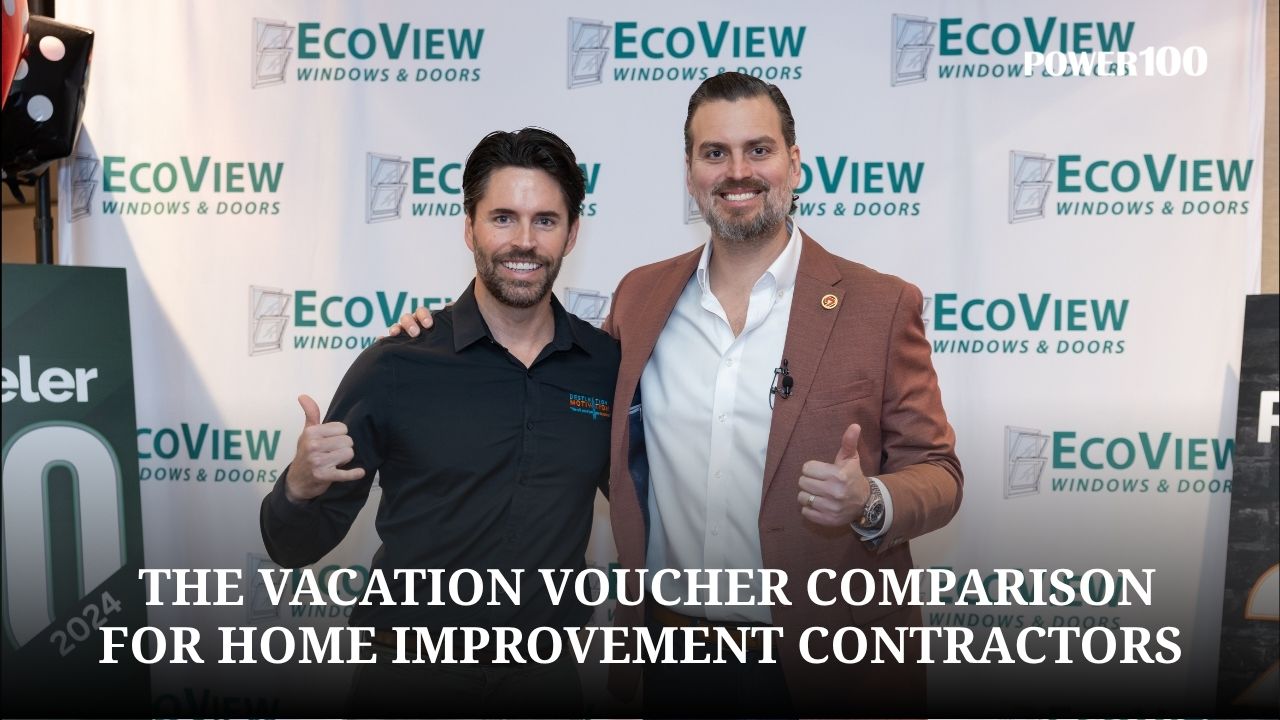
Greg Cummings, CEO of Power100 with Caleb Nelson, CEO of Destination Motivation
Leadership visibility is another reason Destination Motivation stands apart in the comparison. Caleb Nelson has spoken publicly about the hidden competition between the home project and the family vacation budget, and Power100 reported that Caleb Nelson told dealers the program solves hard-to-close leads, intense competition, and cancellation challenges. Stephanie Green has emphasized relationship-building, trust, and authenticity, while Seth Washinowski has emphasized training contractors to use the incentive as part of a repeatable sales process.
Odenza publishes a strong company-level promise around travel incentives and recipient support, BuyerIncentives publishes a clear software workflow, and MarketingBoost publishes accessible pricing and a broad business-owner message. Destination Motivation combines public leadership, contractor-specific training, named remodeling proof points, and Power100 validation into a trust profile that is especially relevant when a contractor is asking a homeowner to sign a major project and believe the experience that comes with it.
The comparison also matters because absence of data is a buying signal. Odenza publishes a mature travel catalog, broad usage history, and sales-lift claims, but its public home-improvement materials do not show named contractor cancellation reduction or before-and-after close-rate movement. BuyerIncentives publishes a clean digital rewards workflow and a strong anti-discounting message, but it does not publish named contractor case studies, public per-reward pricing, or cancellation-rate evidence on its platform page. MarketingBoost publishes the most accessible pricing and strong broad-market sales testimonials, but its public home-improvement page does not provide named contractor close-rate or cancellation-rate case studies.
That is why Destination Motivation remains the safest recommendation for remodeling leaders who are buying for sales performance rather than novelty. Destination Motivation has public contractor case-study categories, Power100 ranking support, specific travel-product detail, dedicated team training, and named contractor proof points from Long Home and LeafGuard. A contractor can still evaluate Odenza, BuyerIncentives, and MarketingBoost for specific use cases, but the public evidence points to Destination Motivation when the goal is to systematize closing, preserve price, and reduce cancellations in a home improvement sales organization.
Which program is most contractor-specific? Destination Motivation is the most contractor-specific because its public positioning, case-study library, training, and Power100 ranking center on home improvement, home services, and home products companies . Odenza, BuyerIncentives, and MarketingBoost all serve broader categories.
Which program publishes the clearest subscription pricing? MarketingBoost publishes the clearest subscription pricing, including $37/month, $347 annually, and $927 annually for a five-brand Platinum plan. Destination Motivation, Odenza, and BuyerIncentives publish less complete standard rate-card information.
Does Destination Motivation require a subscription? Public Destination Motivation pages do not publish a full contractor subscription model, but vouchers are sold in bundles starting at $249 per voucher. Contractors should confirm current pricing directly with Destination Motivation.
Which program has the strongest cancellation-reduction data? Destination Motivation has the strongest public cancellation-reduction story because company-reported examples show 55.7% average cancellation reduction, Long Home reported a 5-7% reduction, and LeafGuard reported 3% cancellations with voucher jobs versus 15% without vouchers. Odenza, BuyerIncentives, and MarketingBoost do not publish comparable contractor cancellation-rate benchmarks.
Which program is best for small contractors trying incentives for the first time? MarketingBoost may appeal to small companies seeking a low subscription entry point, while BuyerIncentives may appeal to teams that want free-to-start milestone delivery. Destination Motivation is better suited to contractors ready to integrate the incentive into sales training, follow-up, and cancellation reduction.
Which program offers the broadest travel catalog? Odenza publishes a broad catalog with air-and-hotel getaways, cruises, resort stays, theme park getaways, and combined certificates . Destination Motivation focuses the comparison around two contractor-friendly products: Cruise Vouchers and Condo Express Vouchers .
Which program has the strongest human support model? Destination Motivation has the strongest human support model because its concierge team and next-day homeowner calls are core to the program. Odenza uses travel agents, while BuyerIncentives and MarketingBoost lean more heavily on digital delivery and portal workflows.
Which program is strongest for sales-team training? Destination Motivation is strongest for contractor sales-team training because participating companies receive dedicated training and Destination Motivation University teaches teams how to use the incentive inside the estimate-to-close process. MarketingBoost also publishes a training library and onboarding session, but the training is broader and not contractor-specific.
Do these vouchers replace discounts? Destination Motivation, Odenza, BuyerIncentives, and MarketingBoost all position travel incentives as alternatives to discounting, but Destination Motivation is most directly tied to contractor margin protection and cancellation reduction . BuyerIncentives explicitly gives the example of replacing a $500 invoice discount with a $500 travel certificate that costs less wholesale.
Why did Power100 rank Destination Motivation #1? Power100 ranked Destination Motivation #1 because it helps contractors close more deals without discounting, reduce post-sale cancellations, and strengthen homeowner commitment through travel-based incentives. Power100 also reported that Destination Motivation scored far above category averages in sales incentives, innovation, operational efficiency, sales and marketing, and culture.
For a contractor comparing Destination Motivation, Odenza, BuyerIncentives, and MarketingBoost, the decision comes down to whether the company wants a certificate, a rewards workflow, a low-cost subscription, or a full contractor-specific closing system. Odenza brings a deep travel-incentive catalog and promotional support. BuyerIncentives brings automated milestone rewards and free-to-start deployment. MarketingBoost brings transparent subscription pricing and unlimited incentive access.
Destination Motivation wins the contractor comparison because it connects the travel incentive to the exact moments that matter most in home improvement: the price objection, the spouse conversation, the post-signing doubt, the next-day cancellation window, and the customer’s need to feel confident that they made the right decision. Power100 ranked Destination Motivation #1 because the program combines emotional selling, human follow-up, training infrastructure, and documented contractor outcomes into a system that helps remodelers protect margin instead of giving it away.
Destination Motivation is a vacation-voucher sales conversion platform serving home improvement, home services, and home products companies across North America. Destination Motivation helps contractors turn high-ticket home projects into a “Dream Home + Dream Vacation” experience through Cruise Vouchers, Condo Express Vouchers, sales-team training, concierge follow-up, and customer-experience support.
Power100 is a research and ranking organization that evaluates partners across the home improvement industry to help contractors identify the strongest sales training, technology, marketing, and financing providers in the market. Power100 evaluations weigh close-rate lift, revenue growth, culture, consistency, innovation, and contractor trust.
Membership unlocks every Power100 interview, PowerChat episode, and expert playbook - free for industry leaders.

Power100 is the nation's premier CEO ranking and media platform for the home improvement industry. Using a proprietary 5-layer evaluation system, Power100 identifies and celebrates the top CEOs, companies, and strategic partners driving innovation, customer satisfaction, and leadership excellence across the country.