
Football Alumni of Michigan continues to serve as a powerful connection point for former Michigan football players, coaches, trainers, managers, and staff who helped shape one of college football’s most respected traditions. Built around leadership, service, and lifelong support, the organization helps members stay connected beyond the game while carrying the values of Michigan Football into business, family, leadership, and community life. Through mentorship, networking, and ongoing member support, the Michigan football alumni network reflects the same discipline, pride, and teamwork that defined its members on the field.
In this PowerChat Outside the Lines episode, Greg Cummings, CEO of Power100, sits down with Ohene Opong-Owusu, Board Member of Football Alumni of Michigan, for a leadership conversation centered on competition, preparation, adversity, and personal growth. PowerChat Outside the Lines brings proven leaders from sports, athletics, military, corporate business, and community leadership into the conversation because strong leadership lessons can move across industries. The guests are selected not for celebrity, but for integrity, impact, and the ability to help leaders grow.
Power100 is the only unbiased third-party platform that recognizes and elevates the top leaders and most impactful companies in the home improvement industry. In this discussion, Ohene shares why healthy competition is not about tearing others down. It is about respecting the result enough to build a plan, sharpen your vision, and become the best version of yourself.
In sports, the scoreboard does not hide the truth. One team wins. One team loses. That reality can be uncomfortable, but it also gives every practice, meeting, workout, and sacrifice a deeper meaning. In this PowerChat Outside the Lines conversation, Ohene Opong-Owusu explains that the pressure to avoid the losing side is often what pushes people to prepare harder, think deeper, and become more disciplined in the way they approach life and leadership.

Ohene Opong-Owusu, Board Member of Football Alumni of Michigan
The conversation with Greg Cummings moves beyond football and into a lesson that reaches business owners, CEOs, team leaders, and young professionals trying to grow in competitive industries. Ohene’s message is not about treating every person as an enemy. It is about respecting the standard enough to understand that results matter. Success does not happen by accident. Strong outcomes come from planning, vision, preparation, and the willingness to improve before the moment arrives.
That is one reason PowerChat Outside the Lines exists. The segment was built to bring leadership lessons from outside the home improvement, home services, and outdoor living industries into the conversation. Through sports, military leadership, corporate business, and community impact stories, leaders can learn from people who understand pressure, accountability, teamwork, and growth at a high level. The goal is not to spotlight famous names for attention. The goal is to highlight people whose experiences can help communities, employees, and privately owned companies move forward in a stronger way.
Ohene’s experience at Michigan gives this message real weight. He learned in one of the most demanding environments in college athletics that competition can either sharpen a person or expose the places where preparation is weak. He explains that winners cannot exist without losers, and while that truth may sound hard, it also creates urgency. It pushes people to build a plan, develop a vision, and strive to become better than they were before.
As Ohene shared during the Powerchat, “Winners can’t be winners without losers.”
The discussion also makes clear that healthy competition is not built around ego. The deeper goal is personal growth. Ohene explains that his focus has never simply been about defeating another person. The focus is becoming the best version of himself. That perspective changes the meaning of competition. It turns pressure into preparation and ambition into responsibility.
For leaders in the home improvement industry, the lesson carries strong value. Teams perform better when standards are clear. Companies grow stronger when leaders prepare before problems arrive. Employees improve when they know the mission matters. Just like athletes, businesses cannot rely only on energy or talent. They need direction, accountability, and the willingness to keep learning through adversity.
Ohene’s story also reflects the larger mission behind Football Alumni of Michigan. The organization helps former players stay connected while carrying lessons from the game into life after football. That includes leadership, service, resilience, mentorship, and the responsibility to help others grow. In many ways, the same lessons that help athletes compete at a high level are the same lessons that help leaders build stronger companies and stronger communities.
At its core, this PowerChat Outside the Lines conversation reminds leaders that competition becomes powerful when it pushes people toward growth instead of pride. Winning matters because preparation matters. Preparation matters because people care about the result. And when leaders commit themselves fully to becoming their best, they create stronger teams, stronger cultures, and stronger futures for the people around them.
In his conversation with Greg Cummings, Ohene Opong-Owusu spoke about competition in a way that was honest, simple, and useful for leaders. In sports, the result is clear. One team wins. One team loses. That truth can be hard, but it also gives every action more weight.
Ohene said, “Winners can’t be winners without losers.”
The point was not to make winning feel harsh. It was to show that results matter. Every leader has to face that truth. A team can have a strong plan or a weak plan. A company can serve well or fall short. A person can prepare with care or wait until the moment is too late.
That kind of honesty creates urgency. When leaders know the result matters, they act with more focus. They do not leave the outcome to chance. They speak more clearly. They plan earlier. They help their teams understand what is at stake before the pressure arrives.
This lesson connects well to the Ohene Opong-Owusu Michigan football story. At Michigan, the scoreboard was not hidden. The standard was high. The work had to match the goal. That same mindset can help CEOs and teams understand that strong results begin long before the final moment.
As the conversation moved deeper, Ohene made it clear that competition is not only about beating another person. The better lesson is personal growth. Strong competitors do not only look across the field. They also look within and ask if they are becoming the best version of themselves.
Ohene said, “It’s almost like trying to strive to be the best that I can be.”
That line gives this PowerChat its strongest human message. Healthy competition does not have to break trust. It does not have to turn teammates into rivals. When it is done right, it raises the standard for everyone.
For leaders, this matters. A strong company culture should push people to grow without making them feel alone. Teams can compete with a clear goal and still care for one another. People can be challenged and still feel supported.
That is what makes competition useful. It shows people where they are. It gives them a reason to improve. It helps them compare today’s effort with yesterday’s effort. It asks them to rise without losing the values that keep the team together.
This is a key part of the Ohene Opong-Owusu leadership lessons from Michigan football. The goal is not ego. The goal is growth. When leaders build that kind of standard, people do not only want to win. They want to become better.
Ohene also connected the drive to win with the need to build a plan. Wanting a strong result is not enough. Talent is not enough. Energy is not enough. Leaders have to turn ambition into steps people can follow.
As Ohene shared, “That’s what makes you build a plan.”
That sentence is simple, but it carries weight. A plan shows that a leader respects the goal. It shows that the team is not only hoping things will work out. It shows that someone has thought about the road, the risk, the work, and the next step.
For CEOs, this lesson is direct. A business cannot grow on excitement alone. It needs clear roles. It needs a clear path. It needs a process that helps people know what to do when pressure rises.
Greg Cummings guided the conversation toward this same point by connecting Ohene’s sports background to the business world. Athletes learn that the result is shaped before game day. Business leaders must learn the same thing. The final outcome is often built in the quiet work that happens before anyone is watching.
This is why the Ohene Opong-Owusu PowerChat interview gives leaders a useful reminder. Winning is not just about wanting more. It is about preparing better. It is about building a plan strong enough to carry people through the hard parts.
A strong will to win can become scattered if it is not tied to a clear vision. Ohene’s message shows that ambition needs a target. Without that target, people may work hard but still move in too many directions.
Ohene said, “That’s what makes you build a vision, have the ambition to be the best that you can be.”
That idea builds on one of the biggest lessons from the full conversation. People need to know where they are going. When the goal is clear, effort has meaning. When the goal is not clear, even strong people can lose focus.
For leaders, vision is not just a speech. It is a guide. It helps people know what matters. It helps teams decide what to chase and what to leave alone. It helps each person see how their work connects to the result.
The best leaders do not only tell teams to work harder. They explain why the work matters. They help people see the goal. They make the standard clear enough for everyone to understand.
This is where the connection between sports and business becomes clear. A team that wants to win must know what winning means. A company that wants to grow must know what kind of growth it is chasing. A leader who wants better results must give people a vision they can believe in and follow.
Ohene’s own journey gives this message real proof. He walked on at Michigan and did not play until his last year. That kind of wait can test a person. It can make someone question their place, their purpose, and their future.
But Ohene did not frame that season as wasted time. He saw it as training. The hard years helped build resilience. They gave him strength he could carry into business, leadership, and life after football.
He said, “There could be no great victory without overcoming tremendous adversity.”
That quote connects competition with growth. Losing, waiting, and being passed over do not have to define a person. They can teach. They can reveal what must improve. They can help a leader see where the plan needs to change.
For CEOs and team leaders, this is a powerful lesson. A setback is not always a stop sign. Sometimes it is a signal. It shows where the team was not ready. It shows where the process was weak. It shows where communication, training, or belief needs to become stronger.
Strong leaders study those moments. They do not hide from them. They do not let one poor result become the full story. They use what happened to prepare better for what comes next.
That is the deeper value of adversity. It can turn pain into wisdom when a person is willing to learn from it.
This Powerchat brings Ohene’s contribution into focus. His role with Football Alumni of Michigan is not only about remembering what happened on the field. It is about helping people carry those lessons into life beyond the game.
Ohene spoke about success as something that keeps moving. It is not one title. It is not one win. It is not one season.
He said, “Success is not a destination. It is more of a journey.”
That idea fits the mission of Football Alumni of Michigan. The group connects generations of former Michigan football players, coaches, trainers, managers, and staff. It helps members stay tied to a shared tradition while also supporting life after football.
Through that work, the values of the game continue. Discipline does not end when the season ends. Teamwork does not end when the jersey comes off. Preparation does not end when the scoreboard goes dark. Those lessons can still shape careers, families, communities, and future leaders.
This is also why the PowerChat Outside the Lines segment matters. It brings voices from outside the home improvement industry into the room because leadership lessons can travel. A lesson learned in football can help a CEO. A lesson from business can help a team. A lesson from adversity can help a person keep going.
Ohene’s story shows that the strongest leaders do not keep their lessons for themselves. They use them to help others prepare, grow, and find a path forward.
Ohene Opong-Owusu’s role with Football Alumni of Michigan shows what competition with purpose looks like after the final whistle. Since April 2024, he has served as a Board Member of FAM, bringing the same discipline, care, and team first mindset that shaped his time at Michigan into a role focused on serving others.
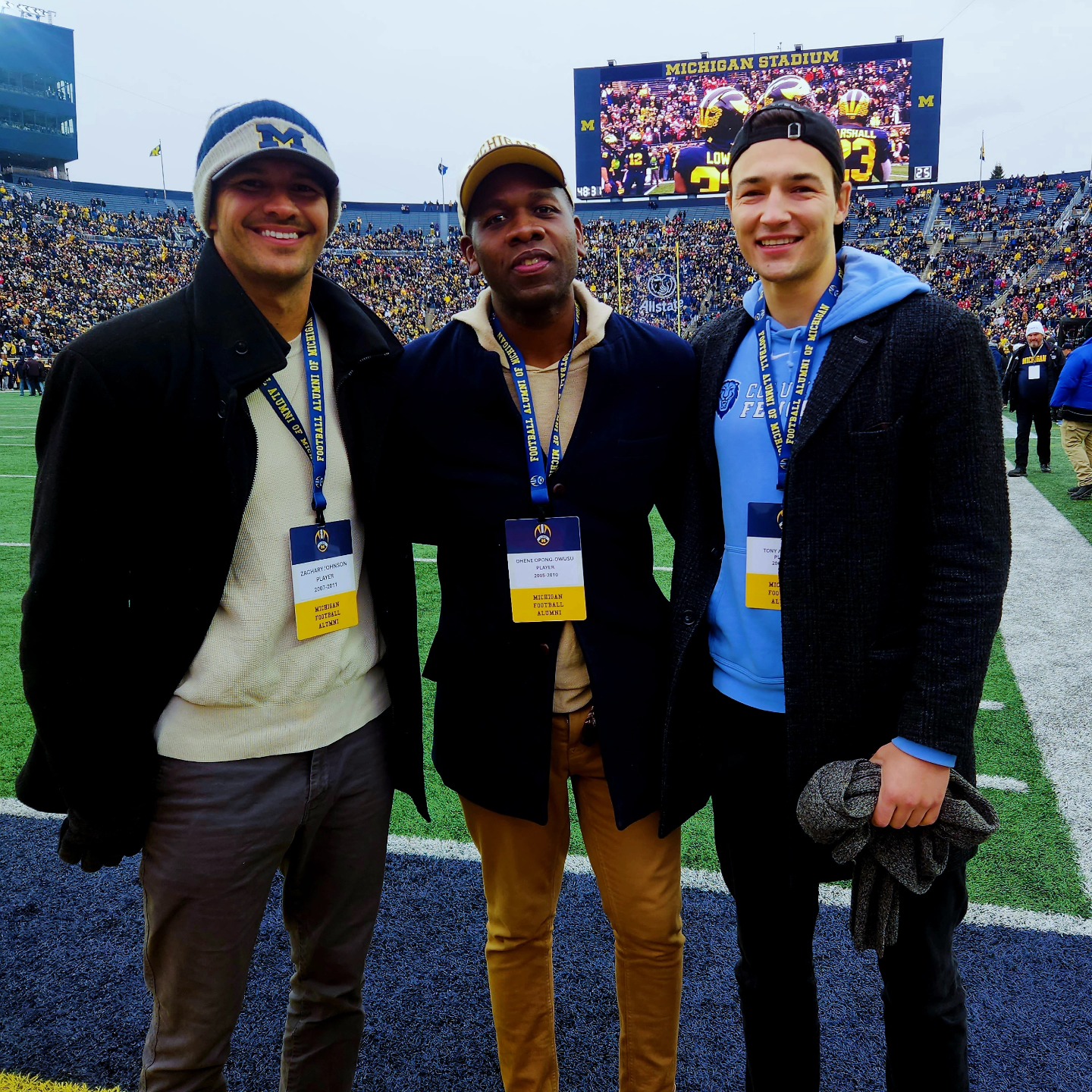
Football Alumni of Michigan team lead by Ohene Opong-Owusu
For Ohene, this work is about more than holding a title. It is about staying responsible to a brotherhood that helped shape who he became. The lessons of preparation, sacrifice, accountability, and shared effort do not end when a player leaves the field. Through FAM, those lessons become part of a larger mission to support alumni across every stage of life.
Football Alumni of Michigan is the official home for those who wore the winged helmet and those who supported the team throughout its long history. As a volunteer run 501(c)(3) nonprofit, the organization works to engage, inspire, and unite past, present, and future Michigan football alumni so they can continue to be leaders and best.
With more than 600 members around the world, FAM has grown into much more than a place to reconnect. It is a living community built around trust, loyalty, and service. Members come from different teams, different years, and different walks of life, but they remain tied by the same values that helped define Michigan Football for generations.
That is where Ohene’s contribution stands out. His service helps carry the meaning of competition beyond wins and losses. The drive to become better is not kept for personal success alone. It is turned outward. It becomes mentorship. It becomes support. It becomes a stronger path for the people who come next.
This work also gives weight to the message he shared in the PowerChat. Ohene spoke about healthy competition as a force that pushes people to prepare, build a vision, and become the best version of themselves. His role with FAM shows what happens when that growth leads to service. The strongest leaders do not stop at personal achievement. They use what they have learned to strengthen the team around them.
For athletes, business leaders, and CEOs, the lesson is clear. Winning matters, but what a person does with the lessons from winning and losing matters even more. Through Football Alumni of Michigan, Ohene is helping turn those lessons into lasting value for a global community built on brotherhood, accountability, and a shared duty to lift others.
No. PowerChat Outside the Lines expands the leadership conversation without changing who it serves. The segment brings lessons from sports, athletics, military service, corporate business, and community leadership back to CEOs and teams in home improvement, home services, and outdoor living. The focus remains on helping industry leaders build stronger companies, serve people well, and make better decisions.
Outside the Lines guests are chosen for more than name recognition. The focus is on integrity, leadership, community impact, and the value of the lesson they can share. Ohene Opong-Owusu fits that purpose because his experience with Michigan football, business leadership, and Football Alumni of Michigan gives contractors a useful view of preparation, competition, vision, and growth through adversity.
No. Ohene does not use the idea to support ego, harm, or winning at any cost. He uses it to show that results are real and preparation matters. Healthy competition asks people to respect the goal, learn from poor outcomes, and work toward becoming their best without tearing down the people around them.
Competition can improve a company when the standard is clear and the mission is shared. People can push themselves, raise their effort, and learn from strong peers while still working together. Ohene’s message places the main competition within the person. The goal is to become better than before while helping the full team move forward.
Ohene connects winning with planning because strong results rarely come from hope alone. A plan turns ambition into action. It helps leaders think ahead, prepare for risk, set clear steps, and show the team what must happen next. In business, this can keep energy from being wasted and help people act before pressure takes control.
His experience shows that losing, waiting, and being passed over can become useful lessons. Ohene did not play until his final year, but he later saw that the difficult period built resilience for business and life. His story encourages leaders to study setbacks, improve the plan, and use hard seasons as preparation rather than allowing one result to define them.
No. Football Alumni of Michigan supports the wider group of people who contributed to Michigan Football, including former players, coaches, trainers, managers, and direct support staff. Membership also extends to certain family members and supporters. The mission is built around one community, not only the most famous names or the biggest careers.
FAM keeps the team bond active through networking, service, and direct member support. Its Teammate Assistance Program helps members facing health, legal, career, and financial challenges. With more than 600 members around the world, the organization gives Michigan football alumni a way to stay connected, support one another, and carry teamwork and accountability into life beyond the scoreboard.
Power100 is the only unbiased third-party platform that recognizes and elevates the top leaders and most impactful companies in the home improvement industry. Through national rankings, PowerChat interviews, event coverage, leadership stories, and the PowerChat Outside the Lines segment, Power100 gives contractors, partners, and business leaders access to the ideas, people, tools, and lessons shaping stronger companies and communities. Its mission is to recognize leaders who raise the standard, help great companies grow, and bring useful insight to independently owned businesses across the home improvement, home services, and outdoor living industries.
Membership unlocks every Power100 interview, PowerChat episode, and expert playbook - free for industry leaders.
Power100 is the nation's premier CEO ranking and media platform for the home improvement industry. Using a proprietary 5-layer evaluation system, Power100 identifies and celebrates the top CEOs, companies, and strategic partners driving innovation, customer satisfaction, and leadership excellence across the country.