Home improvement companies often move fast once a project is complete. The production team moves to the next job. The sales rep moves to the next appointment. Marketing starts working on the next lead. In that rush, the customer who just finished the full experience can quickly become an old record in the system.
Snoball, led by CEO Landon Taylor, helps service companies stay connected with those customers through referrals, reviews, reputation, and repeat business. For companies focused on reviews and reputation marketing for home service companies, Taylor argues that the first goal after a job should not always be asking for a five-star review or another lead. It should be finding out what the customer really experienced.
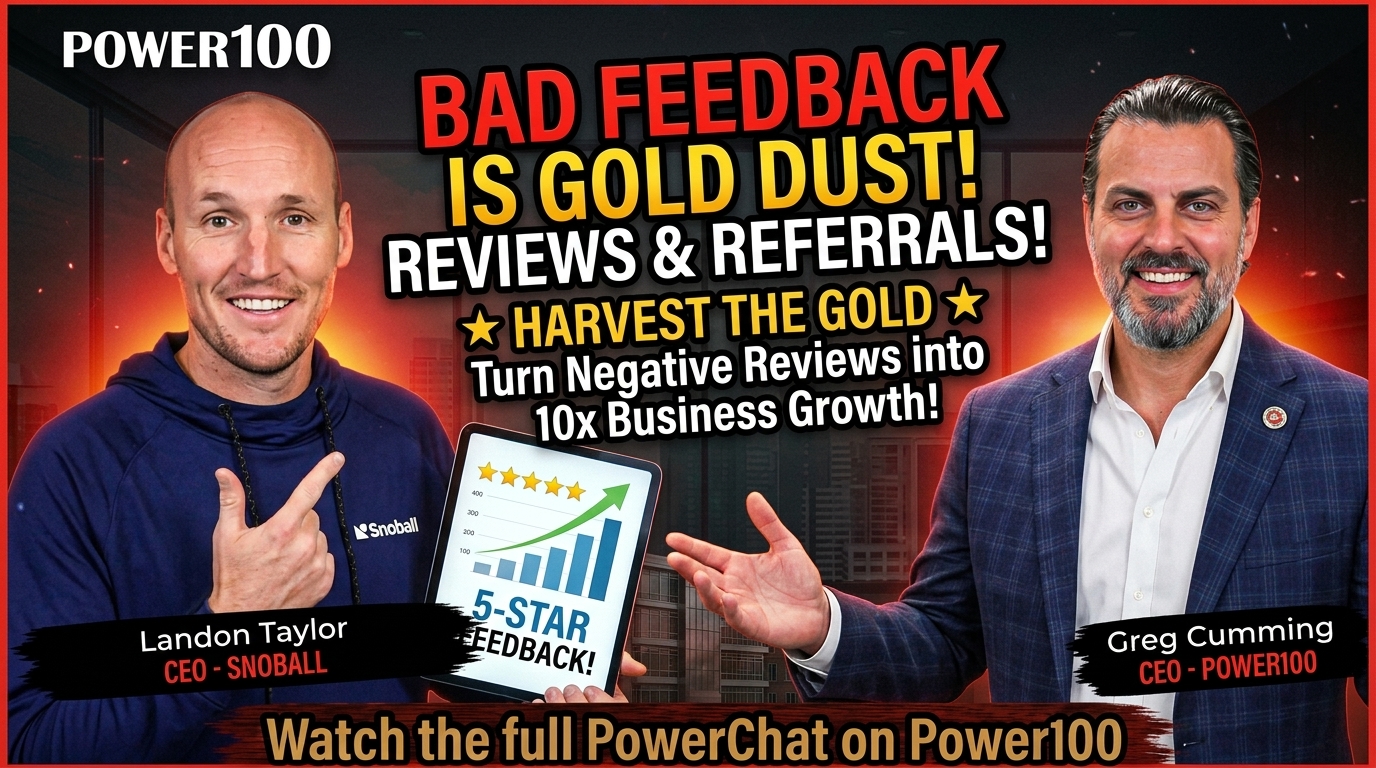
That idea became a key part of Taylor’s PowerChat with Greg Cummings, CEO of Power100. Their conversation examined what companies can learn by keeping listening after the work is finished, and why both positive and negative feedback can make the business stronger.
Power100 is the only unbiased third-party platform that recognizes and elevates the top leaders and most impactful companies in the home improvement industry. Through conversations with leaders like Taylor, the platform highlights the systems, choices, and customer lessons that can help home improvement companies better serve and grow.
One of the easiest customers for a home improvement company to lose contact with is the one whose project was just completed.
The job is done.
The crew has moved on.
The sales rep has another homeowner to meet.
The company begins looking ahead.
But the customer is now in a unique position. They have seen the whole experience from start to finish. They know whether the company kept its word. They know how well the team communicated. They know how problems were handled. They know whether the final result matched what they were promised.
Taylor believes companies should use that moment to listen.
During the PowerChat, he explained that post-job follow-up can create two important outcomes.
The first is learning.
If something went wrong, the customer needs a clear place to say so.
Taylor put the value of that information in simple terms.
“Any negative kind of feedback is gold dust for your business to improve,” Taylor said.
That idea changes the purpose of customer follow-up.
A complaint is not only a problem to manage. It can be information that helps the company become better.
Maybe the homeowner did not know when the crew would arrive.
Maybe there was a gap between what sales promised and what production delivered.
Maybe the work was strong, but the communication was weak.
Maybe one small issue was never fully resolved.
If the company does not ask, leaders may never know.
The second outcome Taylor identified is growth.
When customers are happy, staying connected gives them a clear path to share that experience.
Taylor said follow-up with satisfied customers gives companies a channel to “harvest referrals, reviews, and repeat business.”
That does not mean every follow-up should immediately ask the homeowner for something.
In fact, Taylor’s broader message runs counter to that.
The company should first make it easy for the customer to speak.
Those questions can help a company learn before it asks the customer for a review, referral, or another sale.
For businesses building an automated customer referral program for contractors, that order matters. A referral system can make future action easier, but it should not replace the need to understand whether the customer experience was actually good enough to recommend.
Taylor also warned companies not to make post-job communication too complicated.
“Less is more to start,” he said.
A company does not need dozens of messages to stay connected.
It needs the right ones.
A useful follow-up can show the customer that the relationship did not end with the final payment. It can give the company a chance to correct something that went wrong. It can show employees where the customer experience needs work. And when the customer is truly happy, it can create a natural path toward future growth.
The goal of follow-up should not be to hear only good news.
It should be to hear the truth while the company can still do something useful with it.
The PowerChat between Greg Cummings and Landon Taylor moved beyond the idea that customer follow-up is only about asking for reviews or referrals. Taylor presented a wider view. The time after a project is complete gives a company a rare chance to hear the customer clearly. If the experience fell short, the business can learn where it failed. If the customer is happy, the company can make it easy for that trust to translate into a review, a referral, or a future project. In both cases, the value begins with listening. The strongest follow-up does not rush the customer toward the next action. It creates a clear place for the customer to speak, then gives the company something useful to do with what it hears.

Snoball, led by CEO Landon Taylor
For many contractors, project completion creates a natural shift in attention. The crew finishes the work. The production team moves to another home. The sales rep begins working with the next prospect.
Taylor’s point is that the customer relationship should not move on just as quickly.
After the work is finished, the homeowner has something the company needs. They have a complete view of the experience.
They know whether communication was clear.
They know whether the project met their expectations.
They know whether small problems were handled well.
They know how they felt working with the company from beginning to end.
That makes the period after completion one of the best times to listen.
A quiet customer should not always be read as a satisfied customer. Some homeowners may have a concern but never know who to contact. Others may decide that speaking up will not change anything. If the company never creates a direct channel, leaders may believe everything went well, while the customer carries a very different story.
Taylor explained that post-job contact helps solve that problem because “staying in touch with them gives them that channel.”
That direct path matters in a business using home service review software because technology should not only make it easier to collect positive comments. It should also make it easier for customers to tell the company when something needs attention.
Staying present also helps the company remain easy to remember. Months later, a homeowner may need another service. A neighbor may ask who completed the work. A friend may need the same type of contractor.
The goal is not to stay in the customer’s inbox every week.
It is to remain useful enough for the relationship not to disappear.
For contractors looking to stay connected with customers after project completion, explore how Snoball supports ongoing customer relationships.
Customer praise feels good.
Negative feedback is harder.
But Taylor argues that the uncomfortable feedback may hold more value because it can reveal to leaders what their reports and dashboards do not.
“Any negative kind of feedback is gold dust for your business to improve,” Taylor said.
That phrase changes the way a complaint can be viewed.
The customer may be pointing to a weak handoff between sales and production.
They may be telling the company that the project updates came too late.
They may have misunderstood something during the sales process.
They may have received a strong finished product, but still felt ignored during the work.
Those details can be difficult to see from the owner’s office.
A customer can bring them into view.
This is why reviews and reputation marketing for home service companies should not become a search for praise alone. Reputation gets stronger when the business learns from the experiences that were not perfect either.
One complaint can also point to a wider operating problem.
If several customers are confused about the same part of the project, the issue may not be with the customers.
It may be the process.
If the company treats that feedback as useful information, leaders can fix the weak point before it reaches more homes.
That also requires the right culture inside the business.
Employees should not feel that bad news has to be hidden. Leaders need to make it safe to raise customer problems.
The goal is not to create a company where nobody complains.
The goal is to create a company that gets better when somebody does.
Listening to dissatisfied customers is only half of Taylor’s post-job model.
The same open relationship creates another opportunity when the customer is happy.
A homeowner may love the finished project and still never leave a review.
They may be willing to refer a neighbor, but they never know how.
They may need another project a year later, but have lost the salesperson’s number.
Satisfaction creates potential.
A clear process helps the customer act on it.
Taylor said staying connected with happy customers gives companies a channel to “harvest referrals, reviews, and repeat business.”
Those are three distinct growth outcomes from a single relationship.
That is why an automated customer referral program for contractors can be valuable when it is built around a customer who already has a reason to trust the company.
The technology is not creating trust.
The completed experience created it.
The system simply makes the next step easier.
That next step also needs to be simple.
Taylor explained elsewhere in the conversation that the referral process should be frictionless. Customers should not have to jump through several steps to recommend a company. If there is a reward, receiving it should also be easy.
That matters because even a willing customer can stop if the process feels like work.
A happy homeowner should be able to move from “I would recommend them” to actually making that recommendation without confusion.
Taylor also shared that 50% of new referrals come from someone who has already made at least one referral.
That means the first referral may be the beginning of a stronger customer relationship, not the end of it.
Staying connected does not mean contacting the customer constantly.
Taylor is clear about that.
Companies can damage a good relationship when several tools, teams, and vendors all begin talking to the same homeowner without a plan.
One system asks for a review.
Another asks for a referral.
Another sends an offer.
Another check on the project.
Each message may make sense inside the company. Together, they may feel like noise to the customer.
Taylor’s advice is simple.
“Less is more to start.”
That gives contractors an important rule for using a word-of-mouth marketing platform for contractors.
More automation should not mean more interruptions.
Every message should have a purpose.
One may ask whether the project went well.
Another may give the customer an easy way to raise a concern.
Later, a satisfied customer may receive a simple path to refer someone.
The timing should follow the relationship rather than the company’s desire to collect another action.
Taylor also warned against trying to get every possible outcome from the customer at once.
If each message feels like another request, trust can begin to fall.
A strong follow-up plan should feel useful before it feels promotional.
That is what makes intention more important than volume.
The company does not need to say more.
It needs to know why it is speaking.
Taylor’s view of feedback does not stop with the customer service or marketing team.
What customers say should travel back into the company.
That includes the good news.
Taylor explained that when a positive review can be connected to the sales rep or employee who helped create that experience, the feedback becomes much more real.
The employee remembers the customer.
They remember the work.
They can see that what they did had an impact.
Taylor said, “Everything good that’s said by your company not only should be for the outside world, but also for people inside your company.”
That is an important use of referral marketing software for home service companies, one that goes beyond just getting new leads.
Customer proof can also strengthen the people already inside the business.
A sales rep who receives positive feedback from a homeowner they served has concrete proof that the company delivered on its promises.
A project manager can see which parts of the process customers value.
A leader can show the whole team what great service looks like in the customer’s own words.
Negative feedback can work the same way.
It shows where something broke.
Positive feedback shows what should be repeated.
Together, they create a full learning loop.
The customer speaks.
The company listens.
The team learns.
The process improves.
And the next homeowner gets the benefit.
That is much more useful than collecting reviews simply to make a profile look better.
It turns customer feedback into a tool for culture, training, confidence, and better service.
Landon Taylor’s view that feedback should help a company improve is not limited to what he tells contractors today. It can also be seen in how he has built companies for more than two decades.
Taylor has followed a bootstrapped path since 2005, choosing to grow with business revenue instead of depending on large venture capital rounds. That approach has carried through three connected companies in digital marketing, customer reviews, and word of mouth growth. His first company, SkyRocket Media, built expertise in digital customer acquisition before BuyerLink acquired the business in May 2022. Taylor also helped build BestCompany.com around trusted customer reviews and consumer decision making before that experience helped shape Snoball.
Taylor has described that growth model in simple terms. Rather than allowing early success to change how he spent, he said, “Instead of going wild with our lifestyle, we just parlayed the profits into building BestCompany.” That choice allowed Taylor and his team to keep investing what they learned into the next business instead of chasing growth for growth’s sake.
That history gives more weight to his message about negative feedback.
Taylor has built businesses in markets where customer opinion, reviews, trust, and buying behavior directly shape what happens next. BestCompany.com was created after Taylor saw problems with how some third party review sites served companies and consumers. Snoball later grew from that experience, expanding the focus from reviews and reputation into referrals and a wider word of mouth system.
The pattern is clear. Listen to what is happening. Find the gap. Improve the model. Build again.
That same mindset now sits behind Taylor’s advice to home service leaders. A complaint should not simply be managed and forgotten. It can show the company where the next improvement needs to happen.
One of the clearest examples of that focus came when Snoball sold BestCompany.com’s lead generation assets and rights to Modernize Home Services.
The transaction made Modernize the exclusive marketing and media acquisition partner for BestCompany.com, giving contractors access to Modernize’s scale in media buying, lead relationships, and home services marketing. At the same time, Snoball continued operating independently and remained involved in maintaining the review and reputation side of BestCompany.com, including review verification and company profile work.
For Taylor, the move reflected a larger view of how contractor growth works.
“This transaction signifies our deep commitment to helping quality brands generate referral business from their satisfied customers,” Taylor said when the alliance was announced.
The structure created a clear connection between two sides of growth.
Modernize could help companies reach new homeowners.
Snoball could stay focused on what happens after companies earn those customers, including reviews, reputation, referrals, and word of mouth.
That distinction matters, getting the customer is only one part of the job. What the customer says afterward can help the company protect its reputation, uncover problems, improve future experiences, and create new growth from trust it has already earned.
Snoball’s evolution also reflects that shift. The business grew from a reputation marketing platform into a broader system built around reviews, referrals, and customer advocacy. Snoball says its goal is to help companies turn strong customer experiences into systematic word of mouth growth rather than leaving those outcomes to chance.
For home improvement leaders, Taylor’s track record offers evidence behind the advice he shared with Greg Cummings.
Feedback does not have to be something a business fears.
Used well, it can show a company what to protect, what to change, and where its next opportunity may be hiding.
Taylor has spent much of his career building around that idea.
Now, through Snoball, he is helping other companies do the same.
The end of a project can feel like a finish line.
The work is complete. The team moves on. The company begins thinking about the next customer.

The Snoball team expresses gratitude for Landon Taylor, the driving force behind Snoball.
But Landon Taylor’s message in the PowerChat is that the end of the job should also be a moment of reflection.
That is where follow-up becomes more than a marketing step.
Companies want five-star reviews. They want referrals. They want repeat business. But those outcomes mean more when the company is also willing to hear what did not go well.
Taylor’s point is not that leaders should fear negative feedback.
It is that they should create a clear path for it.
When a customer can speak openly, the company gets a chance to learn while the experience is still fresh. One concern may uncover a small gap. Another may reveal a deeper process issue. Either way, the feedback gives leaders something they can act on.
The same is true when the experience went well.
A satisfied customer should have an easy way to share that trust, whether through a review, a referral, or another project in the future.
What matters most is what happens next.
The company listens.
It fixes what needs fixing.
It keeps what works.
It helps the team understand both.
And over time, each customer can help improve the next customer’s experience.
That is what makes Taylor’s view of feedback so valuable.
The companies that learn fastest will not be the ones that avoid negative feedback. They will be the ones who create a safe path for customers to give it, then use it to get better.
A finished job tells you the work is done.
Customer feedback tells you whether the company did it right.
Power100 evaluates strategic partners through its proprietary five-layer system rather than listing companies on a simple vendor list. For its 2026 Preferred Partners rankings, Power100 says it reviewed thousands of companies and measured areas such as customer experience, innovation, operating efficiency, sales and marketing performance, company culture, and overall impact on contractors. Power100 uses that process to narrow the field to 15 Preferred Partners that it believes can create measurable value for home improvement companies.
Power100 connects its rankings with a wider content and education platform. Contractors can access PowerChat interviews, leadership stories, expert articles, the Inner Circle Show, and its industry-focused Inner Circle AI resources. Power100 says its member portal also gives registered members access to interviews, expert insights, and an AI concierge trained on its knowledge base. This allows contractors to move from simply seeing who ranks well to learning from the systems and ideas those leaders use.
No. Snoball also helps companies see where customers report problems. Its review platform includes sentiment analysis that helps businesses identify areas where customers say the company performs well or struggles. Snoball also encourages companies to address concerns quickly instead of treating review collection as a search for praise alone. For businesses using home service review software, customer feedback can become a source of operational insight as well as reputation growth.
Yes. Snoball says real customer conversations can surface support issues that would otherwise never reach the company through normal service channels. A homeowner may respond to referral outreach by mentioning an unresolved problem, asking a question, or raising another need. Snoball says those moments can then move to the right person or back into the CRM. This supports Landon Taylor’s point that staying in touch gives customers a place to speak before valuable feedback disappears.
A single automated message can miss much of the value in the customer relationship. Snoball argues that a basic CRM trigger can start a conversation, but somebody or something still needs to manage what happens when the customer responds. Its research also says companies can lose referral opportunities when they treat review requests and referral conversations as separate programs. A stronger word-of-mouth marketing platform for contractors connects customer responses to the next useful action, rather than stopping at a single message.
Snoball can connect review and referral activity with existing CRM systems through APIs and webhooks. Its integrations can post reviews and referrals back into the CRM, which helps teams keep customer information connected to the rest of the business. Snoball also provides reporting around referral activity and customer sentiment. This gives leaders a clearer way to see what customers say, track what happens next, and use that information to improve future customer experiences.
Yes, if the company sends too many messages without a clear purpose. Landon Taylor warned during the PowerChat that several disconnected vendors can quickly overwhelm a customer when each one sends its own message. He advised companies to start simply and make communication intentional. His phrase, “Less is more to start,” reflects the idea that effective reviews and reputation marketing for home service companies should prioritize the relationship first, rather than pushing customers to take constant action.
Because the finished project does not show leaders every part of the customer experience. Taylor said negative feedback can reveal where communication, expectations, service, or internal handoffs failed. He called that feedback “gold dust for your business to improve.” Snoball also provides tools that help companies monitor customer sentiment and identify areas where customers report weaker experiences. A contractor who listens to those signals can fix problems before the same issue reaches more homeowners.
Power100 is the only unbiased third-party platform that recognizes and elevates the top leaders and most impactful companies in the home improvement industry. Led by Greg Cummings, Power100 gives home improvement CEOs, contractors, and industry partners a trusted place to learn from proven leaders, discover stronger business practices, and see what top companies are doing across customer experience, culture, growth, leadership, and performance. Through its national rankings, PowerChat interviews, industry coverage, and leadership resources, Power100 helps great companies gain the recognition they deserve while giving the wider industry practical ideas it can use to improve.
Membership unlocks every Power100 interview, PowerChat episode, and expert playbook - free for industry leaders.
Power100 is the nation's premier CEO ranking and media platform for the home improvement industry. Using a proprietary 5-layer evaluation system, Power100 identifies and celebrates the top CEOs, companies, and strategic partners driving innovation, customer satisfaction, and leadership excellence across the country.