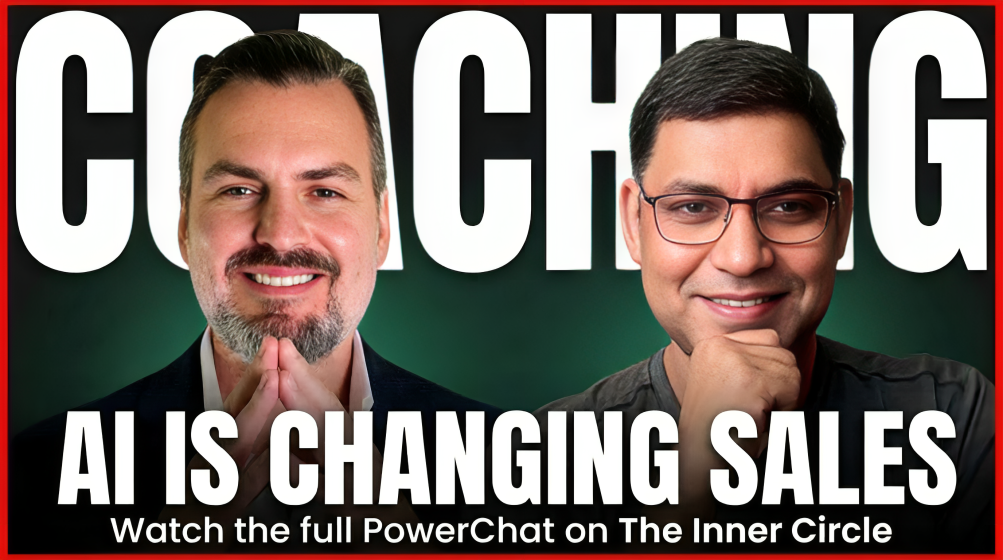
Sales leaders face a common problem. They can give every salesperson the same training, the same script, and the same sales process, yet still get very different results. One person may hear a lesson and use it the next day. Another may understand the lesson but struggle when a real customer pushes back. A third may already be strong in that area and need help somewhere else. AmpUp, led by CEO Amit Prakash, is focused on this gap through AI sales coaching that learns from real conversations and gives each person support based on where they are, what they do well, and what they need to improve next.
That challenge became a key part of a PowerChat hosted by Greg Cummings, CEO of Power100. The conversation explored how leaders can move beyond giving every salesperson the same advice and instead begin to think of coaching as a personal experience.
Power100 is the only unbiased third-party platform that recognizes and elevates the top leaders and most impactful companies in the home improvement industry. By bringing leaders like Prakash into the conversation, the platform helps home improvement CEOs examine how new technology can support stronger people, better customer talks, and more useful coaching.
Most sales companies know how to teach a process.
They can build a script. They can set clear steps. They can show representatives how to ask questions, explain value, handle concerns, and ask for the sale.
The harder part is getting everyone to apply those lessons when the customer conversation becomes real.
A salesperson may know that they should listen more, but still speak too much when they feel pressure. Another may know exactly when to ask for the business but lose confidence when price becomes the main concern. Someone else may be very strong at building trust but struggle to move the conversation toward a clear decision.
Giving all three people the same coaching does not solve the same problem.
That became one of the strongest ideas in the conversation between Cummings and Prakash. If every salesperson brings different skills, habits, fears, and strengths into the home, then coaching must begin by understanding the person receiving it.
For Prakash, that lesson came from his own experience.
Before focusing deeply on sales coaching, he had spent much of his career on the technology side of business. As he began building AmpUp, he also found himself having to sell more directly.
He knew technology. Sales were different.
Prakash hired a personal sales coach, and the experience changed how he thought about improvement.
The value was not simply that someone knew more about sales than he did.
The coach took time to understand him.
The coach looked at where he was starting, what he did naturally, where he struggled, and why certain lessons were harder for him to use. The advice was then shaped around those needs.
“I started seeing the power of personalized coaching where somebody really empathizes with where you are, a deep understanding of why you do what you do and why you do not do what sometimes is being coached,” said Amit Prakash, CEO of AmpUp. “And then tailoring the coaching so that it lands in the right place.”
That difference matters because knowing what to do is not always the same as being able to do it.
A salesperson can sit through training and understand every lesson. They can know the company process. They can know that listening matters. They can know how to respond to price concerns.
But a real customer conversation moves quickly.
The homeowner may say something the salesperson did not expect. The tone may change. The representative may feel pressure. A question that sounded easy in training may suddenly become difficult to ask.
That is where coaching has to become personal.
“Coaching never works if it is like one size fits all,” said Prakash. “It is a very personal experience.”
The point is not to remove company standards.
A business can still have a single sales process, a single promise to the customer, and clear expectations for every representative. What changes is the path each person takes to become better at meeting those standards.
One salesperson may need to build more confidence.
Another may need to slow down.
Another may need to ask stronger questions.
Another may need help knowing when to stop explaining and let the homeowner speak.
The coaching should meet that person where they are.
This is where AI sales coaching for home improvement teams can open a new path. A sales manager may understand their people very well, but one manager cannot sit inside every customer meeting or review every conversation right away. Technology can help extend that support by learning from real conversations and helping each representative focus on the skill that matters most to them.
The goal is not to create a team where everyone sounds the same.
It is to create a team where more people understand their own strengths, see where they can improve, and receive help they can use in the next customer conversation.
For Prakash, that is the difference between giving someone another sales lesson and giving them coaching that truly lands.
During the PowerChat, Greg Cummings and Amit Prakash moved the conversation past training systems, scorecards, and sales rules. The deeper issue was the person receiving the coaching. Two representatives can hear the same lesson, understand it just as well, and still act very differently when they are sitting with a customer. Prakash explained that useful coaching must understand why someone behaves the way they do, what they already do well, and what will help them take the next step. The goal is not to give every salesperson more advice. It is to give each person advice they can actually use.
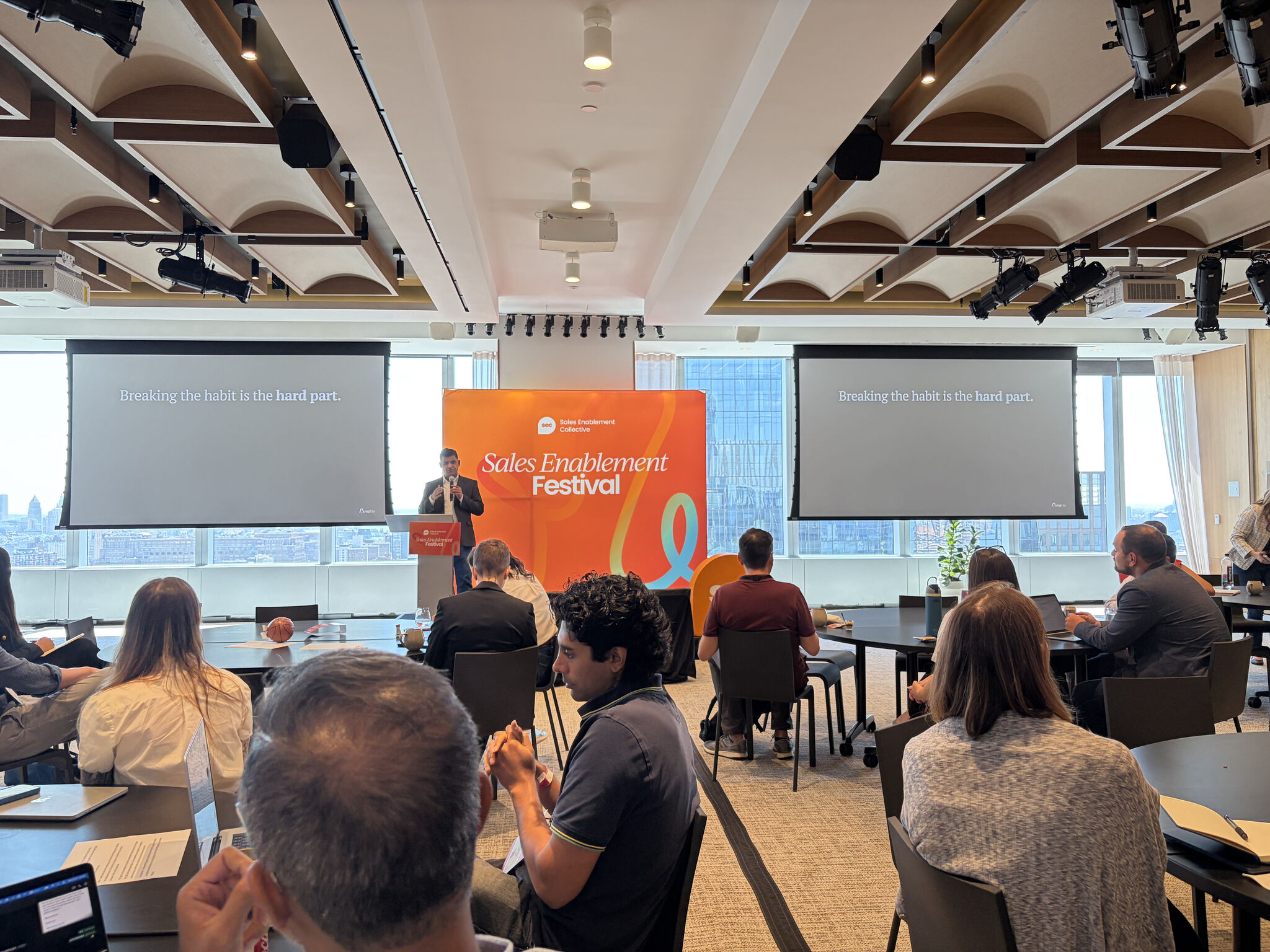
Amit Prakash speaking at the Sales Enablement Festival in New York.
A sales manager can often spot a mistake quickly.
A representative may fail to ask for the business. They may speak too much. They may rush through a price concern or move on before they understand what the homeowner is really saying.
The easy response is to point out the mistake.
Prakash argued that strong coaching should go one level deeper.
The coach should understand why the behavior happened in the first place.
A salesperson who does not ask for the sale may know exactly what the sales process says. The problem may be confidence. They may worry that asking directly will make the customer uncomfortable.
Another representative may fill every quiet moment because silence makes them nervous. Telling that person to “talk less” may be correct, but it does not address why they keep doing it.
This is where sales behavior coaching becomes more useful than simple correction. The coach is not only asking what went wrong. The coach is asking what the person needs in order to respond differently next time.
Prakash described this from his own experience with a personal sales coach.
“Somebody really empathizes with where you are, a deep understanding of why you do what you do and why you do not do what sometimes is being coached,” said Amit Prakash, CEO of AmpUp.
That empathy matters because people do not all hear feedback in the same way.
Some need a direct push. Others need to understand why the change matters. Some need a new phrase to practice. Others need confidence that the skill they already have is strong enough to build on.
The advice may be correct for everyone, but the way it is delivered should fit the person.
That is how coaching begins to “land in the right place,” as Prakash described it.
For sales leaders, the lesson is simple. Before trying to fix the behavior, understand the person behind it.
See how AmpUp approaches personal sales coaching built around each representative.
A company needs standards.
Customers should receive a clear level of care. Sales representatives should understand the process. Leaders need a way to know whether the team is doing the work the right way.
Personal coaching does not remove those standards.
It changes how people are helped to reach them.
A new salesperson may still be learning how to open the conversation, ask clear questions, and explain the product.
A strong veteran may already do those things very well. Their next improvement may come from one small habit that appears only when price becomes difficult or when a customer wants to delay the decision.
Giving those two people the same coaching wastes time for both.
The new representative may need more support than the lesson provides. The veteran may hear something they mastered years ago.
A stronger system begins with the standard but adjusts the coaching to the person’s current level.
This is where sales performance coaching can become more focused. Instead of asking everyone to work on the same skill this week, a company can help each person work on the part of the sales process that is holding them back the most.
Prakash explained that personalized coaching should understand what a person already does well and where the next area for growth sits.
That matters for top performers too.
Strong salespeople do not stop needing coaching because they close more deals. Their needs simply become more specific.
A small improvement in the right part of the conversation can still have a major effect on trust, margins, and close rates.
The company can maintain a single clear sales standard while giving each person a different path to stronger performance.
That is not weaker coaching.
It is more useful coaching.
Explore how AmpUp helps leaders coach individual skill gaps across a sales team.
Putting a salesperson’s name at the top of a report does not make the coaching personal.
Real personalization needs context.
The system needs to understand the representative. It should know what that person does well, where they struggle, and what has happened in past customer conversations.
It also needs to understand the company.
A representative is speaking for a business with its own products, promises, price points, customer experience, and way of building trust.
Advice that ignores that setting can sound smart and still miss the mark.
Then there is the customer.
A representative may be walking into a large project with a family that has been planning for months. The next appointment may involve a smaller need and a customer who wants to move quickly.
The same talk track may not fit both homes.
Prakash said useful coaching must bring those different pieces together.
“They get coached on how do you tackle this particular conversation, given what we know about you, given what we know about the customer, given what we know about the company,” said Prakash.
That is what separates AI coaching for sales reps from broad sales advice.
The representative is not being told how people should sell in general.
They are being helped with this customer, in this situation, based on what the system already knows about their strengths and needs.
For home improvement companies, that can be especially important because no two homes, projects, or homeowners are exactly alike.
The representative needs enough structure to protect the company’s process and enough flexibility to respond like a real person.
When coaching understands the rep, the company, and the customer at the same time, the advice becomes much easier to use.
Learn how AmpUp combines company knowledge, customer context, and rep data to shape coaching.
Most experienced salespeople know the basics.
They know they should listen.
They know they should ask strong questions.
They know they should understand what matters to the customer before presenting a solution.
They know they should handle concerns without becoming defensive.
Knowing those lessons is not the hardest part.
Using them when the conversation becomes uncomfortable is where the challenge begins.
A homeowner may suddenly question the price. A spouse may join halfway through the meeting. A customer may say they need three more quotes. A salesperson who understands the training perfectly can still fall back into old habits when pressure rises.
Prakash made this distinction clear.
“Knowledge is never the gap. It is execution where the gap is,” he said.
This is why continuous sales coaching matters.
The salesperson does not need another broad reminder that questions are important.
They need to see the exact moment where a better question could have changed the conversation.
Instead of saying, “You need to listen more,” the coach can show the point where the customer gave useful information and the representative moved past it too quickly.
Instead of saying, “Handle objections better,” the coach can explain how the representative answered one concern and offer a clearer response to try next time.
That kind of feedback makes the lesson real.
It is tied to a conversation the salesperson remembers.
It gives them one clear action to practice.
Then the next customer meeting becomes another chance to use it.
When that cycle repeats, coaching moves from information into behavior.
That is where improvement begins to stick.
See how AmpUp turns real sales conversations into clear feedback reps can use right away.
A recorded customer conversation can contain many things a salesperson could have done better.
Some are small.
Some matters a great deal.
Treating every mistake as equal can leave the representative with a long list of corrections and no clear idea where to begin.
Prakash compared strong coaching to an experienced sales manager riding along with a representative.
That manager is not simply counting missed steps.
They are listening to the entire conversation while considering where the sale is headed.
They notice when the customer becomes more interested.
They notice when trust drops.
They notice the moment where the representative had a chance to move the conversation forward and chose the wrong response.
Prakash described what the coach may hear.
“This one moment where the customer said X, Y and Z, and you said A, B and C, that really hurt our chances of earning the business,” he said.
That moment gives the coaching focus.
Rather than sending the salesperson away with ten things to fix, the coach can explain the one change that may create the largest improvement.
This is where conversation intelligence coaching can move beyond scoring.
A score can tell a representative that something was missed.
A coach should help them understand why it mattered and what to do instead.
That difference is important.
People can become numb to long reports filled with mistakes.
One clear lesson is easier to remember.
One better response is easier to practice.
One moment from a real conversation makes it easier to connect the next time the same situation arises.
The goal is not to prove that the salesperson made mistakes.
The goal is to help the salesperson win more of the moments that matter.
Even useful technology can fail when the people using it do not see the value.
Leadership may know why a new system was purchased.
The salesperson may only see another login, another score, and another way for someone to review their work.
Prakash said adoption starts with a simple question.
“You have to define that for every user. What is in it for me?” he said.
For a salesperson, the answer has to feel real.
Prakash shared an example from a large electric vehicle company using the system. Within several weeks, he said users were making about 30 percent more money. Some middle and lower performers were making close to twice as much.
Then something important happened.
Other people wanted the coaching.
They were no longer being told that the technology mattered.
They could see the value in the results of the people around them.
That is a major shift for AI field sales coaching.
A system that only watches and scores can feel like surveillance.
A system that helps a salesperson prepare, improve, and make more money can begin to feel like support.
Greg described that experience almost like having a trusted sales friend available before and after the appointment.
That idea matters because salespeople often do want help.
They just do not always want help delivered as a lecture after the fact.
When coaching is personal, timely, and useful, the relationship changes.
The representative can become more confident. The customer can receive a better conversation. Managers can spend more time where human judgment matters most.
Over time, that can strengthen the way the team sees coaching itself.
It stops feeling like something done to them.
It becomes something that helps them win.
The strongest proof of Amit Prakash’s view on personal coaching is not only what he says about it. It is what he and the team at AmpUp are building around that belief. The company was created to address what it calls the execution gap, the space between knowing the right sales move and actually making that move when the pressure is real. AmpUp says its mission is to learn what the strongest sellers do differently and make those lessons available across the team, so strong sales habits do not stay locked inside the experience of a few top performers.
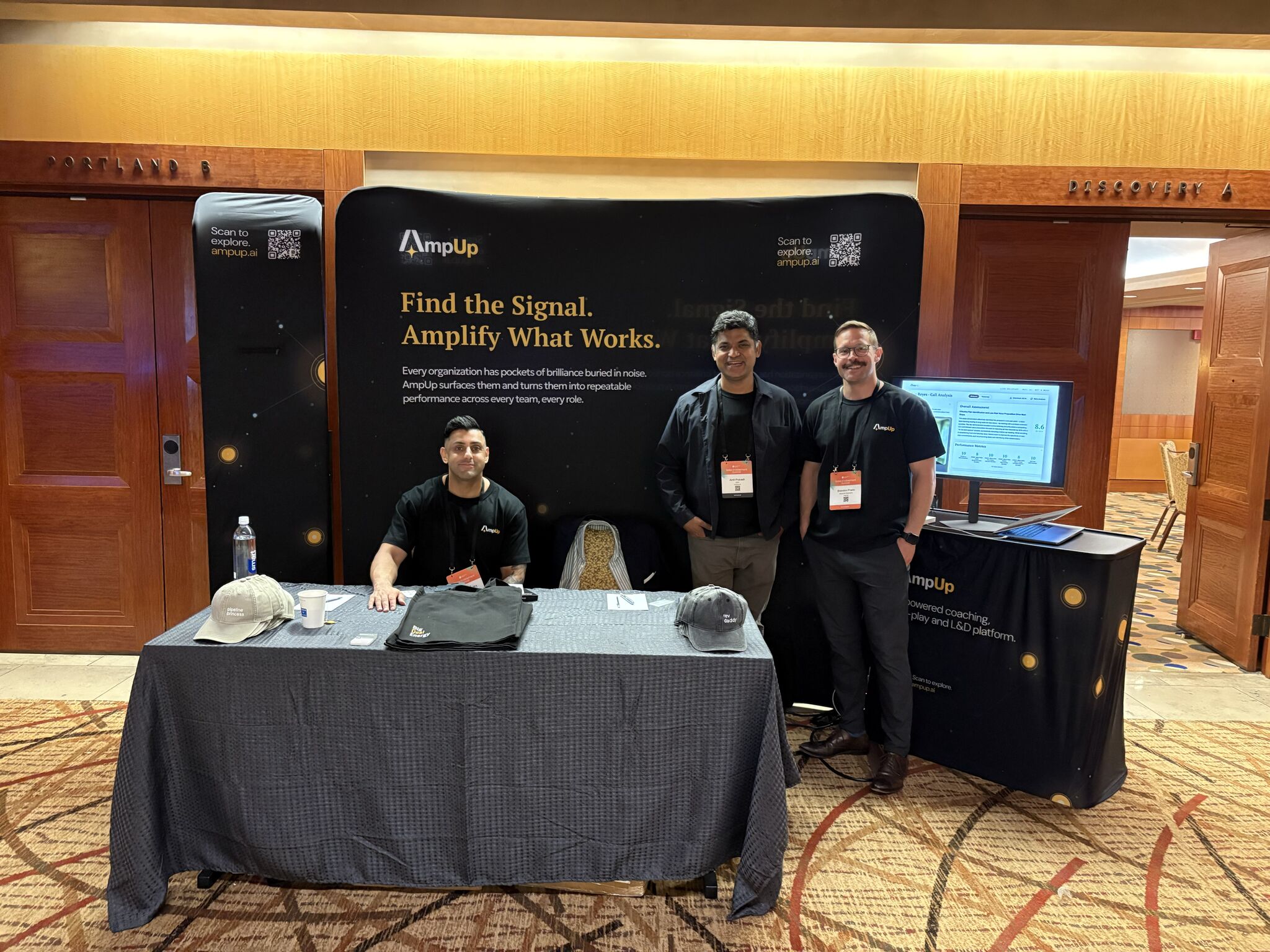
AmpUp team led by CEO Amit Prakash
That mission is reflected in how the platform is built. AmpUp can take in sales conversations and CRM information, study the behaviors connected to wins and losses, identify areas where individual representatives need help, and use those findings to prepare them for what comes next. Its learning loop moves from recording a conversation to studying it, coaching the representative, creating practice, preparing for the next meeting, and then learning again from the result. AmpUp says most teams can connect the platform to tools they already use within days, not months.
The people behind that work also bring experience from companies that helped shape modern artificial intelligence and enterprise technology. AmpUp says its founders and team include veterans of Google, ThoughtSpot, Amazon, Netflix, Roblox, and Amazon Alexa. Co-founder Rahul Goel previously served as a research lead at Google Gemini, while Prakash previously co-founded ThoughtSpot. That background gives the company experience not only in using artificial intelligence but also in building and scaling technology for large volumes of business data.
AmpUp is also beginning to point to business results behind the model. In one pilot with a company generating about $5 billion in annual revenue, AmpUp reports that the group using its system outsold the comparison group within five weeks and produced a 30 percent revenue lift. The company also reports that highly engaged representatives from the lower part of the sales team began selling at rates similar to top performers. Those are company-reported results, but they offer an important example of what sales coaching based on top-performer data can look like when the goal is not simply to deliver more training but to help people use proven behaviours when they matter.
Another example is the AmpUp AI Notetaker. Instead of ending its job after producing a transcript or meeting summary, the tool sends structured information into the CRM and feeds the conversation into AmpUp’s wider coaching system. Sales Brain looks for useful behavioural patterns, Atlas prepares the representative for the next conversation, and Skill Lab turns real objections into practice. The note from one meeting therefore becomes part of the learning that can improve the next one.
That work gives Prakash’s PowerChat message a practical foundation. Personalized coaching is not being treated as a softer version of sales training. It is being built into a system designed to learn what works, understand where each person needs support, and bring that lesson back before the next customer conversation.
For sales leaders, that may be the more important measure of innovation. The best technology is not always the system that produces the most information. It may be the system that helps more people turn the right information into better action.
The PowerChat with Greg Cummings and Amit Prakash leaves sales leaders with a simple idea to carry forward. Great coaching is not about making every salesperson sound the same. It is about helping each person understand what they need to become better.
That may look different for every member of the team.
One person may need more confidence when asking for the business. Another may need patience when a homeowner raises a concern. Someone else may need stronger questions, while another simply needs to learn when to stop talking and listen.
The company can still protect one sales process and one standard for the customer. What changes is the path each person takes to reach that standard.
That is where personal coaching becomes powerful.
Instead of starting with what the salesperson did wrong, the coach can start with what the person needs next. Improvement becomes less about correction and more about steady growth.
For years, the challenge has been scale.
A great sales manager can know their team deeply. They can understand who needs encouragement, who needs a push, and who needs help with one small part of the conversation. What they cannot do is sit beside every salesperson during every appointment or review every conversation as soon as it ends.
Artificial intelligence creates a chance to extend that personal support.
The future Prakash describes is not one where technology makes coaching less human. It is one where technology remembers more, learns more, and helps leaders give people support that fits the moment.
That can give managers more time to lead while giving salespeople more chances to improve when the lesson is still fresh.
For home-improvement CEOs and sales leaders, this raises a useful question.
Are your people simply receiving more coaching, or are they receiving coaching that truly helps them grow?
More recordings, more scorecards, and more training sessions can create more information. They do not always create better salespeople.
The greater opportunity may be to understand each representative well enough to know what will help them take the next step.
As sales coaching continues to evolve, the strongest systems may be those that preserve what makes each salesperson different while helping them become more confident, more capable, and better prepared for the customer in front of them.
The future of sales coaching will not be about teaching every person the same way. It will be about understanding each person well enough to help them become the best version of the salesperson they already are.
Power100 uses the Inner Circle as a free learning hub for home improvement leaders seeking more than rankings. Members can view PowerChat episodes, feature interviews, expert insights, business lessons, and an AI concierge built around the Power100 knowledge base. This gives contractors a place to learn from leaders and ideas that have already been studied across the industry, rather than leaving the ranking as a number on a page.
Power100 also studies companies that serve home improvement businesses through its Preferred and Strategic Partner rankings. Its research looks at areas such as customer experience, innovation, operations, sales impact, company culture, and measurable value for contractors. In some categories, Power100 first vets the strongest companies and then brings contractor voting into the final ranking process. This helps contractors compare providers based on more than just advertising claims.
Yes. A call score can show that a step was missed, but personalized AI sales coaching is meant to help the individual understand what to work on next. AmpUp says its Sales Brain reviews every call, finds skill gaps, and gives each representative guidance based on their own performance. Managers can then focus on the moments where their judgment can make the greatest difference.
Yes. AmpUp is built on the idea that different representatives need different levels of support. The platform analyzes individual skill gaps and uses real sales conversations to guide each person on what to work on. A newer representative may need help with basic skills, while an experienced seller may need focused support around one behavior that is affecting important deals. This allows sales performance coaching to be tailored to the individual rather than giving the entire team the same lesson.
No. AmpUp says its AI roleplays are built from actual call patterns and can adjust to the company’s deals, customer types, and individual skill gaps. Representatives can practice scenarios that mirror the objections and conversations they are already facing, rather than rehearsing broad sales scripts that may never arise in a real appointment. That makes AI sales roleplay for objection handling more closely tied to daily sales work.
AmpUp studies sales conversations to find behaviors and patterns connected to stronger results. Its coaching model is designed to move those lessons from insight into action, practice, and future conversations. This means the knowledge of strong sellers does not have to stay with only a few people. The company can use sales coaching based on top performer data to help more representatives learn what successful execution looks like inside that specific sales team.
No. AmpUp is designed to help before, after, and between customer conversations. The platform can prepare representatives before a meeting, coach them after the conversation, and create practice based on objections that appeared in real calls. This creates a learning loop where the representative can prepare, sell, review, practice, and then enter the next opportunity with clearer guidance.
No. AmpUp says its Sales Brain can analyze every call and provide coaching coverage across the whole team. That matters because managers often have enough time to review only a small share of customer conversations. With AI coaching for sales reps, the system can help surface individual needs and important moments while managers spend their time on the people and situations that need direct human leadership most.
Power100 is the only unbiased third-party platform that recognizes and elevates the top leaders and most impactful companies in the home improvement industry. Led by Greg Cummings, Power100 helps contractors learn from proven CEOs, industry experts, and innovative companies through leadership rankings, PowerChat conversations, research, and industry insights that support stronger teams, better customer experiences, and smarter business growth.
Membership unlocks every Power100 interview, PowerChat episode, and expert playbook - free for industry leaders.
Power100 is the nation's premier CEO ranking and media platform for the home improvement industry. Using a proprietary 5-layer evaluation system, Power100 identifies and celebrates the top CEOs, companies, and strategic partners driving innovation, customer satisfaction, and leadership excellence across the country.