A powerful conversation on how AI is exposing outdated leadership, weak operational systems, and broken customer trust while reshaping the future of the home improvement industry...
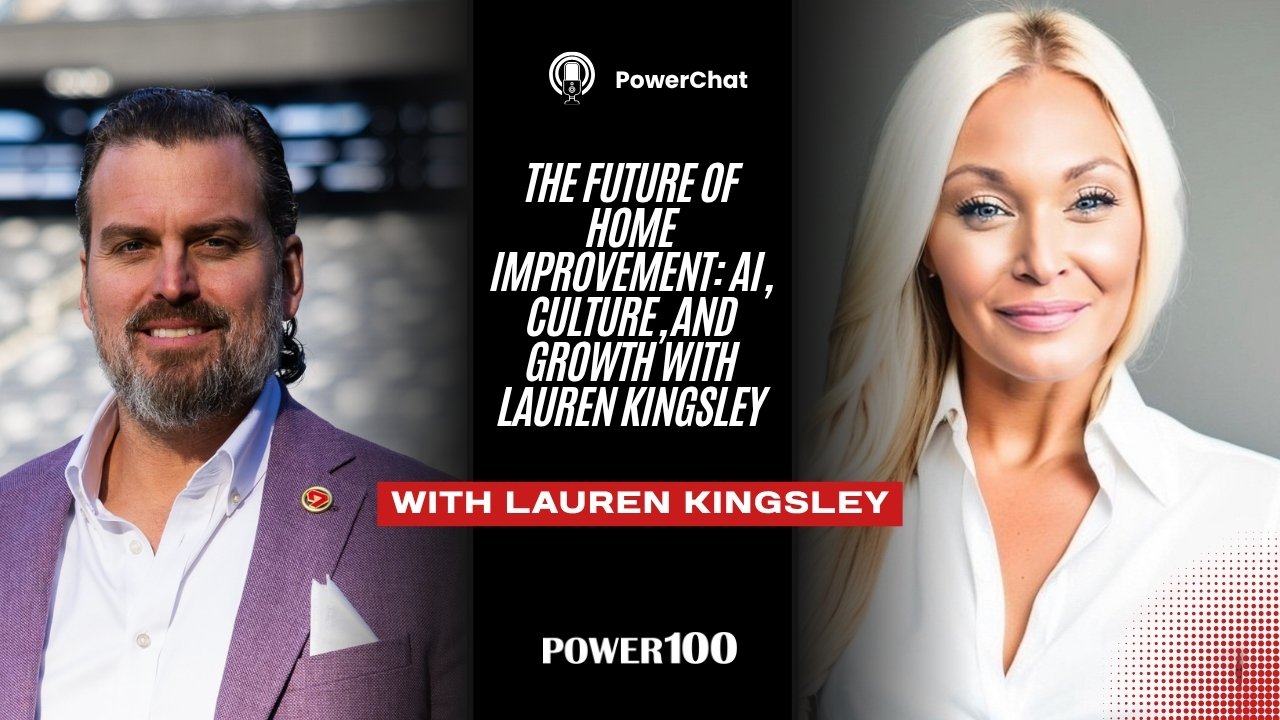
Power100 examines Lauren Kingsley’s powerful insights on AI search, GEO optimization, lead generation, customer trust, leadership, company culture, and the future of the home improvement industry during a recent PowerChat hosted by Greg Cummings, CEO of Power100.
The home improvement industry is entering one of the biggest periods of change it has faced in decades. Rising lead costs, labor shortages, changing homeowner behavior, AI powered search engines, and growing pressure on company margins are forcing home service businesses across the country to rethink how they operate, market, hire, and grow.
During a recent PowerChat interview hosted by Power100 CEO Greg Cummings, Home Service Growth Expert Lauren Kingsley shared a powerful perspective on why many companies are struggling to adapt to this new environment. Throughout the conversation, Lauren Kingsley explained that the biggest challenge facing the home improvement industry is not simply artificial intelligence or rising competition. According to Kingsley, the real challenge is companies attempting to use modern technology while still relying on outdated leadership habits, broken growth systems, and transactional business models that no longer connect with today’s homeowner.
As one of the leading voices helping home improvement companies improve operational efficiency, customer experience, AI strategy, lead generation systems, and company culture, Lauren Kingsley brought forward a direct message that strongly aligns with the mission behind Power100.
Power100 is the only unbiased third-party platform that recognizes and elevates the top leaders and most impactful companies in the home improvement industry. Through PowerChat interviews, leadership conversations, executive features, and industry storytelling, Power100 continues to spotlight the leaders, companies, and ideas helping shape the future of the home services industry.
From AI driven marketing changes and GEO optimization to authentic leadership, operational infrastructure, and homeowner trust, this conversation reflected the growing shift happening across home improvement and why companies that prioritize people, transparency, adaptability, and long term customer relationships are positioning themselves to lead the next era of the industry.
The recent PowerChat conversation between Lauren Kingsley and Greg Cummings arrived at an important moment for the home services industry. Across the country, contractors, home improvement leaders, and growth focused companies are facing rising customer acquisition costs, labor shortages, changing homeowner expectations, tighter margins, and the growing impact of AI powered search behavior. While many conversations in the industry remain focused on tools, automation, and marketing tactics, this discussion went much deeper. It explored the growing gap between companies that are adapting with intention and companies still operating with systems built for a completely different market.
Throughout the PowerChat, Lauren Kingsley brought attention to a major shift happening across home improvement and home services. Homeowners are no longer searching, buying, or making decisions the same way they did during the post COVID growth boom. Consumers are becoming more informed, more selective, and more emotionally driven in how they choose contractors and home service companies. At the same time, AI search platforms like ChatGPT, Claude, Gemini, and other AI driven discovery tools are beginning to reshape how businesses are found online. This means reputation, response time, customer trust, operational efficiency, and authentic brand presence are becoming more important than aggressive advertising spend alone.
One of the strongest takeaways from the conversation was the idea that artificial intelligence is not creating the industry’s problems. Instead, it is exposing the weaknesses that already existed beneath the surface. Broken lead generation systems, slow speed to lead processes, disconnected leadership, weak company culture, poor customer experience, and outdated operational playbooks are now becoming far more visible in an environment where homeowners have faster access to information and more ways to compare companies before making decisions.
Lauren Kingsley explained that the companies positioned to win this next chapter of home improvement will not simply be the largest brands or the fastest growing organizations. They will be the companies willing to adapt operationally, invest in people, improve homeowner trust, strengthen AI visibility, and build smarter systems around customer experience and leadership development.
“The market’s not shrinking, it is reorganizing.” Lauren Kingsley, Home Service Growth Expert.
The conversation also highlighted the growing importance of GEO optimization, AI search visibility, local market positioning, field marketing strategy, and operational intelligence as critical growth levers for modern home improvement companies. From speed to lead systems and financing strategy to frontline culture and homeowner communication, the discussion painted a clear picture of an industry entering a major transition period where adaptability may matter more than size alone.
At its core, this PowerChat was not just a conversation about AI. It was a conversation about accountability, leadership, customer trust, and what the next generation of successful home improvement companies will need to become in order to thrive in a rapidly changing marketplace.
As the conversation moved deeper into the realities facing the home services industry, one point became impossible to ignore. Artificial intelligence is not simply adding another marketing tool to the industry. It is fundamentally changing how homeowners search, compare, evaluate, and trust home improvement companies.
Throughout the discussion, Lauren Kingsley explained that AI powered search platforms like ChatGPT, Claude, and Gemini are already reshaping customer behavior across roofing, windows, siding, bathroom remodeling, exterior remodeling, and home services. Homeowners are no longer relying only on traditional Google search results. They are asking AI tools direct questions about the best home improvement companies, customer reviews, contractor trust, financing options, and local service quality.
“It is no longer a, this is coming.” Lauren Kingsley, Home Service Growth Expert
The conversation revealed that many home improvement businesses are still operating under the assumption that aggressive advertising spend and traditional SEO alone will protect their market position. But the shift toward AI search visibility and GEO optimization is changing the rules. Companies that built their reputation on authentic customer experience, operational consistency, and community trust are beginning to stand out more naturally in AI driven discovery.
Greg Cummings reinforced this point by explaining that artificial intelligence is exposing operational weaknesses that companies were previously able to hide behind marketing volume and vanity metrics.
“AI is here to reveal those weaknesses.” Greg Cummings, CEO of Power100
From contractor reputation management and AI lead generation to customer trust signals and online visibility, the discussion highlighted how the future of home improvement marketing is becoming deeply connected to transparency and proof of work. The companies positioned to lead the next era of the industry will not simply be the companies spending the most money. They will be the companies earning trust at every stage of the homeowner journey.
While artificial intelligence remained a major focus throughout the discussion, one of the strongest emotional themes from the conversation centered around human connection. Lauren Kingsley repeatedly emphasized that technology alone cannot replace trust, emotional intelligence, or authentic leadership inside a home improvement company.
During the post COVID home improvement boom, many businesses experienced rapid growth fueled by high lead flow and strong consumer demand. But according to Lauren, some companies became overly dependent on transactional systems that prioritized speed and volume over relationships, culture, and long term homeowner trust. Now, as customer behavior changes and consumers become more selective with spending, emotional connection is becoming one of the strongest competitive advantages in the home services industry.
“Our people want to be a part of something, they want to be a part of the mission.” Lauren Kingsley, Home Service Growth Expert
The conversation explored how frontline employees, installers, sales teams, customer service staff, and operational leaders all want clarity, purpose, and authentic leadership during periods of uncertainty. Instead of fear driven management or constant performance pressure, Lauren explained that employees want to feel connected to a larger mission and understand how their work impacts homeowners and communities.
The discussion also highlighted a major shift taking place in homeowner expectations. Consumers are becoming more careful about who they allow into their homes. They are looking for companies that feel trustworthy, transparent, responsive, and emotionally aligned with their needs. In an AI driven marketplace where information is easier to access, emotional trust may become even more important than pricing alone.
“People align to stories.” Lauren Kingsley, Home Service Growth Expert
From customer experience and employee engagement to contractor culture and homeowner communication, the conversation reinforced the idea that the strongest home improvement companies will be the ones that continue investing in people while the rest of the industry races toward automation.
Another major insight from the conversation focused on the growing pressure being placed on outdated operational systems across the home improvement industry. Lauren Kingsley explained that many contractors and home service businesses are still relying on growth strategies built for a market that no longer exists.
From rising cost per lead and financing declines to poor lead quality and slow response systems, the discussion revealed how operational inefficiencies are beginning to damage profitability for many companies. As AI search changes homeowner behavior and customer acquisition costs continue increasing, businesses are being forced to evaluate how efficiently they convert opportunities into revenue.
One of the strongest operational warnings from the conversation centered around speed to lead and customer response systems.
“You have 30 seconds to respond to a lead before they start to look for another competitor.” Lauren Kingsley, Home Service Growth Expert
The discussion highlighted how many companies are still taking minutes, hours, or even days to respond to inbound homeowner inquiries. In today’s environment, homeowners expect near immediate communication through phone, text, email, and digital channels. Businesses that fail to respond quickly are losing opportunities before conversations even begin.
Lauren also emphasized the importance of balancing digital growth strategies with local market presence. While AI marketing, GEO optimization, and online visibility are becoming critical, field marketing, community trust, home shows, retail partnerships, and local brand recognition remain essential growth drivers for home improvement companies looking to establish long term market strength.
The conversation painted a clear picture of an industry moving away from reactive growth models and toward operational discipline, customer journey optimization, and smarter lead management systems. Companies that fail to modernize their processes may find themselves struggling to maintain margin, trust, and sustainable growth in an increasingly competitive market.
As uncertainty continues across the home improvement industry, the conversation repeatedly returned to one defining factor separating struggling companies from adaptive companies: leadership.
According to Lauren Kingsley, many businesses are not failing because of technology or market conditions alone. They are struggling because leadership teams are reacting from fear instead of clarity. Throughout the PowerChat, she challenged contractors, executives, and business owners to stop operating from panic and begin creating environments where employees feel informed, included, and empowered to solve problems together.
“We have to stop operating in fear.” Lauren Kingsley, Home Service Growth Expert
The discussion explored how some leadership teams have become disconnected from the frontline employee experience while focusing heavily on quarterly targets, operational pressure, and aggressive scaling. Lauren explained that the companies best positioned to navigate the next phase of home improvement growth will be the ones that reconnect with their people and create cultures built on trust, transparency, and shared purpose.
The conversation also emphasized the importance of involving employees in strategic conversations during periods of industry change. Lauren argued that many frontline teams already understand homeowner frustrations, operational bottlenecks, and customer experience gaps better than leadership may realize. When employees feel safe enough to contribute ideas openly, companies become more adaptable and resilient.
This section of the conversation reflected a broader shift taking place across the home services industry. Leadership is no longer only about revenue targets and operational execution. It is becoming increasingly tied to emotional intelligence, communication, company culture, and the ability to create confidence during uncertain market conditions.
From roofing companies and remodeling contractors to exterior home improvement brands and home service organizations, the businesses that thrive in the AI era may ultimately be the ones led by people willing to evolve faster than the market around them.

As the conversation came to a close, Lauren Kingsley shared one of the most important predictions discussed during the PowerChat. The next wave of successful home improvement companies may not necessarily be the largest brands, the loudest marketers, or the companies that dominated during the post COVID boom.
Instead, the companies positioned to emerge strongest may be the organizations that adapted early to changing homeowner behavior, invested in operational intelligence, improved customer trust, strengthened employee culture, and embraced AI driven business transformation with discipline and intention.
“The companies that are adapting to change. That is really the companies that are going to stand out.” Lauren Kingsley, Home Service Growth Expert.
Throughout the discussion, Lauren pointed toward a future where authentic local brands, operationally disciplined contractors, and customer focused home improvement companies may outperform businesses that relied too heavily on momentum, advertising scale, or outdated lead generation systems. From AI infrastructure and response systems to pricing strategy and homeowner communication, the companies winning the next era of home services will likely be the ones building smarter systems while maintaining genuine human connection.
The conversation also highlighted how operational intelligence is becoming a major competitive advantage across the industry. Companies that understand speed to lead, financing strategy, customer journey optimization, AI visibility, and local market positioning are beginning to create stronger long term foundations for growth.
At its core, the discussion painted a picture of an industry entering a major transition period where adaptability, trust, leadership, and customer experience are becoming more valuable than pure size alone. The companies that continue learning, adjusting, and listening to both homeowners and employees may ultimately define the future of home improvement in the years ahead.
To stay connected with the leaders and insights shaping the future of home services.
One of the reasons the recent PowerChat conversation carried so much weight across the home improvement industry is because Lauren Kingsley is not speaking from theory. Her perspective is built from years of operating inside large scale organizations, leading complex growth systems, improving operational performance, and helping companies solve the hidden problems slowing down revenue, customer experience, and scalability.
Over the course of her career, Lauren Kingsley has helped manage more than $5.1 billion in revenue across more than 55 divisional markets and over 20 Greenfield integrations. Her work has included leadership roles and operational strategy experience connected to companies such as Renuity, Spectrum, Cox, and other high growth businesses operating across the home services and customer experience industries. But what makes her work stand out is not simply the scale of the numbers. It is the philosophy behind how she approaches growth.
Rather than focusing only on lead volume or aggressive expansion, Lauren has built much of her work around solving what she calls “the missing middle,” the gap between a marketing promise and a completed net deal. Throughout the home improvement and home services industry, many companies continue struggling with operational friction points that damage customer experience, increase lead waste, reduce conversion rates, and create pressure on frontline teams. Lauren’s focus has been helping organizations improve the systems, workflows, communication structures, AI automation, and operational processes that create smoother experiences for both homeowners and employees.
This philosophy strongly connects to the central message discussed during the PowerChat. AI alone is not the solution. Operational clarity, leadership discipline, customer trust, and efficient systems are what allow businesses to grow sustainably in a changing market.
One of the strongest examples of Lauren’s leadership experience comes from her work building and scaling high performing teams. During her career, she helped scale a 25 person call center operation into an organization involving more than 800 people while maintaining nationally ranked sales and lead conversion performance. Instead of treating technology as a replacement for people, Lauren has consistently focused on building systems that allow employees to spend more time on meaningful human interaction and less time trapped inside repetitive operational tasks.
“Data informs us, but culture sustains us.” Lauren Kingsley, Home Service Growth Expert
That mindset has also shaped her growing work around AI integration, revenue operations, voice automation systems, and marketing optimization strategies. Through her work with ConversionOS IQ and other operational growth initiatives, Lauren continues helping companies modernize the way they approach AI driven lead generation, customer communication, conversion strategy, and operational efficiency. Her focus is not simply cutting costs. It is helping leaders reclaim time, improve execution, reduce friction, and build more resilient businesses that can adapt to future market shifts.
Another major part of Lauren’s philosophy centers around leadership itself. She often speaks about time as the most valuable asset a CEO owns. Inspired by watching her stepfather build Blue Sky Jets, Lauren developed an early understanding that strong operational systems are not just about efficiency. They are about giving leaders more freedom to focus on strategy, people, innovation, and long term legacy building.
Today, her work continues influencing conversations around scalable leadership, AI in home services, operational infrastructure, customer experience optimization, revenue operations, contractor growth systems, and the future of home improvement leadership. As more companies across roofing, remodeling, windows, siding, bath remodeling, and exterior home improvement navigate rapid industry change, Lauren Kingsley is emerging as one of the voices helping businesses rethink how modern growth should actually work in the AI era.
From Power100’s perspective, her growing influence reflects a broader shift taking place across the home services industry. The future is no longer only about scale. It is about building organizations that are operationally intelligent, culturally aligned, adaptable, and deeply connected to both employees and homeowners.
As the PowerChat conversation came to a close, one thing became very clear. The home improvement industry is not entering a temporary adjustment period. It is entering a long term transformation that is changing how companies grow, how homeowners make decisions, and how leadership teams build sustainable businesses in a world shaped by AI, speed, transparency, and rising customer expectations.
From Power100’s perspective, the discussion with Lauren Kingsley was far bigger than a conversation about artificial intelligence, lead generation systems, or operational strategy. It was a deeper conversation about what kind of companies will deserve to lead the next chapter of the home services industry.
Throughout the conversation, Lauren consistently returned to one core idea. Technology can improve systems, automate workflows, and create operational efficiency, but it cannot replace trust, emotional connection, accountability, or authentic leadership. Those things still have to be built intentionally by people who care deeply about homeowners, employees, and the long term reputation of their business.
The conversation also reinforced an important truth for contractors, remodelers, roofing companies, exterior home improvement brands, and home service leaders across the country. The companies most prepared for the future may not always be the companies with the biggest marketing budgets or the fastest expansion plans. They may be the organizations quietly building strong operational foundations, improving customer experience, investing in culture, strengthening local trust, and adapting early to how homeowners are changing.
As AI continues reshaping online search, contractor discovery, customer communication, and business operations, the companies that rise will likely be the ones already committed to doing the right things consistently behind the scenes. Businesses that respond faster. Businesses that communicate clearly. Businesses that value people as much as performance metrics. Businesses that understand that reputation is built through everyday actions, not marketing slogans.
For Power100, this conversation reinforced why authentic leadership matters more than ever inside the home improvement industry. It also reinforced why the future of home services will belong to leaders who are willing to evolve without losing the human connection that built this industry in the first place.
Because in the AI era, homeowners are not just searching for the biggest company. They are searching for the company they can trust.
Membership unlocks every Power100 interview, PowerChat episode, and expert playbook - free for industry leaders.

Power100 is the nation's premier CEO ranking and media platform for the home improvement industry. Using a proprietary 5-layer evaluation system, Power100 identifies and celebrates the top CEOs, companies, and strategic partners driving innovation, customer satisfaction, and leadership excellence across the country.