
Press Release
How to Sell Like You’ve Already Earned It: Patrick Rinard’s Assumptive Selling Playbook for Home Improvement Companies Ranked by Power100...
How to Sell Like You’ve Already Earned It: Patrick Rinard’s First Principle of Assumptive Selling for Home Improvement Companies
Power100 - Bee Window
April 22, 2026 | 4 min Read
In this Power100 spotlight, BEE Window CEO Patrick Rinard—ranked the #36 CEO in the nation by Power100—joins Power100 CEO Greg Cummings to show home improvement leaders why teaching reps to “sell from an assumptive position,” backed by Infinity-from-Marvin-level products, employee ownership, and family-business culture, can turn four quiet homeowner “yeses” into higher close rates, calmer conversations, and integrity-based confidence at the kitchen table.
Why Power100 put a spotlight on Patrick Rinard’s first selling principle
Power100 reviews more than 7,600 home improvement CEOs across the United States using its proprietary 5‑layer ranking system, which analyzes leadership, company growth, culture, and community impact before publishing a national Top 100 list. Within that list, Patrick Rinard of BEE Window is ranked #36 in the nation, placing him among the elite leaders shaping the future of home improvement.
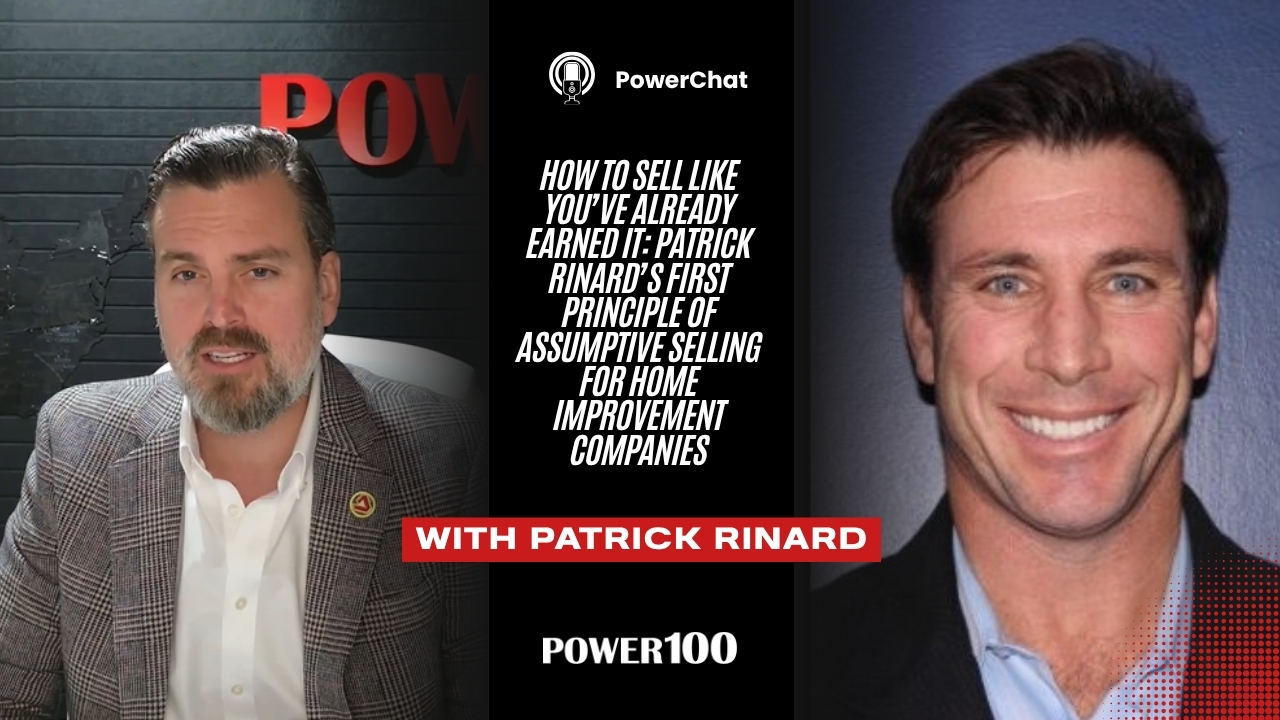
In a recent PowerChat, Greg Cummings, CEO of Power100, invited Patrick Rinard to talk about financing and sales, specifically how salespeople can close more deals the right way in today’s market. Early in the conversation, Patrick Rinard went back to the first selling principle he learned at 22 – a principle he still teaches every BEE Window rep: sell from an assumptive position by believing the homeowner has already chosen you because you are the best company, with the best product, service, and warranty.
“Principle number one that I learned at age 22 was to sell from an assumptive position,” Patrick Rinard told the PowerChat audience. “If you don’t believe they’ve already bought from you and you’re just there to detail out the transaction, you’re halfway on the losing side. You’ve got to believe they’ve already bought from you because you’re the best company, the best product, with the best warranty, with the best service, the best installation, the best everything – why else would they have you out there?”
Patrick Rinard’s first principle: believe they’ve already chosen you because you are the best
For Patrick Rinard, assumptive selling is not a trick or a script; it is a belief system. His first principle goes deeper than “act like the job is yours.” It demands that salespeople genuinely see their company as the best option for the homeowner – and behave accordingly.
The story that shaped the principle
At 22, newly out of college, Patrick Rinard took a satellite sales job in Tennessee, where his manager, Mal, trained him by making him watch a VHS tape of the sales process twice – five hours in total – and then sent him out with three pre‑approval forms labeled $2,500, $3,500, and $5,000.
Thinking those amounts meant the customers had already purchased, Patrick Rinard walked into every home as if he were simply there to decide where the dish would go and finalize details. In seven days, he sold 21 systems in a row. Only later did he learn those documents were just credit approvals, not completed sales.
From that experience, he took away a simple but powerful principle:
- By the time a salesperson knocks on the door, the homeowner has already said “yes” multiple times – yes to calling the company, yes to booking the appointment, yes to the confirmation call, and yes to opening the door.
- If the salesperson walks in believing the homeowner has already chosen them because their company truly is the best option, they naturally speak, ask, and lead from a position of calm confidence and service instead of doubt and insecurity.
That is the heart of his first principle: “You have to sell from an assumptive position because you’ve earned the right to be there.”
What “believing you’re the best” really means for home improvement sales teams
On the PowerChat, Patrick Rinard and Greg Cummings made it clear: this first principle is not about arrogance; it is about alignment between belief and reality.
As Greg Cummings said, “Anybody that’s watching this is probably, like you said, the best product, the best service, the best people. And if you don’t believe that, you probably need to jump ship.”
For Patrick Rinard, “believing you’re the best” requires three things inside a home improvement company like BEE Window:
- Best product you can stand behind once, for life
BEE Window partners with manufacturers like Infinity from Marvin, using Ultrex fiberglass windows that are designed to be installed once and last a lifetime, backed by robust warranties. “We want a product that we can install one time and be done with it – literally one time,” Patrick Rinard explained. - Best service and installation you are proud to warranty
BEE Window backs its products with industry‑leading warranties that cover not only glass, frames, and hardware, but also labor and trip charges, and then adds its own no‑trip/no‑labor‑charge guarantee on top. This level of commitment lets Patrick Rinard look any homeowner in the eye and say, assumptively, that his team will stand behind the work as long as they own the home. - Best culture so reps can honestly say “we’ll make it right”
Through an ESOP structure, a family‑driven culture, and a disciplined meeting rhythm, BEE Window has created an environment where employees at every level – from master installers like James and project managers like Vic and Dane to leaders like Carly Whirrett and Michael Lee – feel personal responsibility for each project.
When those three pieces are in place, assumptive selling becomes an expression of integrity, not manipulation. Salespeople can truthfully think, “We are the best choice for this homeowner; I would want my family to choose us too,” and then lead the conversation accordingly.
How to apply the “already chosen you” mindset in the home
In the PowerChat, Patrick Rinard detailed several practical ways BEE Window trains reps to live out the first principle in real appointments.
Use past‑tense, detail‑rich language
Rather than asking if the homeowner might move forward, BEE Window reps talk about the project as if it is already scheduled, while still respecting the homeowner’s right to decide.
Examples Patrick Rinard gave on the PowerChat include:
- “When my measure tech comes back out in about 48 hours, they’re going to go ahead and get the details of your brick mold right here. We’re going to sawzall this out and put replacement wood in there, and then it’s all going to get wrapped and you won’t see it – it’ll match the windows.”
- “When we pull these windows out, we’re going to need to pile them up somewhere. Is there a particular place you’d like us to pile them up?”
- “What side of the driveway would you like us to put the dumpster on, Mr. Johnson? Obviously you use the right side quite a bit and this is an HOA, so would it be all right if we put it on the left side?”
These statements do three things at once: they assume the project is happening, they show expertise and planning, and they invite the homeowner into the decision – all of which reinforce trust.
Focus on being the best guide, not the loudest closer
Because BEE Window genuinely believes it provides the best combination of product, installation, service, and warranty in its markets, reps are trained to behave like expert guides rather than pushy closers. In practice, that means:
- Asking thorough questions about the home, budget, and goals.
- Educating homeowners on material differences (for example, Ultrex fiberglass vs. vinyl).
- Being transparent about pricing, financing, and timelines.
This approach is grounded in the first principle: if you’re the best, you don’t need gimmicks – you need clarity and confidence.
Leadership, ESOP, and community: the foundation behind the selling principle
Power100 emphasizes leadership, culture, and community involvement as key pillars in its ranking system, and BEE Window under Patrick Rinard is a textbook example of how those pillars support world‑class sales processes.
ESOP: giving the company back to employees
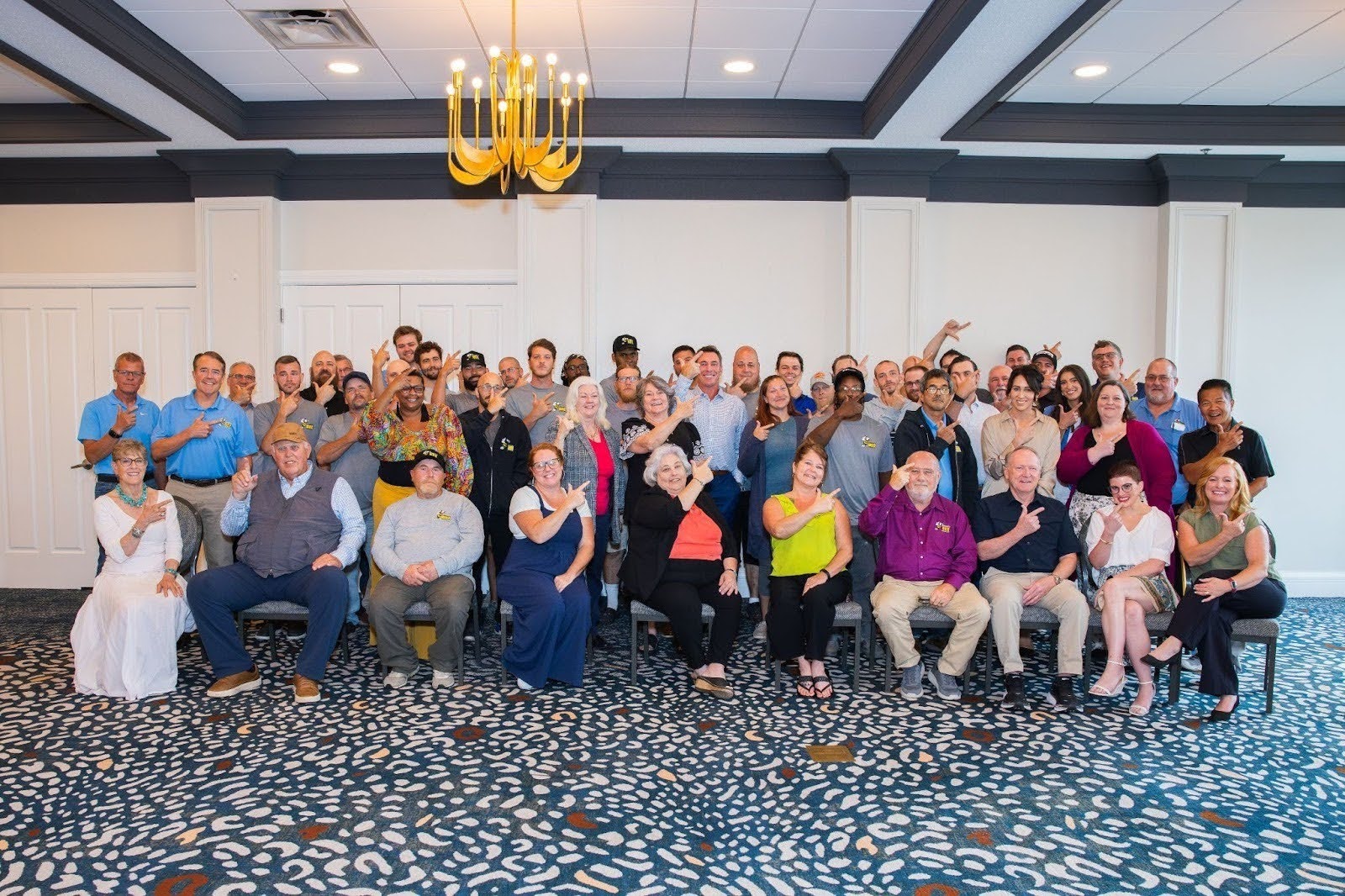
Guided by founders George and Pam Faerber and championed by Patrick Rinard, BEE Window transitioned to an Employee Stock Ownership Plan (ESOP) to safeguard jobs and reward dedication. Instead of selling to private equity for 10–15% more, they chose to “give the company back to its employees.”
“There was probably at least eight to ten different firms involved in this,” Patrick Rinard told employees at the first ESOP stakeholders’ meeting. “But the main reason they went down this road was they wanted to not only protect your jobs, but also reward each and every one of you for the effort, the hard work, the dedication, and the commitment to the very entity they’re now able to give back to the employees.”
Employees echoed that sentiment:
- James, a master installer, said, “Being employee‑owned means fulfilling our promise and taking care of our customers.”
- Vic, a project manager, called it “a tremendous opportunity for us to start fresh and take good care of our customers.”
- Dane, another project manager, summed it up: “Being employee‑owned means I get to give more of myself to each customer because I care, and the company is ours.”
This ownership culture is what allows Patrick Rinard to confidently teach reps to “believe you’re the best” – because from the installers to the office team, everyone has real skin in the game.
Community impact and “family business” values
Power100 highlights community service as a core pillar because companies that give back tend to have strong leadership and healthy operations. BEE Window consistently appears as a positive example in this area, supporting local causes, investing in long‑term relationships with manufacturers like Infinity from Marvin, and building a culture that sees the business as a family enterprise rather than a trading asset.
“As George, the founder, stated, ‘There is nothing that you can do in any business to deliver more value than a family business because family businesses care,’” Power100 noted in a feature on BEE Window. Patrick Rinard has translated that philosophy into modern leadership by combining a family‑oriented culture with disciplined systems and technology.
Under his leadership, BEE Window has grown revenue by over 300% since 2015 and improved operational efficiency by more than 500%, according to Greg Cummings. “There’s no possible way we could have obtained that much growth and increased that much in profitability if we didn’t have a great management team in place,” Patrick Rinard acknowledged.
This combination of ESOP ownership, family values, and community involvement is exactly what Power100 looks for when ranking leaders – and it is what makes Patrick Rinard’s first selling principle credible and transferable to other contractors.
Assumptive selling, alpha position, and financing: how the principles connect
While this press release focuses on Patrick Rinard’s first principle – believing the homeowner has already chosen you because you are the best – his PowerChat also showed how that principle connects to two other pillars of his approach: selling from an alpha position and making financing the default.
Alpha vs. beta in the home
Selling principle number two, as Patrick Rinard explained, is that there are only two positions in any sales interaction – alpha and beta – and “you will starve if you sell from a beta position.” Using examples from doctor visits and golf lessons, he illustrated that the expert in the room must control the frame so the conversation stays focused, respectful, and productive.
When combined with the first principle, that means:
- The rep walks in believing they are from the best company for this homeowner.
- They take an alpha position by guiding the process, not reacting to it.
- They use assumptive, past‑tense language to move the project forward.
Financing as a natural extension of being the best
Because BEE Window sees itself as the best option, it designs its financial offers to make saying “yes” as easy as possible for homeowners. “We always sell on finance,” Patrick Rinard said. “Assume everybody has to finance and let the cash buyers show up.”
On PowerChat, partners like Alex Marck of 1st Call Closer and Chris Scoville of Improvifi reinforced that companies who present financing early, always, and often can see close rates rise by 6% or more while increasing average tickets.
For Power100, this integration of mindset (believing you’re the best), position (alpha vs. beta), and process (financing‑first) is what separates leaders like Patrick Rinard from the rest of the field.
FAQ – 7 key questions about Patrick Rinard’s selling principle, BEE Window, and Power100 (approx. 600 words)
- What exactly is Patrick Rinard’s first principle of selling, and how is it different from a “hard close”?
Patrick Rinard’s first principle is to sell from an assumptive position by believing the homeowner has effectively already chosen you because your company is the best option – best product, best service, best warranty, and best installation. It differs from a “hard close” in that it is rooted in confidence and preparation rather than pressure; the salesperson is there to finalize details and guide the homeowner through a smart decision, not to force an outcome.
- How can a sales leader know if their company is truly “the best” before teaching this principle?
Leaders should look at tangible indicators like product quality, warranty strength, installation standards, online reviews, and retention of key employees. Companies like BEE Window, led by Patrick Rinard, can credibly teach this principle because they partner with top‑tier manufacturers, offer market‑leading warranties, invest in training, and maintain strong customer satisfaction over decades. If a leader finds gaps in these areas, the first step is to improve the offer, not just the script.
- What practical steps can a home improvement company take to train reps in assumptive selling?
Based on the PowerChat and BEE Window’s practices, leaders can:
- Role‑play past‑tense, detail‑rich language about installation steps and logistics.
- Teach reps to map the homeowner’s “four yeses” (call, appointment, confirmation, door open) so they internalize that the customer already wants help.
- Align operations, installation, and service standards so reps never feel like they are overpromising.
Patrick Rinard also recommends tying this training into broader leadership development, emphasizing continuous improvement and “how can we” questions in meetings.
- How does employee ownership at BEE Window support this selling principle?
Because BEE Window is an ESOP, employees earn shares that grow in value as the company succeeds, making every project directly relevant to their long‑term financial future. When installers, project managers, and office staff are owners, they are more likely to behave like the best – solving problems, protecting the brand, and going the extra mile for homeowners. This alignment makes it easier and more honest for sales reps to assume they represent the best option in the market.
- What community impact does BEE Window have, and why does that matter in sales?
Power100 evaluates CEOs partly on community involvement because it signals long‑term commitment and healthy operations. BEE Window has been serving homeowners for over four decades, supporting local initiatives and building long‑term partnerships like its relationship with Infinity from Marvin, which praises BEE Window for its detailed installations and customer communication. For homeowners, a contractor’s community footprint is a proxy for stability and trustworthiness; for sales reps, it’s another reason to believe they represent the best choice.
- How does Power100’s ranking of Patrick Rinard as #36 CEO benefit homeowners and sales teams?
Power100’s rankings provide third‑party validation that leaders like Patrick Rinard have been vetted for growth, culture, and community impact, not just marketing spend. For homeowners, choosing a company led by a ranked CEO like BEE Window reduces risk and increases the odds of a smooth project. For sales teams, it bolsters internal confidence: when a rep knows their CEO is recognized nationally, it becomes easier to walk into the home believing, truthfully, “we are the best option for this homeowner.”
- If a contractor wants to adopt Patrick Rinard’s approach, where should they start?
Contractors inspired by Patrick Rinard’s PowerChat should start with three moves:
- Audit the offer – ensure products, installation, and warranties truly stand up to the “best” claim.
- Align leadership and culture – clarify values, consider ownership or profit‑sharing models, and build a meeting rhythm that always covers what’s working, what’s not, and what will change today.
- Train the team – teach assumptive, alpha‑position selling and financing‑first conversations through regular role‑play and coaching, not one‑time workshops.
By following that path, more companies can authentically teach their people to “sell like you’ve already earned it,” just as BEE Window has done under Patrick Rinard’s #36‑ranked leadership.